
 SparxIT
 SPXCommerce
 What's Your A




eCommerce
eCommerce
What is Agentic AI Ecommerce: What It Means and How Brands Can Use It
-
Vikash Sharma
- Apr 15, 2026
- 11 mins read

Considering that you operate an ecommerce brand in 2026, you will probably be grappling with a common exasperation. Your data is omnipresent, yet the speed with which you can act on it is unreasonably slow.
What you were doing yesterday is what your analytics platform told you. Your BI reports tell you why it was bad last quarter. And your marketing team continues to manually A/B test subject lines, price smarter than competitors, and recover abandoned carts before customers even have the tab open.
The problem isn’t a lack of data, it’s a lack of intelligent, autonomous action. It is exactly this gap that agentic AI ecommerce is designed to bridge.
Agentic AI does more than generate insights. It takes action. It does not ask humans for permission at each stage of execution, supports multi-step AI workflows, and learns from results, continuing to optimize 24 hours a day.
This guide dissects precisely what agentic AI is, how it differs from traditional automation, and where it generates the most value in ecommerce.
What Is Agentic AI?
Artificial intelligence systems that are capable of autonomously perceiving their surroundings, formulating sub-goals, planning courses of action, and taking actions without necessarily involving humans in each step are referred to as agentic AI.
Imagine it as a calculator (provides you with a number) versus a good operations manager (aware of your objectives, researches to find solutions, decides, and implements them, and reports back to you).
In the ecommerce scenario, an AI agent can observe that a product’s conversion rate has fallen by 18% over 48 hours, diagnose that a competitor lowered their prices, and automatically adjust pricing within specified guardrails. It can also deploy new ad creatives to relevant audience segments and capture the entire decision chain without requiring human approval at each step.
This shift toward autonomous, decision-making systems is not just theoretical, as it is rapidly becoming a core capability in modern software. According to Gartner, by 2028, at least 33% of enterprise software applications will include agentic AI capabilities, up from less than 1% in 2024.
The term agentic is based on agency, the ability to act on its own towards a purpose. In terms of AI in retail and ecommerce, it characterizes systems as not just reactive to queries but also actively seeking out results specified by the business leaders. It is the key distinction between a proactive AI platform and a reactive analytics dashboard.
How Agentic AI Differs from Traditional AI & Automation
The majority of ecommerce teams have tried AI in some way in recommendation engines, email personalization, or a chatbot in customer service. But agentic AI is quite a different category. This distinction is the key to investing in any platform.
| Dimension | Rule-Based Automation | Generative AI (LLM) | Agentic AI (Ecommerce) |
| Initiative | Reactive; responds to stimuli | Reactive; acts on prompts | Proactive; takes initiative toward objectives |
| Workflow | Single-step, predefined paths | Single-turn conversations | Plans and executes multi-step sequences |
| Adaptability | Follows strict rules and regulations | Produces text; no persistent memory | Learns and adapts based on outcomes |
| Human Involvement | Required for each decision | Required for each prompt | Optional (human-in-the-loop for guardrails) |
| Tool Use | Only pre-coded integrations | Limited without plugins/tools | Independently uses APIs and external platforms |
| Output | Data and reports | Text and content | Actions and measurable, quantifiable results |
Takeaway: Agentic AI doesn’t just assist in acts. Unlike traditional automation or generative AI, it can plan, execute, and optimize tasks toward business goals with minimal human input. For ecommerce teams, this means shifting from tools that support decisions to systems that actively drive outcomes.
Key Components & Architecture of Agentic AI Ecommerce
To evaluate any platform, you need to understand how agentic AI works and build the appropriate stack. A typical agentic AI system in ecommerce includes five connected layers:
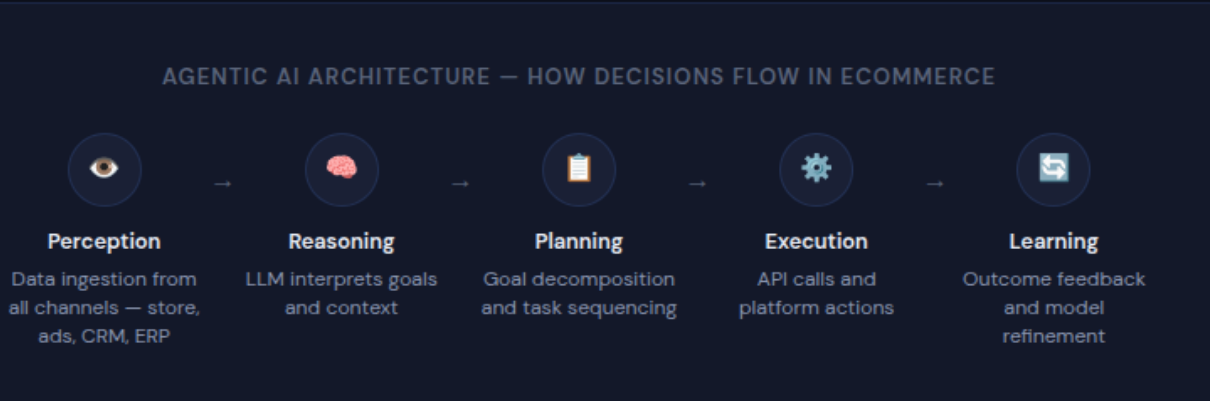
1. Perception Layer Linking All Your Data
To make good decisions, agents require context. That implies real-time consumption of sales, customer behavior, inventory, competitor pricing, advertisement performance, and CRM information in ecommerce.
Even the most intelligent agent cannot make good decisions without a coherent database. The Data Connector Hub of these agents integrates 150+ ecommerce data sources into a single, clean semantic layer that agents can reason over in real time.
2. Reasoning Engine The LLM Core
The core of any agentic system is a large language model serving as the reasoning engine. This model in LLM ecommerce applications reads context, interprets business goals, decomposes complex goals into sub-tasks, and determines which tools to invoke.
How well this reasoning layer has been trained to make decisions that you can trust, given a specific context of ecommerce, is how the quality of the reasoning layer is judged.
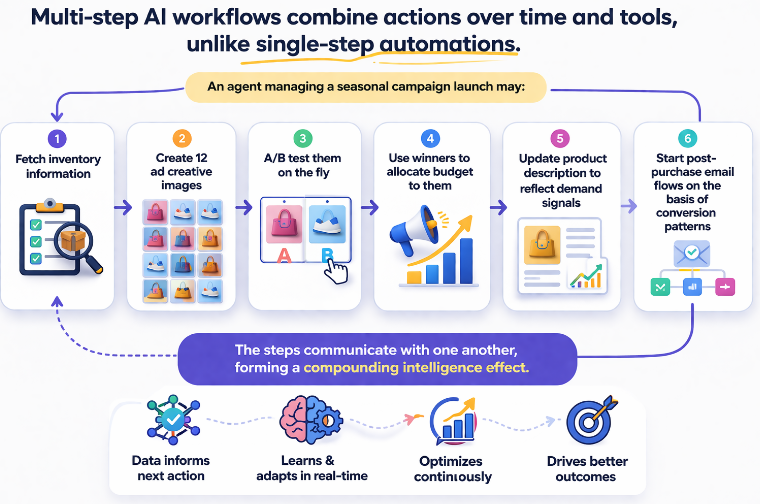
3. Multi-step AI Workflows Where the Magic Happens
Multi-step AI workflows combine actions over time and tools, unlike single-step automations. An agent managing a seasonal campaign launch may take the steps shown in the image below:
4. Memory & Context Management
Agentic systems have three types of memory: working memory, episodic memory, and semantic memory. This eliminates any contradictions in past decisions by agents and provides consistency across long-running workflows needed in enterprise ecommerce operations.
5. Human-in-the-Loop Guardrails
The most successful autonomous AI retail applications are configurable guardrails, price change limits, budget constraints, brand safety filters, and escalation procedures that expose high-stakes decisions to human approvers. This renders the agentic AI enterprise safe without rendering it toothless.
Core Use Cases of Agentic AI Ecommerce
The value of agentic AI ecommerce can best be visualized in terms of specific points. The most impactful applications the brands are implementing in 2026 are:
1. Dynamic Pricing Optimization
Agents track competitor prices, demand indicators, and margin goals and autonomously adjust prices within guardrails to maximize revenue per visit without compromising margin.
2. Cart Abandonment Recovery
Multi-step agents detect intent to abandon, and produce customized recovery sequences over email, SMS, and retargeting programmed by recovery probability per customer.
3. Inventory & Supply Chain Intelligence
Agents track sell-through rates, seasonal demand curves, and supplier lead times, which initiates a reorder workflow before a stockout affects revenue and customer satisfaction.
4. Hyper-Personalization at Scale
AI agents divide shoppers based on real-time behavioral cues, not only demographics, but automatically deliver personalized product feeds, offers, and content experiences.
5. Search & Discovery Optimization
Agents are constantly experimenting and optimizing on-site search rankings, filter logic, and category merchandising to maximize product discovery and conversion in your catalog.
6. Autonomous Customer Service
End-to-end returns, order tracking, and product inquiries that escalate to human agents are handled only by agentic copilots when necessary, reducing support costs by 40-60%.
AI Marketing Agents: More than Campaign Automation
One of the most obvious outcomes of AI agents ecommerce is in marketing. Conventional marketing automation is based on if-then rules: If the user abandons the cart, send an email after 1 hour.
The question that agentic marketing AI answers is quite different: What is the best next step for this customer, across all available channels, at this moment?
1. Autonomous Campaign Orchestration
An agentic marketing system can be linked to your ad platforms, email ESP, and CRM, and it can plan, launch, monitor, and optimize campaigns on its own.
It spends on creatives that are doing well, halts those that are doing poorly, creates new versions of the copy, and shifts the channel mix, all within human-learned limits.
2. Predictive Audience Segmentation
Instead of fixed cohorts with weekly updates, agentic AI creates dynamic segments that update in real time based on behavioral indicators such as browsing depth, scroll behavior, cross-session intent indicators, and purchase velocity.
These living audiences are paired with the right message at the proper time, through the right channel, and personalization is achieved in a way that feels truly personal, not algorithmic.
3. Content Intelligence & Catalog Optimization
Agents can audit your product descriptions, PDP content, and landing pages to identify conversion-inhibiting gaps, generate optimized variations, test and promote winners.
This is particularly effective in large catalogs where human content staff are physically unable to respond to demand cues, seasonal changes, and competitive variability.
4. Cross-Channel Attribution & Budget Reallocation
Knowing which touchpoints actually drive conversion is one of the most difficult challenges in ecommerce marketing.
In agentic AI, AI-driven decision-making models attribute dynamically by session and channel and rebalance budgets in real time based on what actually works, rather than last-click assumptions or weekly fixed planning cycles.
| Marketing Task | Manual Approach | Rule-Based Automation | Agentic AI Approach |
| Email Personalization | Segment-level templates | Dynamic content blocks | Individual-level generative content |
| Ad Creative Testing | Manual A/B tests (weeks) | Auto-pause underperformers | Create, test, deploy, and iterate rapidly (hours) |
| Budget Allocation | Monthly planning cycles | Dayparting rules | Real-time reallocation based on predicted ROAS |
| Campaign Reporting | Weekly analyst reports | Automated dashboards | Agentic insights with narrative + auto-recommendations |
Agentic Analytics & AI-Powered Decision Making
Conventional analytics informs you of what has occurred. Predictive analytics is what will happen. Agentic analytics goes further. It decides and acts. This has been a paradigm shift, and this is what most ecommerce brands are just starting to internalize.
1. From Dashboards to Decision Engines
Suppose your analytics platform identified that customer acquisition costs had soared by 22% over the last 6 hours. An inactive dashboard displays a red bar.
A competitor launches a flash sale, and an agentic system detects the impact, adjusts ad bidding, and alerts the merchandising team with recommendations. It also triggers targeted offer emails to high-intent non-converters, all before the morning standup.
2. Anomaly Detection & Autonomous Response
The agentic systems are better at detecting anomalies across thousands of metrics at once, conversion rate decreases by SKU, shipping delay patterns by carrier, and changes in review sentiment by product line.
Importantly, they not only alert but also trigger appropriate actions based on predefined playbooks, learned behaviors, and confidence thresholds that you configure ahead of time.
3. Forecasting That Feeds Action
Demand forecasting has always been valuable in ecommerce. The operationally live forecasting of a trending SKU is automatically triggered by agentic AI, which adjusts the homepages’ merchandising priorities and pre-allocates ad budget to the category.
The response and the forecast are not two independent processes that are run by humans, but one self-executing system.
Tools & Technologies: Building Your LLM Ecommerce Stack
Real-world LLM ecommerce architecture is not an individual product, but a stack of interlinked elements that cooperate. This is the way top brands are building their agentic AI infrastructure by 2026:
1. Foundation Models & Reasoning Engines
A powerful underlying model is the core of any agentic system. The majority of enterprise ecommerce implementations are based on customized versions of top models and business-specific catalog data, pricing policies, and brand policies.
This forms a domain-specific reasoning engine that understands your business, not just language in general.
2. Agent Orchestration Frameworks
Multi-agent systems need an orchestration layer that allocates tasks to specialized agents, handles task dependencies, and gracefully handles failures.
Frameworks such as LangGraph and AutoGen, together with enterprise platforms, provide ecommerce teams with the infrastructure to execute complex multi-step AI workflows with high reliability in production and not just in demos.
3. Proactive AI Platform vs. AI Copilot: What Model Should You Have?
The market is dominated by two deployment models. A proactive AI platform is also autonomous, i.e., it takes actions, executes workflows, and only presents decisions at a specified confidence level.
An AI copilot ecommerce model does not replace humans in the decision-making process; it provides suggestions and action plans and awaits approval before acting.
The majority of mature brands use both: high-frequency, low-stakes decisions under autonomous agents and high-stakes, brand-sensitive decisions under copilot mode.
| Stack Layer | Category | Examples | ProactiveAI Role |
| Data Foundation | Unified data layer | Snowflake, BigQuery, dbt | Native connectors + semantic layer |
| Reasoning Engine | Foundation LLM | GPT-4o, Claude, Gemini | Fine-tuned ecommerce models |
| Orchestration | Agent runtime | LangGraph, AutoGen | ProactiveAI Agent Runtime |
| Actions / Tools | Platform integrations | Klaviyo, Meta Ads, Shopify | 150+ pre-built connectors |
| Observability | Audit and monitoring | Langfuse, custom logs | Complete decision audit trails |
Best Practice for Agentic AI Ecommerce
Implementing agentic AI does not necessarily involve purchasing a platform. Those brands that achieve the best outcomes have a planned, staged execution model. The following are the principles that always distinguish between successful deployments and costly experiments:
1. Begin with a single high-value, limited-use case
Excellent entry points are cart abandonment recovery, a single product category with dynamic pricing, or automated budget reallocation. On day one, don’t automate your whole operation, then scale.
2. Think quality of data first, then quality of AI
Agents are as good as their reasoning data. Compromised, disjointed, or outdated data will lead to poor decisions, no matter how sophisticated the model is. First, audit your pipelines and create a single data basis.
3. Define guardrails and escalation protocols upfront
Record the choices that the agent is capable of making independently, those that needed human intervention, and what an emergency override was. Such limits create trust in an organization and eliminate uncontrolled automation.
4. Build for observability and auditability
Revenue-impacting decisions are made by autonomous systems. You should have full access to the rationale behind every decision made in compliance, learning, and continuous improvement. Give preference to those platforms that have an in-built decision audit trail.
5. Run parallel operations before full handoff
Allow the agent to observe and make recommendations without executing changes, and do not run, and the humans continue to act autonomously. Compare results 2-4 weeks prior to autonomous execution rights. This creates confidence and identifies edge cases.
6. Measure incremental lift, not aggregate metrics
Conducted run-controlled holdout experiments to determine the actual contribution of autonomous actions. In its absence, you can accrue revenue to the agent that would have been accrued by other means anyway.
How ProactiveAI Powers Agentic Ecommerce for Modern Brands
At ProactiveAI, we transform disjointed ecommerce data into self-directed action. Our platform integrates data from your stack into an instant, real-time semantic layer that can be immediately understood and acted on by AI agents.
We implement goal-oriented agents in marketing, pricing, inventory, and customer experience to implement multi-step processes, not tasks. Our agents work 24/7 within the guardrails you set, whether launching campaigns, reallocating budgets, optimizing pricing, or initiating lifecycle journeys.
Our self-service agentic analytics engine does not simply report the insights it finds opportunities, makes decisions, and implements them in real-time, and is fully transparent and auditable.
We enable brands to accelerate the gap between insight and action, with uncomplicated deployment (autonomous or copilot) and rapid implementation, with minimal operational complexity.
Conclusion
Competitiveness in the ecommerce arena has never been as intense. The brands that are gaining momentum have one important thing in common: they no longer see AI as a reporting feature but rather as an operational feature.
It is not a trend that agentic AI ecommerce will be in the future, but a competitive advantage that forward-looking brands are currently implementing at scale.
The fundamental pivot is easy to articulate yet difficult to accomplish: shifting towards action, independently and at scale. That demands a proper data foundation, an appropriate agentic design, significant guardrails, and an ecommerce platform partner with a profound understanding of AI and ecommerce.
You want to automate marketing processes, break down real-time pricing intelligence, or create a fully agentic commerce operation, so the path begins with one well-scoped use case and the appropriate infrastructure.
We have created just such an infrastructure at ProactiveAI. Between agentic analytics, AI-driven decision-making, and end-to-end ecommerce automation, we assist commerce teams in doing more with the intelligence already at their disposal and acting quickly and consistently.
Frequently Asked Questions
What is agentic AI in ecommerce?
In ecommerce, agentic AI is defined as autonomous systems, which take in data, decide, and take multi-step actions, such as pricing, personalization, and campaigns, without direct human intervention, and continuously optimize their actions using real-time signals and objectives.
How is agentic AI different from generative AI?
Generative AI generates content or responses through prompts, whereas agentic AI takes it a step further, planning, making decisions, and taking action. It goes beyond content generation to execution.
What tasks can AI agents automate for ecommerce brands?
AI can be used to automate dynamic pricing, campaign execution, cart recovery, customer segmentation, inventory management, product recommendations, and customer support multi-step processes, being performed with an ongoing optimization of performance, based on real-time data and outcomes.
Are AI agents safe to use in business processes?
Yes, under guardrails such as budget constraints, approval levels, and audit trails. Agentic systems operate within a set of boundaries that provide control, transparency, and safe decision-making, while mitigating the risks of unintended acts.
What is the difference between an AI copilot and an AI agent?
AI Copilot is a system that helps humans make decisions and offers ideas and suggestions, but it requires authorization. An AI agent is an independent system that makes decisions and takes actions within predefined guardrails to minimize human effort and enable real-time optimization.
You might also like
Handpicked articles for your reading list.


Get the latest insights on Conversational AI
Stay ahead of the curve with weekly updates on data analytics, AI trends, and eCommerce growth strategies delivered straight to your inbox.
Join 5,000+ industry leaders. Zero spam, just pure insights.