
 SparxIT
 SPXCommerce
 What's Your A
eCommerce
eCommerce
How to Calculate Customer Lifetime Value (CLV) Easily
-
Vikash Sharma
- Mar 31, 2026
- 8 mins read
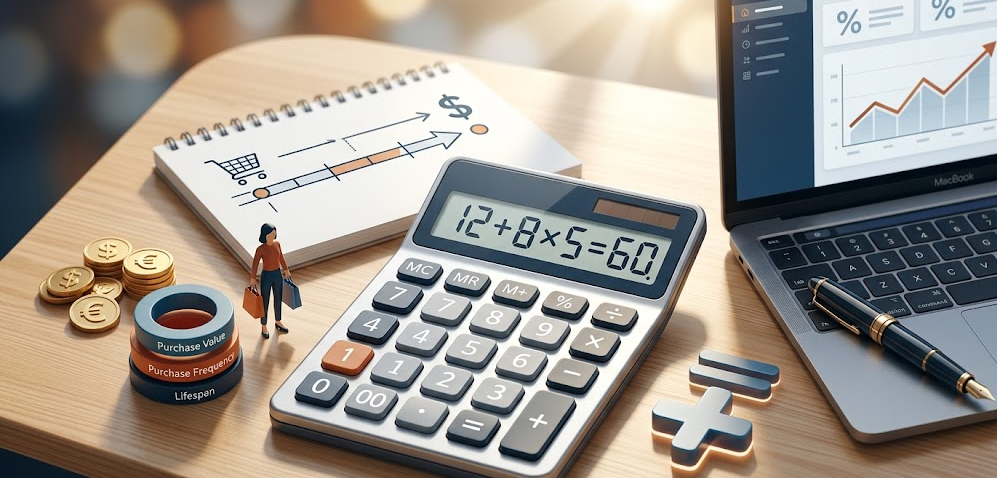
Have you ever wondered who the really worthwhile customers are? You’re not alone. Intelligent companies already know the amount of income each client brings over the course of their relationship.
Whether you’re a startup founder, marketing manager, or business analyst, understanding how to calculate Customer Lifetime Value (CLV) is like having a crystal ball for your revenue. It informs you who you should nurture, whom you should spend your marketing budget on, and which categories of customers should receive VIP treatment.
Let’s dive into the world of customer lifetime value calculation and turn you into a CLV pro.
What is Customer Lifetime Value?
Before we jump into the customer lifetime value formula, let’s get crystal clear on what we’re measuring.
Customer Lifetime Value refers to the amount of revenue you are likely to get out of one customer in the overall life of the customer with your business. Consider the long-term value of having a happy person versus the short-term satisfaction of making a single sale.
Here’s why it matters:
- Smart marketing expenditure: Have a clear idea of the amount of money you can put into buying new customers.
- More effective retention plans: Find your most prized customers and be able to retain them again.
- Informed business choices: Invest in products, services, and segments of the customer that make real profit.
- Sustainable growth: Develop a business model through long-term relationships, not on a single transaction basis.
The Customer Lifetime Value Formula: Your Starting Point
Ready to calculate customer lifetime value? Let’s start with the most straightforward CLV formula:
CLV = Average Purchase Value × Purchase Frequency × Customer Lifespan
Let’s break this down:
- Average Purchase Value: How much a customer typically spends per transaction
- Purchase Frequency: How often they buy from you within a specific timeframe
- Customer Lifespan: How long they remain an active customer
Customer Lifetime Value Example
Imagine you run a specialty coffee subscription service. Here’s your data:
- Average purchase value: $45 per order
- Purchase frequency: 12 times per year
- Average customer lifespan: 3 years
CLV Calculation: CLV = $45 × 12 × 3 = $1,620
This implies that each customer is worth $1,620 over their lifetime. By now, you can see that in the event that your customer acquisition cost is $200, then you are on the right track. If it’s $1,800? It is time to reconsider your approach.
How to Calculate CLV in Marketing: The Advanced Approach
Want to get more sophisticated with your customer lifetime value modeling? Let’s explore the customer LTV formula that accounts for profit margins and discount rates.
Advanced CLV Formula:
CLV = (Average Purchase Value × Purchase Frequency × Gross Margin) × (1 / Churn Rate)
Or, if you want to factor in the time value of money:
CLV = Σ [(Revenue per Customer × Gross Margin) / (1 + Discount Rate)^t]
Where:
- Gross Margin: Your profit percentage after costs
- Churn Rate: The percentage of customers who stop buying
- Discount Rate: The rate at which future revenue decreases in value
Lifetime Value Calculation Example
Let’s say you’re an e-commerce business selling athletic wear:
- Monthly revenue per customer: $100
- Gross margin: 40%
- Monthly churn rate: 5%
- Average customer lifetime: 20 months
Calculate customer value: CLV = ($100 × 0.40) × (1 / 0.05) = $40 × 20 = $800
This customer lifetime value equation gives you a more realistic picture by accounting for actual profit and customer retention.
How to Calculate CLV in Excel: A Step-by-Step Guide
Love spreadsheets? Here’s how to calculate the lifetime value of a customer using Excel:
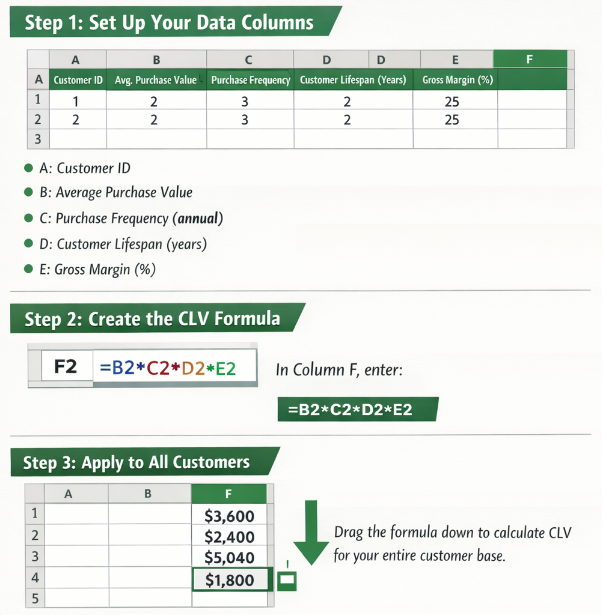
- Column A: Customer ID
- Column B: Average Purchase Value
- Column C: Purchase Frequency (annual)
- Column D: Customer Lifespan (years)
- Column E: Gross Margin (%)
Step 2: Create the CLV Formula
In Column F (CLV), enter:
=B2*C2*D2*E2
Step 3: Apply to All Customers
Drag the formula down to calculate CLV for your entire customer base.
Pro Tip: Pivot tables can be used to segment customers by CLV range. This will help you immediately determine your platinum, gold, and bronze customer levels.
How to Find CLV for Different Business Models
One of the best things about Customer Lifetime Value (CLV) is its adaptability. Depending on how your business makes money, the formula and the data you focus on will change. Below is a deeper breakdown of how to calculate and interpret CLV across common business models.
1. Subscription-Based Businesses
For SaaS companies or subscription services:
-
- Formula
CLV = (Average Monthly Recurring Revenue × Gross Margin) ÷ Monthly Churn Rate - What this means
Subscription businesses depend on recurring revenue and customer retention. Even small improvements in churn can dramatically increase CLV.
- Formula
- Key inputs explained
- Average Monthly Recurring Revenue (MRR): Average revenue generated per customer each month
- Gross Margin: Revenue minus direct service costs
- Monthly Churn Rate: Percentage of customers who cancel each month
- Why it works
Lower churn = longer customer lifespan = higher CLV. This model rewards retention-focused strategies like onboarding, feature adoption, and customer success. - Optimization tip
Focus on reducing churn before increasing acquisition spend; retention has a compounding effect on CLV.
2. E-commerce Businesses (Retail, DTC, Marketplaces)
-
- Formula
CLV = Average Order Value × Number of Repeat Purchases × Average Retention Time - What this means
E-commerce CLV is driven by purchase frequency and how long customers keep coming back.
- Formula
- Key inputs explained
- Average Order Value (AOV): Average spend per transaction
- Repeat Purchases: Number of orders per customer over time
Retention Time: How long customers continue purchasing
- Why it works
This model highlights opportunities for upselling, cross-selling, and loyalty programs to increase revenue per customer. - Optimization tip
Improve CLV by increasing repeat purchase rates through email marketing, personalized offers, and post-purchase engagement.
3. B2B Companies (Enterprise, Services, Long-Term Contracts)
-
- Formula
CLV = (Average Contract Value × Gross Margin × Average Contract Length) − Customer Acquisition Cost - What this means
B2B CLV accounts for longer sales cycles, higher contract values, and significant acquisition costs.
- Formula
- Key inputs explained
- Average Contract Value (ACV): Revenue per contract
- Contract Length: Duration of customer relationship (years or months)
- Customer Acquisition Cost (CAC): Sales and marketing spend to acquire one customer
- Why it works
This approach ensures CLV reflects true profitability, not just revenue, which is critical for scaling sales teams sustainably. - Optimization tip
Increase CLV by extending contract lengths, improving renewal rates, and expanding accounts through upsells and cross-sells.
The Real Power: Using CLV to Drive Growth
Now that you know how to calculate CLTV, let’s talk strategy. Here’s where customer lifetime value modeling becomes your competitive advantage:
1. Optimize Your Marketing Budget
Assuming you have a CLV of $1,000 and a customer acquisition cost of $300, you will have $700 to work with. This means you can afford to:
- Invest in premium advertising channels
- Test new marketing strategies
- Offer attractive onboarding discounts
2. Segment Your Customers
All customers are not created equal. Use the lifetime value of a customer to create tiers:
- High CLV: White-glove service, exclusive perks, priority support
- Medium CLV: Standard experience with targeted upsells
- Low CLV: Automated nurturing, efficiency-focused approach
3. Improve Retention Strategies
The following is a compelling statistic: a 5% increase in customer retention can increase profits by 25% to 95%. When you understand customer lifetime value calculation, you know exactly how much you can invest in keeping people around.
Focus on:
- Rewards in terms of loyalty programs that reward repeat buyers.
- Customized messages on the history of purchasing.
- Active customer service to stop churn.
4. Product Development Decisions
There is something your high-CLV customers are telling you. What products do they buy? What features do they love? Apply this understanding as a roadmap.
Common CLV Mistakes (And How to Avoid Them)
Mistake #1: Ignoring Customer Acquisition Cost
CLV is a formula you cannot compute without considering the cost of acquiring the customer. Always compare:
CLV to CAC Ratio = Customer Lifetime Value / Customer Acquisition Cost
A healthy ratio is typically 3:1 or higher.
Mistake #2: Using Outdated Data
Customer behavior changes. That customer lifetime value example you calculated last year? It could be drastically different at this time. Calculate no less than quarterly.
Mistake #3: Treating All Customers the Same
Standardized CLV lacks the intricacies. Segment by:
- Customer acquisition channel.
- Product category
- Geographic region
- Customer demographics
Mistake #4: Forgetting About Referrals
High-value customers often bring friends. Factor in referral value when you calculate customer lifetime value for a complete picture.
Advanced CLV Tactics: Level Up Your Analysis
Take your CLV analysis to the next level with advanced techniques that go beyond basic calculations. Predict future value, track trends, and act in real time to maximize customer profitability.
| Advanced CLV Technique | What It Is | Key Inputs / Data Used | Why It’s Valuable |
| Predictive CLV Modeling | Uses machine learning to forecast future customer lifetime value | Early purchase patterns, engagement metrics, demographic data, and behavioral indicators | Identifies high-value customers early and improves targeting, retention, and marketing ROI |
| Cohort Analysis | Groups customers by acquisition date and tracks CLV over time | Acquisition date, retention rates, revenue per cohort | Reveals trends, compares performance across cohorts, and improves CLV forecasting accuracy |
| Dynamic CLV Tracking | Continuously updates CLV using real-time customer behavior | Live usage data, transaction activity, engagement signals | Enables proactive intervention to prevent churn and protect high-value customers |
Tools to Simplify Your CLV Calculation
No desire to make everything by hand? These tools make it easier to calculate customer value:
| Tool Category | Tool Name | What It Helps With |
| Web Analytics | Google Analytics | Tracks purchase behavior, customer journeys, and retention metrics |
| CRM Platforms | Salesforce | Built-in customer data management and CLV tracking |
| HubSpot | Customer lifecycle tracking with revenue and retention insights | |
| Zoho CRM | CLV estimation using sales, engagement, and retention data | |
| Business Intelligence (BI) Tools | Tableau | Advanced CLV visualization and dashboarding |
| Power BI | Data modeling and interactive CLV reporting | |
| Looker | Centralized data exploration for CLV analysis | |
| Specialized CLV Software | Optimove | Predictive CLV modeling and customer segmentation |
| Custora | Customer analytics and lifetime value forecasting | |
| Pecan AI | Automated predictive CLV and churn modeling | |
| End-to-End Analytics Platforms | ProactiveAI | Converts raw data into actionable, strategic CLV intelligence |
When you need a unified solution that delivers analytics and actionable insights, you can use platforms such as ProactiveAI to convert raw data into strategic CLV intelligence.
Putting It All Together: Your CLV Action Plan
Here’s your roadmap to mastering how to calculate lifetime value:
Week 1: Gather Your Data
- Mean buy value amongst all customers.
- How many times have you purchased in the last 12 months?
- Churn and customer retention rates.
- Product or service line gross margins.
Week 2: Run Your Calculations
- Use the basic customer lifetime value equation first
- And then test the more sophisticated equations, which include margins and churn.
- Prepare your Excel template to track continually.
Week 3: Segment and Analyze
- Develop customer levels by CLV.
- Trace the trends of high-value customers.
- Low-value/churning segments of spot red flags.
Week 4: Take Action
- Optimize marketing budgets using CLV.
- Introduction of retention programs on high value customers.
- Segmentation Test strategies to drive lifetime value.
Conclusion
Learning how to find Customer Lifetime Value isn’t just an academic exercise; it’s the difference between guessing and knowing where your business stands. Whether you’re using a simple customer lifetime value formula or sophisticated customer lifetime value modeling, this metric gives you the clarity to make smarter decisions.
It is important to remember that each customer relationship is an investment. The customer lifetime value calculation shows the return on that investment. Waste it, and you will be creating a more profitable, sustainable business, and make it even stronger with each satisfied customer.
Are you about to assume control of your customer data and gain greater insight into CLV? Begin to track, begin to calculate, and see how the knowledge of your customer lifetime value will change your entire business strategy.
Frequently Asked Questions
What Is Predictive CLV Modeling?
Predictive CLV modeling uses historical and behavioral data with machine learning to estimate a customer’s future lifetime value, helping businesses focus on high-value customers early.
Why Is Cohort Analysis Important for CLV?
Cohort analysis groups customers by characteristics like acquisition date, revealing retention trends and revenue patterns that average metrics can hide.
What is dynamic CLV tracking?
Dynamic CLV tracking continuously updates lifetime value in real time based on customer behavior, allowing proactive interventions to prevent churn.
Which Businesses Benefit Most from Advanced CLV Tactics?
Subscription-based, e-commerce, and B2B companies with recurring revenue or large customer datasets gain the most from predictive modeling, cohort analysis, and dynamic tracking.
What Data Do I Need for Advanced CLV Calculations?
Typical inputs include transaction history, engagement metrics, demographic data, churn rates, purchase frequency, and customer acquisition costs.
How Can I Use Advanced CLV to Improve Revenue?
By identifying high-value customers, forecasting churn, and tailoring retention strategies, businesses can increase customer loyalty and maximize profitability.
You might also like
Handpicked articles for your reading list.

Get the latest insights on Conversational AI
Stay ahead of the curve with weekly updates on data analytics, AI trends, and eCommerce growth strategies delivered straight to your inbox.
Join 5,000+ industry leaders. Zero spam, just pure insights.