
 SparxIT
 SPXCommerce
 What's Your A





AI & Analytics
eCommerce
What is Channel Attribution? Types, Models & Examples
-
Vikash Sharma
- May 01, 2026
- 5 mins read
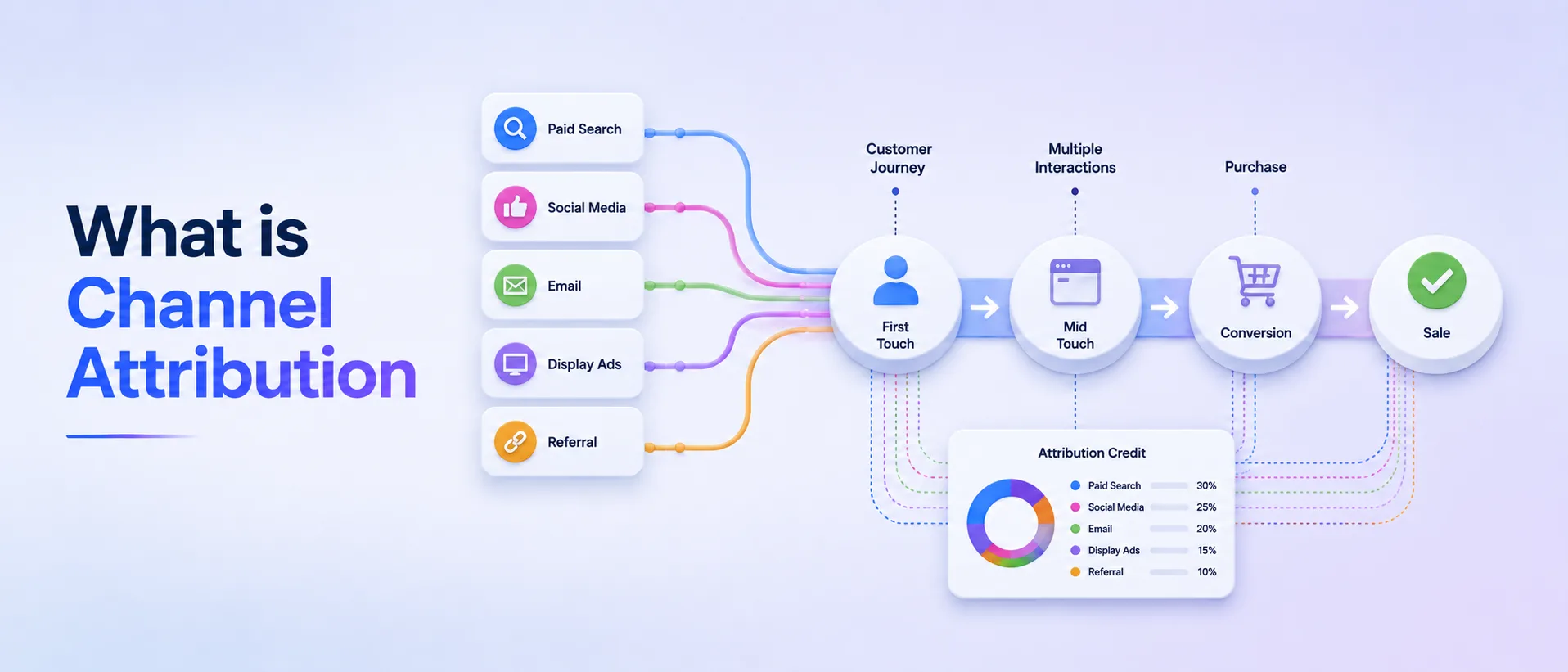
What if you spent $80,000 on Google Ads, LinkedIn, email marketing, and paid social media campaigns, and you couldn’t figure out which one converted the sale? That’s the reality for many marketers operating without clear attribution. Without channel attribution, you’re allocating budget based on guesswork, terminating successful channels, and rewarding the wrong channels.
By tracking every customer touchpoint and linking it to revenue, you clearly see what’s working. In this blog, you will learn to shift resources to channels that perform, optimize return on investment, and tie marketing to business results.
What is Channel Attribution?
Channel attribution is the practice of assigning credit to the channels that drive customer conversions. It helps to answer the question: what channels, campaigns, or touchpoints should we credit for the sale?
A customer journey works like a relay race, with each touchpoint passing momentum forward. A customer finds your brand through a blog post, clicks on a retargeting ad two days later, opens an email promotion, and then converts via a branded Google search. Channel attribution assigns value to each leg of the race.
Channel revenue attribution goes a step further by linking touchpoints to pipeline and closed revenue, not just conversions. This is particularly important in B2B SaaS multi-channel attribution, with sales cycles that can take months and involve scores of touchpoints.
Types of Attribution Models
Attribution models are the rules for allocating credit to touchpoints. These can be categorized as rule-based or data-driven, which are often analyzed using an ecommerce reporting dashboard, enabling marketers to compare performance visually.
1. First-Touch Attribution
This model gives 100% credit to the first interaction channel. Useful for brand building, but neglects all “nurture” channels.
2. Last-Touch Attribution
This model gives 100% credit to the last touchpoint before conversion. It is the default model for most advertising platforms, but significantly underestimates top-of-funnel impact.
3. Linear Attribution
This model distributes credit evenly across all touchpoints in the journey. Better than single-touch, but doesn’t account for channel influence.
4. Time Decay Attribution
Gives more weight to touchpoints closer to conversion. Accounts for recency theory and is good for short sales cycles and promotions.
5. Position-Based (U-Shaped)
40% first and last touch, 20% split in between. Offers a balance between acquisition and conversion, widely used in B2B.
6. Data-Driven Attribution
This model applies machine learning to real conversion data. Now, businesses use advanced models powered by AI business intelligence that are often embedded in modern attribution platforms. Most accurate with large data sets.
What is Cross-Channel Attribution?
Cross-channel attribution helps understand how channels work together to drive conversions across multiple devices, platforms, and sessions. It connects the complete customer journey, rather than single-channel reporting.
For instance, a B2B buyer might see a LinkedIn sponsored post on a mobile phone, watch a webinar on a desktop, get a nurture email, and finally convert after interacting with a Google retargeting ad. Cross-channel attribution will credit the four touchpoints as a single conversion.
Challenges in Cross-Channel Attribution
- Identity resolution: Cross-device, cross-browser tracking without cookies is becoming harder.
- Offline-online disconnect: Webinars, calls, and trade show attendance don’t automatically show up in web analytics.
- Data silos: CRMs, ad platforms, emails, and websites all use different data structures, requiring strong infrastructure to unify them.
- Privacy laws: GDPR, CCPA, and iOS changes restrict third-party data collection, complicating cross-device attribution.
To measure it, teams use cross-channel attribution tools to integrate first-party data from CRM, web analytics, ad platforms, and email, then apply attribution rules to the unified data. To address these challenges, companies adopt self-service data analytics platforms that enable teams to unify data and explore attribution insights.
What is Multi-Channel Attribution?
Multi-channel attribution gives credit for a conversion across multiple channels rather than to a single channel. The phrases “multi-channel” and “cross-channel” are often used synonymously, but there is a slight difference: while multi-channel attribution focuses on the number of channels involved, cross-channel attribution also considers the interactions between channels.
The importance of multi-channel attribution is evident when you consider that buyers use 6-10 channels before making a decision. Without MCA, you may cut channels that drive conversions but don’t appear as the final click.
Multi-Channel Attribution Reporting
Multi-channel attribution reporting reveals insights such as which channels are used to start journeys, which are most often used to convert journeys, and which channel combinations are most effective at driving conversions. This granularity supports better decision-making for budget allocation at the journey level rather than the campaign level.
Extending Attribution with Forecasting
Attribution doesn’t just explain past performance, but it can also guide future strategy. By integrating attribution data with revenue forecasting, businesses can better anticipate outcomes and make more informed decisions about budget allocation and campaign planning.
When marketing insights are tied to forward-looking projections, teams can align their efforts with expected demand and ensure that channel investments support sustainable growth.
Top Channel Attribution Tools
Multi-channel attribution software should integrate your data sources, offer different attribution models, and provide revenue-based reporting. Here are the leading platforms:
- ProactiveAI: AI-powered analytics and attribution platform for data-driven marketers, offering a holistic approach to marketing channel attribution by integrating marketers’ CRM and ad platforms into a single attribution workspace.
- Google Analytics 4: Free and popular analytics platform with data-driven attribution for Google properties, but struggles with cross-platform B2B marketing journeys.
- Rockerbox: An attribution platform for eCommerce and DTC customers that does a good job of tracking the effectiveness of TV, offline, and digital marketing channels.
For marketers seeking cross-channel marketing attribution software that supports complex B2B journeys, integrates with Salesforce or HubSpot, and enables custom attribution rules, ProactiveAI has an edge over all-purpose analytics platforms.
Best Practices to Optimize Cross-Channel Attribution
Optimizing cross-channel attribution requires consistent tracking, unified data, and the use of multiple models to generate accurate, revenue-focused insights. Check the practices below:
1. Standardize your UTM taxonomy
UTM parameters must be consistent across all campaigns to achieve accurate attribution. Without them, channels get misclassified, and journeys are fragmented.
2. Unify your data sources early
Link your CRM, advertising, email, and web analytics to a centralized attribution platform, preferably before you set your budget targets.
3. Run attribution models in parallel
Avoid relying on a single model, as it can distort decision-making. See how last-touch, first-touch, and data-driven models compare to gain deeper insights
4. Attribution should be to revenue, not leads
Lead attribution is good, but revenue attribution is game-changing. Roll conversion data through to closed-won opportunities in your CRM.
How to Choose the Right Attribution Model
There’s no one “right” attribution model. It depends on your business model, sales cycle, and your marketing question.
| Your Situation | Recommended Model |
| Short, high volume (eCommerce) | Data-Driven or Time Decay |
| B2B SaaS (3–12 month sales cycle) | Position-Based (U-Shaped) or W-Shaped |
| Focus on brand awareness measurement | First-Touch |
| Optimizing bottom-of-funnel channels | Last-Touch |
| Established program with historical data | Data-Driven (ML-based) |
| Affiliate marketing attribution | Last-Touch or Custom Rule-Based |
Conclusion
Channel attribution is no longer a “nice to have.” It is the operational backbone of a data-driven marketing organization. Whether it’s to understand what campaigns build a pipeline, how channels work together in a complex B2B customer journey, or what to cut and what to grow, attribution provides the certainty you need to make decisions.
Build on a solid data foundation, select models that align with your sales process, compare different attribution models, and invest in tools like ProactiveAI, is that bridge the gap between marketing and revenue, not just clicks.
Frequently Asked Questions
What's the difference between multi-channel and cross-channel attribution?
Multi-channel attribution allocates credit among channels. Cross-channel attribution examines channel interactions.
Which attribution model is best for B2B SaaS?
Position-based U or W-shaped models are good to start. Data-driven models are best once you have enough conversions.
How do I measure cross-channel attribution without third-party cookies?
Use first-party data such as CRM tracking, UTM parameters, and server-side tagging. Also include surveys and identity resolution methods.
What is channel revenue attribution?
It connects marketing touchpoints directly to revenue. This shows how much each channel contributes to closed deals.
How does cross-channel attribution work for affiliate marketing?
It tracks affiliate interactions alongside other channels. This ensures fair credit beyond last-click attribution.
You might also like
Handpicked articles for your reading list.

Get the latest insights on Conversational AI
Stay ahead of the curve with weekly updates on data analytics, AI trends, and eCommerce growth strategies delivered straight to your inbox.
Join 5,000+ industry leaders. Zero spam, just pure insights.