
 SparxIT
 SPXCommerce
 What's Your A




eCommerce
Marketing
What is a Good ROAS? Industry Benchmarks for 2026
-
Vikash Sharma
- Apr 27, 2026
- 10 mins read
You spend thousands on ads every month. But when someone asks, ‘Is your ROAS good?’ the answer isn’t clear. Is 3x strong? Is 5x the target? Should your answer change across platforms like Amazon and Facebook? If these questions feel frustrating, you’re not alone.
Awareness of ROAS is widespread among paid media teams, but many still lack a credible benchmark to compare performance against.
They pit themselves against industry averages that are too imprecise to reflect their platform, their margins, and their business model. The outcome is budgetary misallocation, lost scaling, and an overall sense of being in the dark about whether the ad machine is actually performing.
What qualifies as a good ROAS depends on context, and clarity is essential. When you know your break-even ROAS, industry benchmarks, and platform performance, you can stop guessing and start optimizing with confidence.
This guide provides precisely that: platform-by-platform ROAS benchmarks in 2026, a realistic break-even formula, and industry specifics. Also, view the roadmap on how to use AI analytics tools to bridge the gap between your current ROAS and the industry leaders.
What Is ROAS?
ROAS (Return on Ad Spend) is a marketing efficiency metric that shows how much your business earns per dollar spent on advertising. It is the most important performance metric of paid media campaigns on Google, Meta, Amazon, TikTok, and all other advertising platforms.
ROAS can be expressed as a multiple (4x), a ratio (4:1), or a percentage (400%). All three mean you generate $4 in revenue for every $1 spent. The multiple format is the most understandable for benchmarking, and that is what we will use in this guide.
ROAS vs. ROI: The Difference Between Them
ROAS and ROI are often used interchangeably, yet they measure two entirely different things. ROAS is used to measure revenue per unit of advertising spend.
ROI measures net profit after all costs, including product, operations, and marketing expenses. A 4x ROAS could be interpreted as negative ROI when your product margins are slim. A combination of the two metrics will provide you with the complete financial picture.
What Is the Good ROAS Number? The Honest Answer
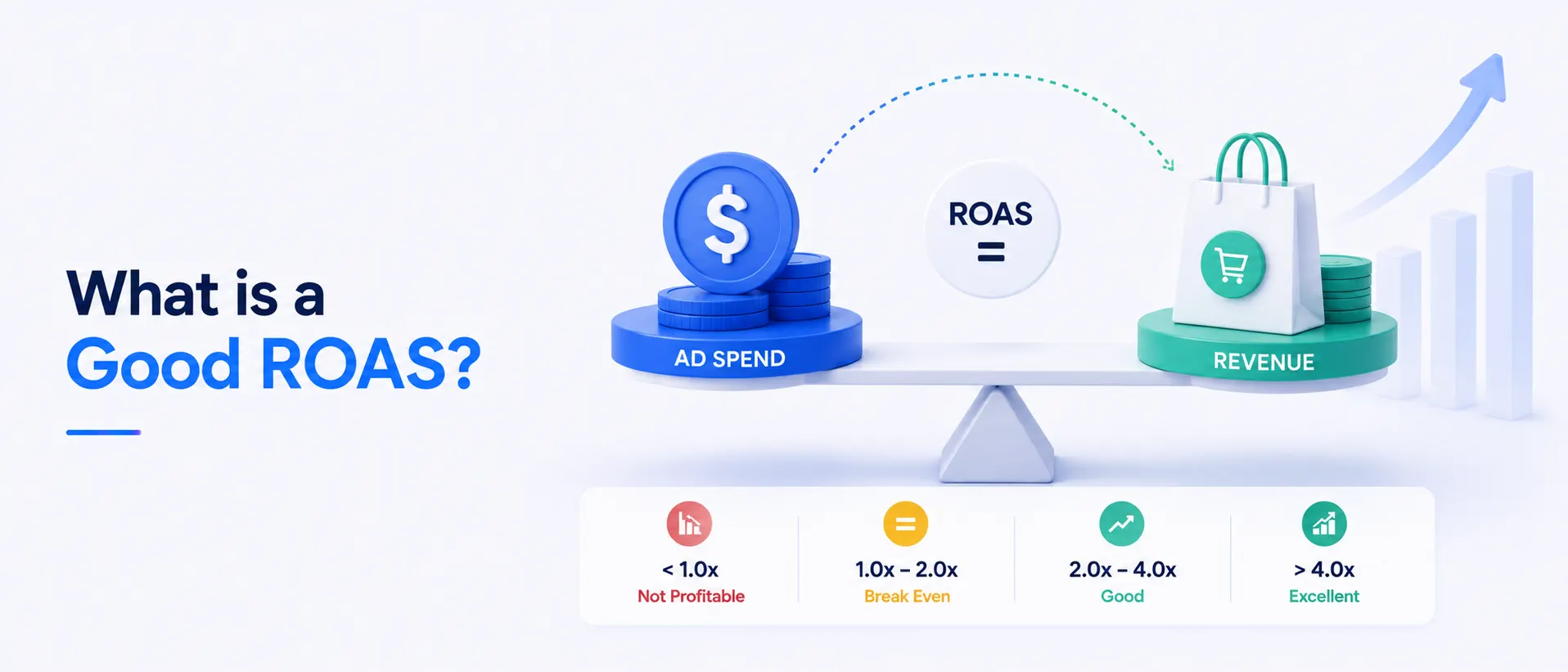
The most sincere response to the question of what is a good ROAS number: it is all a matter of profit margins. The rule of 4:1 is a good ROAS target that seems to repeat itself over and over again, but it’s not universal, and following it blindly can lead you in the wrong direction.
With a 25% average gross margin, you must achieve a 4.0x ROAS to offset your cost of goods sold. Any less than 4x at 25% margins indicates that your advertisements are literally making you a net loss, even though your dashboard might say otherwise.
| ROAS Range | What It Signals | When It’s Acceptable | Rating |
| Below 2.0x | Nearly impossible to make a profit with normal businesses | Only 50%+ margins or high-LTV subscription models | Concerning |
| 2.0x – 3.0x | Break-even or marginal for most businesses | Acquisition of new customers, brand awareness campaigns | Marginal |
| 3.0x – 5.0x | Strong profitable performance for most margin structures | Average performance for most ecommerce brands | Good |
| 5.0x – 8.0x | Strong indicates effective targeting and strong creative | Mature campaigns, retargeting, high-intent search | Strong |
| Above 8.0x | Extraordinary, often seen in retargeting or niche high-margin verticals | Legal, software, retargeting campaigns, B2B with long lifetime value | Exceptional |
How to Calculate Your Break-Even ROAS
Your break-even ROAS is the lowest ROAS at which your ad spend will cover the cost, i.e., no profit but no net loss. All the points above this value are the actual margin contribution. It shows you a specific target for where you want to be as a business, rather than something taken from a generic industry average.
Break-Even ROAS Formula
Break-Even ROAS = 1 ÷ Gross Margin %
Example: 1 ÷ 0.30 (30% margin) = 3.33x break-even ROAS
To make this tangible, we can go through three realistic scenarios:
- Scenario A: Supplement brand with high margin (55% margin) →1.82x ROAS
- Scenario B: Fashion ecommerce brand (30% margin) →3.33x ROAS
- Scenario C: Electronics retailer (12% margin) →8.33x ROAS
Important Lesson: To even break even on advertisements, an electronics brand requires 8x + ROAS (Your margin = your target).
What is a Good ROAS Benchmarks by Industry in 2026
ROAS benchmarks also vary widely across industries due to differences in profit margins, average order value, customer lifetime value, competitive intensity, and sales cycle length. The list of benchmarks below is based on aggregated 2026 data on the key ad platforms.
| Industry | Avg. ROAS 2026 | Why It’s High/Low | Rating |
| Legal Services | 8.0x | Large case values; one client acquisition leads to high LTV | Exceptional |
| Travel & Hospitality | 6.5x | High AOV bookings; strong purchase intent signals | Strong |
| Toys & Games | 6.0x | Seasonal peaks and impulse-driven buying behavior | Strong |
| B2B / Technology (SaaS) | 5.0x | High contract values with long-term LTV despite longer sales cycles | Good |
| Real Estate | 5.0x | High transaction value; strong local search demand | Good |
| Home Services | 5.0x | Strong local intent; repeat service opportunities | Good |
| Healthcare | 5.0x | High patient lifetime value; regulated acquisition limits | Good |
| Supplements / Health DTC | 4.5x | Subscription-driven revenue with recurring LTV | Good |
| Apparel & Fashion | 4.3x | Volume-based sales; high creative turnover required | Good |
| Beauty & Cosmetics | 4.0x | Strong repeat purchase behavior; competitive ad costs | Good |
| General Ecommerce (DTC) | 4.0x | Mixed margins and AOV across categories | Good |
| Pet Products | 3.8x | Strong customer loyalty; growing subscription models | Good |
| Food & Beverage | 3.5x | Lower margins balanced by high purchase frequency | Moderate |
| Electronics / Consumer Tech | 3.2x | Thin margins (8–15%); highly competitive market | Moderate |
| Furniture / Home Goods | 3.0x | High AOV but long consideration and purchase cycles | Moderate |
ROAS Benchmarks by Ad Platform (2026)
The same campaign objective yields very different ROAS when you run it on different platforms. These platforms differ in user intent, CPMs, and how they reward creative quality. The comparison of the big platforms in 2026 is as follows:
Google Search Ads
6.0x – 8.0x
Best ROAS of any platform to run bottom-funnel campaigns. Purchase intent is high, and users are actively searching for them, resulting in high conversion rates of branded and non-branded keywords.
Google Shopping
5.0x – 7.0x
Strong product-specific intent. Performance Max campaigns are also increasing the ceiling and compressing reporting visibility. Most of the ROAS variance is due to optimization of feeds.
Facebook / Meta Ads
3.0x – 5.0x
Middle-funnel powerhouse. The privacy features of iOS modify the size of attribution windows; 7-day click is the new reporting standard. There is one ROAS lever that is of the highest order, and that is creative quality.
Instagram Ads
2.5x – 4.5x
It is slightly less than Facebook, as the format is visual-first and the audience targeting is wider. Reel advertisements are doing better than the static ones in most categories. Powerful fashion, beauty, and lifestyle brands.
Amazon Sponsored Ads
3.0x – 6.0x
Great commercial intent of purchase. Amazon’s ROAS (inverse of ACOS) is typically higher for most established ASINs with good reviews and BSR rankings.
TikTok Ads
2.0x – 4.0x
An emerging platform with lower CPMs but lower purchase intent. Branded content is far outperformed by UGC-style creatives. Most appropriate with DTC brands that appeal to 18-35 demographics.
What Is a Good ROAS for Ecommerce?
In the case of ecommerce brands, a good ROAS for ecommerce falls within a range between 4:1 and 5:1 as a healthy range, and it can vary dramatically depending on the type of product and whether you are running new customer acquisition or retargeting campaigns.
- The average acquisition campaign with new customers has a normal ROAS between 2x and 3x, which can still be profitable when combined with customer lifetime value (LTV).
- Retargeting campaigns for people who have been to your site or have left carts usually deliver 6x-10x ROAS because of warm audiences and purchase intent.
- Branded search campaigns nearly always outperform, and often achieve 8x-15x ROAS, but they take demand that you might have won organically anyway.
- The evaluation of top-of-funnel awareness campaigns ought to be measured by various metrics other than direct ROAS reach, frequency, or view rate.
What Is a Good ROAS for Google Ads?
Google itself applies 2:1 as its threshold ROAS in its Economic Impact documentation, i.e., revenue: ad spend 2:1. What most performance marketers regard as the floor is not the goal. To determine what is a good ROAS for Google Ads, as of 2026, the pragmatics would be as follows:
| Type of Google Ads Campaign | Target ROAS Range | Key Success Factor |
| Branded Search | 8x – 20x+ | Low CPC, high CVR, while partially benefiting from organic intent attribution |
| Non-Branded Shopping | 4x – 7x | Product feed quality, number of reviews, and competitive pricing |
| Performance Max (PMax) | 3.5x – 6x | Asset quality, first-party data signals, and strong audience lists |
| Dynamic Search Ads | 3x – 5x | Relevance scoring, landing page quality, and strong site structure |
| YouTube Video Ads | 1.5x – 3.5x | Mid-to-top funnel impact; evaluated via view-through conversions |
| Display / GDN Remarketing | 4x – 8x | Audience segmentation, frequency capping, and consistent creative refresh |
What Is a Good ROAS for Facebook Ads?
The most common ROAS metric that is misunderstood, and the primary channel for DTC e-commerce, is Facebook (Meta) ads. The post-iOS 14 attribution environment means that what is a good ROAS for Facebook ads depends heavily on which attribution window you’re reporting against.
- The industry-standard attribution window for 2026 is a 7-day click and a 1-day view. Any ROAS of less than 3:1 on this window is subject to creative and audience audit.
- Scaling decisions often rely on 1-day click attribution. If campaigns don’t reach 2x+ on this metric, scaling becomes difficult.
- A blended Facebook ROAS of 3.5x to 4.5x is a healthy performance in 2026 with DTC brands with margins of 30-40%.
- The most common cause of ROAS decay is creative fatigue. The majority of Meta ads begin to drop in performance after 14-21 days of consecutive service. Creative fatigue detectors in ProactiveAI identify non-performing ad sets before they can further decrease your ROAS.
What Is a Good ROAS on Amazon?
Amazon uses a slightly different measure, the ACOS (Advertising Cost of Sale), which is simply 1 divided by the ROAS expressed as a percentage. It is a straightforward formula: ROAS = 1/ACOS. A 20% ACOS is a 5x ROAS.
| Amazon Ad Type | Good ACOS Range | Equivalent ROAS | Context |
| Sponsored Products | 15% – 25% | 4x – 6.5x | Best ROI on Amazon with established ASINs |
| Sponsored Brands | 20% – 35% | 2.9x – 5x | Brand awareness and category traffic; higher-funnel targeting |
| Sponsored Display | 25% – 40% | 2.5x – 4x | Retargeting and competitor conquesting |
| New Product Launch | 40% – 80% | 1.25x – 2.5x | Temporarily acceptable to gain traction, visibility, and ranking position |
What is a good ROAS on Amazon using established sellers? The average of the healthy performance is 4x6x Sponsored Products ROAS and less than category ACOS. Product rollouts can operate at 1.5x -2.5x ROAS with the aim of ascending the BSR rank, then optimizing profitability.
What Is a Good ROAS on Etsy and eBay?
Etsy ROAS Benchmarks
Etsy has a native advertising feature (Etsy Ads) that runs outside the marketplace on a pay-per-click basis.
What is a good ROAS on Etsy? The majority of established stores aim to achieve 3x to 5x ROAS, but the potential upper limit depends heavily on listing quality, the shop’s star rating, and product photography quality.
Categories such as handmade, vintage, and customized tend to perform better than mass-produced products because of reduced price competition.
- The profitable Etsy Ads performance is typically measured as 3x+ ROAS.
- Top-rated shops with high levels of SEO and a customer base can achieve 5x to 8x ROAS.
- Etsy Ads are most effective as a supplement to strong organic search engine optimization (not as an alternative to it).
eBay ROAS Benchmarks
Promoting Listings Standard at eBay is based on a cost-per-sale platform, making what is a good ROAS on eBay more predictable than CPC platforms. In the case of Promoted Listings Standard, a competitive category can be targeted at a 5x-7x ROAS.
eBay charges an ad rate (% of final value paid as ad cost) are usually 2-8%, which makes the break-even computation of ROAS a little simpler: assuming a 5% ad rate and a 25% margin, a 4x ROAS is required to break even with ad costs.
What Is a Good ROAS in B2B Marketing?
ROAS is most complicated in B2B marketing. What is a good ROAS in B2B marketing cannot be answered in the same way as ecommerce, because B2B sales take time (weeks to months) to close, there’s no clear attribution, and the value of a converted lead is $50,000 in annual revenue (on average).
Paid media B2B marketing benchmarks for 2026:
- LinkedIn Ads: 2x-3x ROAS is good, with high CPC ($5-$15). LinkedIn investment can be justified by a single enterprise sale.
- Google Search (B2B): 4x-7x ROAS for solution-seeking purchasers who search for specific software or service categories.
- B2B Display / Retargeting: 3x-5x ROAS for warm audiences, based on website visitors or CRM list matches.
- Pipelines ROAS (value of pipeline generated from ads) can be more important than revenue ROAS in B2B, particularly for long sales cycles.
Conclusion
There is no number you can read on a blog post that tells you what is a good ROAS for you it depends on your margins and channels, and how you want to grow.
The difference between blindly guessing and actually knowing is that you have three markers: your break-even ROAS, your industry ROAS, and your platform-specific ROAS.
The most important thing to take away from this article is this: ROAS is a vanity metric without context. For a low-margin electronics company, 3x ROAS might be great, but for a high-margin DTC subscription company, it might be a disaster.
The key figure is always in relation to the cost of delivering your product and the value that a customer brings to your business.
As we progress through 2026, the advertisers gaining ground aren’t those with arbitrary goals such as “hit 5x.” They’re the ones who:
- Know their exact break-even point
- Break down performance by channel and stage
- Balance short-term ROAS with long-term LTV
- Fiercely drive efficiency for high-intent and retargeting
The takeaway here is straightforward: set your floor, know your range, and target your ceiling. In that case, ROAS will no longer be a confusing metric, but a laser-focused guide that will tell you when to expand, when to reduce, and where the next opportunity lies.
Frequently Asked Questions
What is a good ROAS percentage?
For the average business, a good ROAS is 300% – 400% (3x – 4x). But your goal should be determined by margins. Determine break-even ROAS (1 ÷ margin) and a profit margin to sustain and grow your business.
What is a good ROAS for a new ecommerce brand?
A 2x-3x ROAS for a new e-commerce brand in the first 3-6 months is reasonable. Initial campaigns are about learning, finding the right audiences, creatives, and products to advertise, and LTV is used to offset the initial poor returns.
What's a good ROAS for Facebook (Meta) ads in 2026?
For most DTC brands, a good ROAS for Facebook (Meta) ads in 2026 is 3.5x-4.5x on a 7-day click basis. Retargeting can be 6x-10x, while prospecting campaigns usually start at 2x-3x.
What is a good ROAS for Amazon?
On Amazon, a good ROAS for Sponsored Products campaigns is 4x-6x (15% – 25% ACOS). Lower ROAS (1.5x-2.5x) may be used to launch new products to build rankings, product reviews, and improve sales velocity.
What is a good Etsy ROAS?
Etsy Ads should have a good ROAS of 3x as a minimum to be profitable, and 5x-8x for top performers. Product images, keywords, and reviews play an important role in performance for competitive products.
What is a good ROAS in B2B?
Good ROAS in B2B marketing varies. LinkedIn Ads perform at 2x-3x, while on Google Search at 4x-7x. Many marketers focus on pipeline ROAS, as long sales cycles may not directly translate to revenue.
You might also like
Handpicked articles for your reading list.

Get the latest insights on Conversational AI
Stay ahead of the curve with weekly updates on data analytics, AI trends, and eCommerce growth strategies delivered straight to your inbox.
Join 5,000+ industry leaders. Zero spam, just pure insights.