
 SparxIT
 SPXCommerce
 What's Your A



eCommerce
eCommerce
Know How eCommerce works? Beginner to Advanced Guide
-
Vikash Sharma
- Feb 10, 2026
- 12 mins read
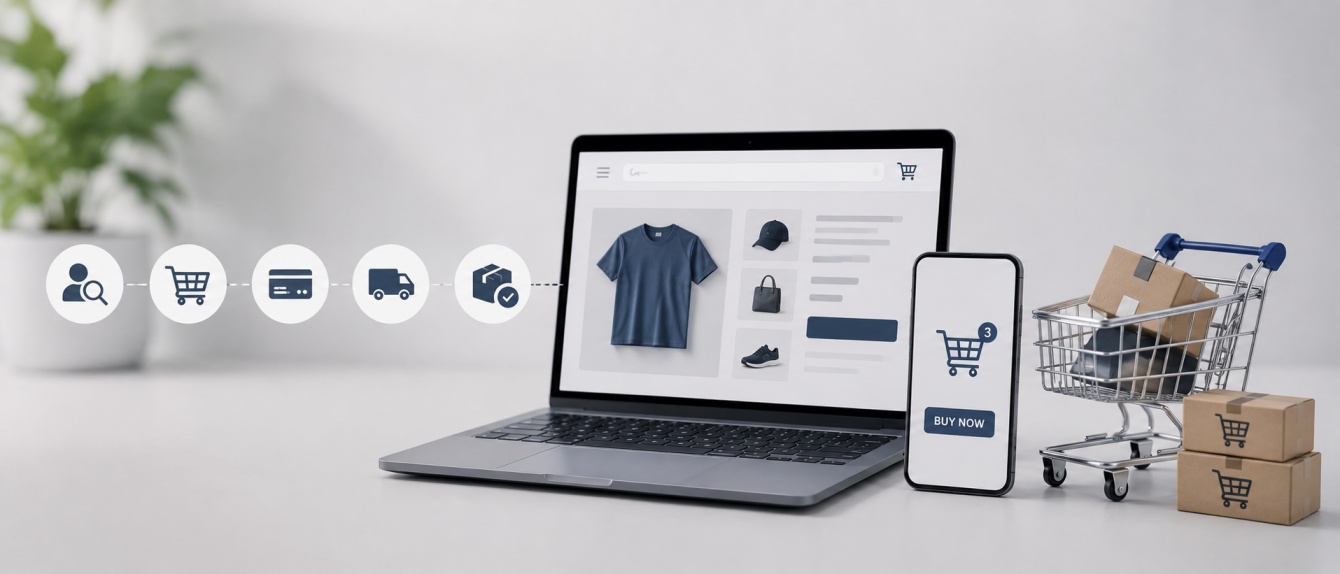
You have most likely made dozens of purchases online. You press a button, fill out the card details, and a box appears at your doorstep a couple of days later. Simple, right?
However, it is not a simple experience as it is backed by a highly advanced machine, one that comprises databases, payment gateways, logistics, networks, security measures, and a great deal of millisecond-based decision-making.
Whether you’re a curious shopper, a first-time entrepreneur, or a business looking to scale digitally, this guide breaks down how eCommerce works from the basics all the way to the advanced stuff. Let’s dig in.
1. What Is eCommerce and How Does eCommerce Work?
eCommerce (abbreviated as e-commerce) refers to the process of purchasing and selling objects and services online. It is hardly enough to refer to it as online shopping.
This has seen the eCommerce burst in the past decade. Sales in eCommerce worldwide were projected to exceed $3.6 trillion by 2025, and the figure continues to grow. The once-niche channel has become the main growth driver for businesses of all sizes, from single-founder startups to Fortune 500 companies.
In essence, the e-commerce process operates in the following manner:
- A customer visits an e-commerce site, browses the merchandise, and places an order.
- The platform used by the store receives the request, verifies the inventory, and sends the details of the order.
- Financial transaction is secured at a payment gateway.
- Once the order is received, the seller packs and ships it.
- A logistics system will take the product to the door of the buyer.
All these processes occur on interacting systems, sometimes in a few seconds. And yet beneath it, underlying, lies technology, security, and business logic.
2. Types of eCommerce Business Models
Understanding how eCommerce works starts with knowing which model you’re dealing with because the process looks different depending on who’s buying from whom.
-
B2C (Business-to-Consumer)
The most familiar model. Imagine Amazon, Myntra, or the websites of any brand. Companies do business with personal consumers. It is centered on the user experience, impulse purchasing, and convenience.
-
B2B (Business-to-Business)
Here, companies sell to other companies. The volumes of order are greater, the price is also negotiated, and several stakeholders are often involved in the buying decisions. Platforms such as Alibaba and industry-specific portals operate according to this model.
-
C2C (Consumer-to-Consumer)
Websites such as eBay, OLX, or Facebook Marketplace enable people to sell to one another. The site is more of a facilitator rather than a seller.
-
D2C (Direct-to-Consumer)
The brands eliminate the intermediary and sell directly to the channels. This offers them complete control in pricing and branding, and customer information.
-
B2G (Business-to-Government)
Organizations that provide products or services to governmental agencies include office supply providers, technology solution providers, and defense contractors accessed through digital procurement portals.
3. How Does an eCommerce Website Work?
A beautiful store is not really an eCommerce site; it is a complex machine, composed of multiple interrelated parts that work together.
a) The Frontend (What You See)
This is all the customer will see: product pages, menu navigation, search box, shopping carts, and checkout processes. It is developed with HTML, CSS, and JavaScript and designed to help users make a purchase with ease.
b) The Backend (The Engine Behind It)
As you browse, it is the backend doing the heavy lifting:
- All the listings, pictures, prices, and inventory numbers are stored in the product database.
- User accounts store order history and saved preferences.
- Business logic concerns discount codes, tax calculations, shipping regulations, and related matters.
- It is an API that enables various systems, payment processors, logistics, and marketing tools to communicate with one another.
c) The Hosting Infrastructure
Your web-based store now exists on servers, hosted on a platform such as Shopify or WooCommerce, or it was designed and deployed on a cloud platform, such as AWS or Google Cloud. The infrastructure used to host your site will determine your site’s loading speed, the amount of traffic it can support, and the security of the data.
d) SSL & Security Layers
All valid eCommerce sites use HTTPS (SSL certificates) to encrypt information between the browser and the user’s server. This is not negotiable, particularly regarding payment information.
e) Content Management System (CMS)
The CMS of eCommerce stores is provided by such platforms as Shopify, Magento, BigCommerce, or WooCommerce that enable merchants to add products, handle the inventory, make promotions, and process orders without writing even a single line of code.
4. How eCommerce Search Works
The search works wonderfully in eCommerce when you enter red sneakers size 10 into your Amazon search bar, and you are instantly presented with what you need.
How eCommerce search works involves several layers:
a) Keyword Matching
A search engine looks for product names, descriptions, tags, and metadata to find matches to the user’s query. The point of reference is simple text matching.
b) Ranking Algorithms
Not every matching result is similar. The platform classifies products based on relevance, sales speed, customer ratings, price, availability, and, in some cases, sponsored placement (sponsored products).
c) Filters and Faceted Search
After the results are shown, filters (size, color, price range, brand) enable users to narrow down. This is referred to as faceted navigation, and it significantly increases conversion rates as individuals find what they are interested in more quickly.
d) Personalized Search
Put simply, in advanced eCommerce systems, AI will use your service history and past purchases to customize your search results based on your browsing history, past purchases, and demographic indicators. Two individuals who type the same query on Amazon can have two different results.
e) Natural Language Processing (NLP)
Search engines nowadays are not only about keywords but also about intent. When you type in ‘gift dad loves to cook,’ a good eCommerce engine will not search for the exact match keyword; it will interpret the keyword and return the best-matching products, such as quality cookware or a set of knives that the father likes to cook with.
5. How Payment Gateways Work in eCommerce
This is where most people are asking themselves about in eCommerce, and not without a valid reason. It takes a lot of faith to leave your card information online.
The functioning of payment gateways in eCommerce may be summarized into the following flow:
Step 1: Customer Initiates Payment
Enter the card details (or use a saved wallet such as PayPal, Google Pay, or Apple Pay) and select Pay Now.
Step 2: Encryption and Tokenization
The payment information is instantly encrypted and posted to the payment gateway. The gateway substitutes your real card information with a coded token; the merchant does not get to see your unencrypted card number.
Step 3: Authorization Request
It requests the acquiring bank (merchant’s bank), which in turn requests the card network, which in turn requests the issuing bank (your bank).
Step 4: Approval or Decline
Your bank checks: Does it have an adequate balance? Is the transaction suspicious? It replies with an approval or denial message – this normally lasts 1-3 seconds.
Step 5: Settlement
The funds are set aside once approved. Once the order is fulfilled, the money will actually change hands between your bank and the account of the merchant during a cycle of settlement.
Key Security Standards
Payment systems should be based on PCI DSS (Payment Card Industry Data Security Standard), a strict set of security measures that protect cardholders’ data throughout the process.
6. How eCommerce Shipping & Delivery Works
Two-day free shipping is no longer a luxury, but rather a necessity. That is an operational feat to make happen.
How eCommerce shipping works involves a chain of decisions and actions:
a) Order Management
Your order is sent to the Order Management System (OMS) of the merchant, and they determine where it should be fulfilled (a warehouse, a third-party fulfillment center, such as Amazon FBA, or even the store).
b) Picking and Packing
Warehouse workers (or, more and more, robots) find the product in the warehouse stock, collect it, pack it, print a shipping label on it, and hand it over to a truck driver.
c) Carrier Selection
The platform (or merchant) will automatically choose a carrier, either FedEx, UPS, DHL, India Post, or others, depending on the cost, speed, destination, and weight. Rate shopping rate comparisons are done in real time.
d) Tracking and Visibility
After the package is scanned into the carrier system, a tracking number is generated and you are sent an e-mail with it. Each of the following scans updates the tracking in real-time.
e) Last-Mile Delivery
The hardest part. The delivery of the package to the local facility to your door is known as last-mile delivery. Speed, cost, and reliability are most questioned here. Firms spend a lot of money on optimization of this step – dynamic routing applications to delivery lockers to crowdsourced drivers.
f) Returns
The returns involve huge portions of eCommerce, notably in fashion. A good returns process entails prepaid labels, return tracking, inspection, and restocking or disposal, all of which are managed through reverse logistics systems.
7. How eCommerce App Works
Over 62% of online shopping is estimated to take place on mobile devices in 2027. It is therefore important to know how eCommerce apps operate.
a) Native vs. Hybrid Apps
A native app (such as the Amazon app on iOS) is developed to run on a single platform and has maximum performance. Hybrid applications are created and deployed to platforms on frameworks such as React Native or Flutter.
b) Core Functionality
The eCommerce app also shares the same backend APIs as the website – retrieving product information, taking payments, maintaining users, and order tracking. The interface is different and features mobile-specific elements.
c) Mobile-Specific Features
- Deal, order updates, and abandoned cart push notifications.
- Face ID or fingerprint (Biometric authentication) for seamless and secure login.
- Hyperlocal offers, location-based store finders, or delivery tracking.
- Visual search (take a photo, find similar products), camera integration.
- One tap checkout with autofilled payment options and addresses.
d) Performance Optimization
Mobile applications adopt caching, lazy loading, and compression of pictures so that they are fast even over a slow connection. Since conversion rates in mobile eCommerce are already shaky, any delay of one second will sink them.
8. B2B eCommerce vs. B2C eCommerce: Key Differences
B2B (business-to-business) and B2C (business-to-consumer) eCommerce can be practiced by the same method, and yet this is not equally true. The major differences can be summarized as follows:
| Feature | B2B eCommerce | B2C eCommerce |
| Buyers | Businesses | Individual consumers |
| Pricing | Negotiated, tiered, account-based | Fixed, transparent |
| Approvals | Multi-step workflows | Immediate checkout |
| Payment | Invoices, credit terms | Instant payment |
| Order Size | Bulk orders | Small quantities |
| Catalog | Custom per client | Public for all |
| Integration | ERP & procurement systems | Payment & marketing tools |
| Sales Cycle | Long & relationship-driven | Short & transactional |
9. How eCommerce Works in India
The eCommerce market in India is a very dynamic and distinct market in the world. It has 800 million internet users and a rising middle class, which is a huge opportunity, but it is also a big challenge.
How eCommerce works in India has its own distinct flavors:
a) Cash on Delivery (COD) Is Still King
Although UPI (Unified Payments Interface) has increased, a significant percentage of eCommerce orders in India are done on COD. This shows distrust of online payments among some demographics and ease in making a payment after getting goods.
b) UPI and Digital Wallets
On the other hand, UPI has transformed digital payment for individuals who have embraced it. Applications such as PhonePe, Google Pay, and Paytm have popularized instant, free digital transfers, and larger online commerce websites have incorporated UPI into their checkout processes.
c) Hyperlocal Commerce
Apps such as Blinkit, Zepto, and Swiggy Instamart were the first to introduce the concept of 10-minute grocery delivery in Indian metros. This is a hyperlocal model which is based on the dark stores (mini-warehouses located in the urban centres) and dense networks of delivery agents.
d) Vernacular Commerce
As millions of new internet users go online in their regional languages, the most popular platforms are now offering interfaces in Hindi, Tamil, Telugu, Bengali, and more, making eCommerce more accessible.
e) Regulatory Landscape
The Indian government, via the Ministry of commerce has come up with rules relevant to the eCommerce, which are regarding information localization, seller disclosures, and FDI limitations.
f) Tier 2 and Tier 3 City Growth
Although metros were driving early adoption, the second wave of Indian eCommerce development is emerging in smaller cities, where growing smartphone penetration, improved logistics infrastructure, and aspirational purchasing patterns are creating huge new markets.
10. The eCommerce Process: End-to-End Flow
At this point, we have looked at each section individually, so now we can assemble it. The entire process of “how does online shopping works” can be discovered through retention as follows:
Stage 1: Discovery & Awareness
You are discovered by customers via SEO (organic search), paid advertising (Google, Meta, TikTok), social media, email, influencers, or word of mouth. This is the beginning of your marketing funnel.
Stage 2: Consideration
They visit your site or app, have a look at the merchandise, reviews, and compare. Your UX, product photography, descriptions, and social proofs are all used to develop trust.
Stage 3: Decision & Purchase
They place an order, go through the check-out, and pay. This is where a quick and efficient multi-payment checkout process cannot be compromised.
Stage 4: Fulfillment
Confirmation of the orders, picking, packing, shipping, and delivery. All the steps must be visible to your team as well as the customer.
Stage 5: Post-Purchase
Monitoring of orders, shipments, feedback, and customer service. The experience does not stop after the delivery, but this is where the loyalty starts.
Stage 6: Retention & Loyalty
Email messages, loyalty programs, personalized recommendations, referral programs. The cost of getting a new customer is 5-7x higher than that of retaining an existing customer. It is the loop of the eCommerce process.
11. Common eCommerce Challenges (and How to Solve Them)
No guide on how eCommerce works would be complete without addressing the real-world challenges businesses face:
1. Cart Abandonment
The average cart abandonment rate in the world is approximately 70%. General reasons: unwanted shipping expenses, complicated checkout, account had to be made. Fix: simplify the checkout process, provide guest checkout, implement exit-intent popups, and send abandoned cart emails.
2. Inventory Management
Excessive inventory binds up funds. Stockouts lose sales. Its answer is data-driven inventory planning, which is precisely what the ProactiveAI forecasting engine provides.
3. Customer Acquisition Costs
The CAC has increased significantly as ad platforms become more competitive. The solution: invest in organic (SEO, content, email), better retention, and LTV maximization.
4. Logistics & Returns
Delays in shipping and challenging returns eliminate customer confidence. Finding trusted carriers establish achievable goals for delivery and returns should be easy.
5. Scattered Business
The majority of eCommerce brands do not have a single view of their data: it is distributed across Shopify, Google Analytics, Meta Ads, email services, and ERPs. ProactiveAI is a solution that is capable of integrating all your data sources into one, explanatory analytics layer.
12. How ProactiveAI Powers Smarter eCommerce
Understanding how eCommerce works is step one. It is a competition that demands the use of data in making decisions, and that is precisely what ProactiveAI provides.
The ProactiveAI is a Business Intelligence system designed to meet the needs of the modern eCommerce. These are the ways its core solutions can revolutionize the manner in which online businesses are conducted:
a) Conversational AI Analytics
ProactiveAI conversational AI analytics allows anyone to ask business questions in plain English, such as what the best products are or why people abandon their carts, and receive answers in seconds. No technical skills or dashboards needed- Insights are quick, correct, and accessible throughout your staff.
b) Pre-built eCommerce Dashboards
Monitor revenue, AOV, LTV, inventory turnover, returns, and customer acquisition cost using AI-configured eCommerce dashboards. Start monitoring key metrics in seconds, without any time-consuming BI implementation or technical configuration, only by connecting your data to its sources.
c) Advanced Forecasting Engine
Use machine learning and past sales data, seasonal data, and external data to forecast bestsellers, control inventory, and dead stock. Precise predictions can help eCommerce brands make smarter buying decisions and improve profitability during periods of high demand.
d) Self-Service Reporting
Design personalized reports using drag-and-drop features, set up automatic delivery, and disseminate knowledge throughout your organization. By giving teams immediate access to important data without IT or SQL, faster, smarter, data-driven decisions are enabled at all tiers.
You can be an eCommerce merchant with your own shop, a mid-market store with numerous intermediaries, or a massive company retailer with intricate operations, and ProactiveAI keeps up with you.
Conclusion
eCommerce is not merely an alternative to the physical retail anymore; it is the foundation of modern commerce. Whether you’re buying a pair of shoes, a B2B software license, or bulk inventory for your retail shop, the fundamental mechanics of how eCommerce works are the same: technology, trust, and logistics working together at speed.
Not only is the process of search and payment gateways through shipping and marketplace development interesting trivia to understand, but it is also important. It is practical knowledge that can be used to make wiser choices, no matter whether you are a seller, a marketer, or a developer creating the next best online store.
And if you are willing to take your eCommerce presence to the next level, particularly with services such as Instacart, SpxCommerce is precisely the type of partner that can help you reach that level faster.
Frequently Asked Questions
What is eCommerce in simple terms?
eCommerce is the process of buying and selling goods or services online. It includes browsing products, making digital payments, processing orders, managing inventory, and delivering products through coordinated digital and logistics systems.
How does an eCommerce transaction work?
An eCommerce transaction begins when a customer places an order online. The payment gateway verifies payment, the seller processes fulfillment, ships the product, and the customer receives tracking updates until delivery.
What are the main types of eCommerce models?
The main eCommerce models include B2C, B2B, C2C, D2C, and B2G. Each model differs based on who sells to whom, pricing structure, order size, and buying process complexity.
How do eCommerce websites manage inventory?
eCommerce websites use inventory management systems to track stock levels in real time, sync warehouse data, update product availability automatically, and forecast demand to prevent stockouts or overstocking.
Why do customers abandon their carts?
Customers abandon carts due to high shipping costs, complicated checkout processes, mandatory account creation, slow websites, or payment issues. Simplified checkout and transparent pricing help reduce abandonment rates.
What is the difference between B2B and B2C eCommerce?
B2C eCommerce targets individual consumers with fixed pricing and quick purchases, while B2B involves bulk orders, negotiated pricing, longer sales cycles, and multiple approval workflows.
You might also like
Handpicked articles for your reading list.


Get the latest insights on Conversational AI
Stay ahead of the curve with weekly updates on data analytics, AI trends, and eCommerce growth strategies delivered straight to your inbox.
Join 5,000+ industry leaders. Zero spam, just pure insights.