
 SparxIT
 SPXCommerce
 What's Your A


eCommerce
eCommerce
Shopify vs Amazon: Which Platform is Better for Ecommerce in 2026?
-
Vikash Sharma
- Apr 24, 2026
- 12 mins read
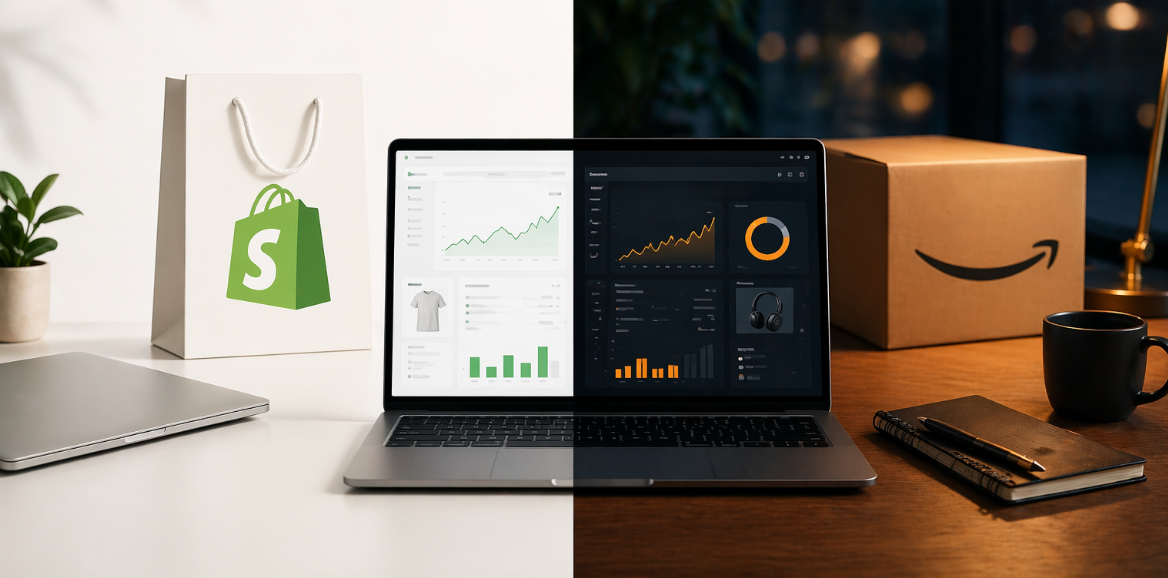
You are planning to sell online. You’ve got the product, the packaging, maybe even the brand name. Next, you encounter a common strategic decision many new sellers face: whether to build an independent storefront on Shopify or leverage Amazon’s marketplace and its extensive customer base of over 300 million active shoppers.
The wrong decision doesn’t just cost money. It takes you months of momentum, customer data you will never regain, and a market position you will take years to regain.
The issue is that both platforms seem to be great on paper. Shopify serves more than 4.8 million businesses across the world and provides you with full control of your brand, customer information, and margins.
Amazon provides immediate traffic through the world’s largest product search engine, where customers arrive with high purchase intent. It is not about which platform is objectively the best. The question is, on which platform is more suitable for your business model, growth stage, and long-term objectives?
This step-by-step guide provides answers to shopify vs amazon fee structures, practical examples, dropshipping and seller finance alternatives, and a data-driven, applicable decision equation.
Amazon vs Shopify Platform Overview: Two Completely Different Business Models
It is essential to comprehend the nature of these platforms prior to comparing them as individual features. The shopify vs amazon business model contrast is, in fact, a contrast between two diverse philosophies of commerce.
Shopify is an ecommerce hosted service. It gives you the infrastructure, and you construct a store on it. You have your domain, your design, your customer relations, and all data points created. Shopify doesn’t sell products. It helps you to sell them.
Amazon is an online store. Your products are in a list with millions of competitors. The algorithm of Amazon displays your product to interested customers. You don’t build a store. You list products within Amazon’s ecosystem. The buyer relationship belongs to Amazon.
| Factor | Shopify | Amazon |
| Platform Type | Hosted ecommerce store builder | Online marketplace |
| Monthly Base Cost | $39–$399/month | $39.99/month (Professional) |
| Transaction Fees | 2.4–2.9% + 30¢ | 8–17% referral fee per sale |
| Brand Control | Complete | Minimal, Amazon template |
| Customer Data | Seller owns all data | Amazon owns it |
| Fulfillment Options | Self, 3PL, Shopify Fulfillment | FBA (Prime eligible) |
| Dropshipping | Fully supported | Allowed with restrictions |
| Seller Competition | You vs the external market | You vs Amazon Basics + all other sellers |
| Store Customization | Full design freedom | Standardized templates |
| Account Risk | Low as you own the platform | High suspension risk is always present |
| Long-Term Brand Equity | High | Low as it depends on the marketplace rules |
Shopify vs Amazon Fee Comparison
The amazon vs shopify ecommerce platform comparison is most revealing in fees. The headline figures are similar. The real cost per sale is very different from the headline numbers.
Shopify Fee Structure
Shopify has a flat monthly fee along with payment processing. When you use Shopify Payments (their own gateway), you are charged no extra transaction fees.
| Plan | Monthly Cost | Payment Processing | Third-Party Gateway Fee |
| Basic | $39/mo | 2.9% + 30¢ | +2.0% |
| Shopify | $105/mo | 2.7% + 30¢ | +1.0% |
| Advanced | $399/mo | 2.4% + 30¢ | +0.5% |
You are charged about 2% in fees through third-party payments (Basic plan), which translates into an effective rate of about 3.5%. Scale to $100, and it drops to ~3.2%. The greater the quantity you sell, the more viable upgrading becomes.
Amazon Fee Structure
Amazon charges fees based on category and usage. To the vast majority of sellers, it is a subscription, a referral fee on each sale, and on top of that (with FBA) fulfillment and storage costs.
| Fee Type | Amount | Notes |
| Monthly Subscription | $39.99/mo | Professional seller account |
| Referral Fee | 8–17% per sale | Category-dependent; Clothing = 17% |
| FBA Fulfillment Fee | $3.22–$6.85+ per unit | Based on size and weight |
| FBA Storage (Jan–Sep) | $0.87/cu ft/month | Spikes to $2.40 Oct–Dec |
| Closing Fee (media) | $1.80 per item | Books, music, video, DVD |
You are paying $7.50 per sale on that same 8% referral: 50 Electronics sales, resulting in an effective fee rate of 15%. With a 17% referral rate plus FBA fees, the total effective cost can exceed 25%.
The advantage of the fee is realized only when Amazon operates at very large volumes, where the costs of referrals are offset by the efficiency of FBA’s logistics approach.
Shopify vs Amazon Brand Control & Customer Ownership
Shopify gives brands full control over their stores, customer data, and overall experience, enabling direct relationships and long-term loyalty-building. In contrast, Amazon limits brand control while owning the customer relationship, making it easier to scale quickly but harder to build a distinct brand identity.
| Shopify Gives You | Amazon Restricts You To |
| Your own branded domain (yourbrand.com) | Ready-to-use product page templates |
| Full customer email & purchase history | No direct access to customer email |
| Custom checkout, upsells, and flows | Checkout handled entirely by Amazon |
| Full design control, no template limits | Limited control despite Brand Registry |
| Email & SMS marketing to your list | No off-platform customer resale |
| Loyalty programs, subscriptions, memberships | Very limited loyalty program capabilities |
| First-party behavioral data for retargeting | A+ Content with strict guidelines only |
Why This Matters
The Customer Data Compounding Effect: One of the Shopify sellers who achieves 50,000 email subscribers in three years has a real business asset that can be put into action each time they launch, each promotion, each season.
An Amazon vendor with the same volume of sales does not own direct access to customer data, and Amazon controls all the customer relationships.
When that Amazon seller wants to increase prices, introduce new products, or get out of the market, they do not have an email list, customer LTV data, or a direct connection to leverage. The brand that they believed they were creating exists at the mercy of Amazon.
Traffic & Discoverability: The Biggest Practical Difference
Talk to any Shopify merchant about their top priority, and they will tell you that it is traffic. Shopify provides you with the store, but it does not fill it with buyers.
Amazon acts as a product search engine where customers arrive with high purchase intent. Customers come with a pre-conceived notion of buying. This makes it hard for standalone stores to compete in the initial levels.
How Shopify Sellers Get Traffic
- Paid advertising on Google Shopping, Meta Ads, TikTok ads, and Pinterest. Very effective and needs budget and optimization skills.
- Organic search traffic accrues with time. The structure of the blog and product page in Shopify is favorable to the high-SEO results, yet they will require 6-18 months.
- High potential of DTC brands that are well-visualized in products using Social media & influencer marketing
- Email & SMS help drive repeat purchases, with the highest ROI after creating a list.
- The multi-channel integrations of Shopify, including Sell on Instagram, TikTok Shop, Facebook, and even Amazon at the same time, using the channel apps of Shopify.
How Amazon Sellers Get Visibility
- Amazon SEO, powered by the A9 and A10 algorithms, allows sellers to optimize product titles, bullet points, backend keywords, and A+ Content to improve organic rankings. Key ranking signals include conversion rates and review velocity.
- Amazon PPC, including Sponsored Products, Sponsored Brands, and Sponsored Display, is a pay-to-play advertising system within the platform. It becomes highly competitive and often more expensive in trending or saturated categories.
- The Prime and FBA badge, assigned to products fulfilled by Amazon, significantly boosts visibility and increases conversion rates. This is especially true among Prime members, who prioritize fast and reliable shipping.
- Amazon Vine and customer reviews play a crucial role in performance, as both the quantity and quality of reviews directly influence product ranking, credibility, and overall conversion rates.
The Traffic Reality Check:
Traffic Referral competition on the same page is part of the traffic that Amazon has created. Your listing is next to three competitors and potentially Amazon, which owns its own label product. Shopify traffic is expensive to invest in initially, but pays off more frequently once acquired, since the store has no competing listings.
Amazon Dropshipping vs Shopify: Which Is Safer & More Scalable?
Amazon dropshipping offers fast scalability through built-in traffic, but comes with high platform risk and limited control over your business. Shopify, on the other hand, is safer long-term with full ownership and flexibility, though scaling requires effort in marketing and customer acquisition.
| Factor | Shopify Dropshipping | Amazon Dropshipping |
| Platform Permission | Fully supported & encouraged | Allowed but tightly restricted |
| Supplier Branding Rules | Flexible, any supplier | Your branding only and no supplier packing slips |
| Account Suspension Risk | Low | High, policy violations are common |
| Supplier Options | AliExpress, DSers, Spocket, AutoDS, SaleHoo | Limited; must be approved dropship sources |
| Profit Margin | Moderate, depends on ad spend efficiency | Low, referral + FBA fees compress margins |
| Scalability | High, automate with apps | Moderate, compliance overhead scales |
| Brand Building | Yes, your store, your brand | Minimal |
Amazon does not allow reselling products from other retailers as a dropshipping model. Breaking the rules leads to account suspension or removal. Dropshipping can only be done when the seller of record is yourself, and you handle your own packaging and branding.
There are no restrictions on Shopify dropshipping. You also integrate Shopify and suppliers using apps such as DSers, Spocket, or AutoDS, automate the process of order fulfillment, reports, and manage every aspect of customer experience. The outcome is a more sustainable, brand-building model, but it requires traffic investment on day one.
Dropshipping Scenario
The Niche Pet Accessories Brand: A vendor is starting a dropshipping shop for eco-friendly pet accessories. On Amazon, in 6 weeks, their best-selling listing is marked as having a packaging compliance problem. It is suspended, and the reviews are lost.
They have 4,200 email subscribers on Shopify using the same product and same supplier with Spocket, targeted Meta campaigns to a warm audience, and a 34% repeat purchase rate, customers that the Amazon version would never have heard of.
Amazon vs Shopify Selling Platform Comparison
The selling on shopify vs amazon is often determined by logistics when it comes to the physical product seller.
| Amazon FBA | Shopify Fulfillment Options |
| Ship inventory to Amazon warehouses | Self-fulfillment (from home, warehouse, or office) |
| Amazon handles picking, packing, and delivery | 3PL partners like ShipBob, ShipMonk, etc. |
| Prime 1–2 day delivery badge boosts conversions | Shopify Fulfillment Network (SFN) is available |
| Amazon manages returns and customer service | Dropshipping, no inventory required |
| $3.22–$6.85+ per unit fulfillment fee | Fully branded packaging and unboxing experience |
| $0.87–$2.40 per cubic foot monthly storage | No hidden storage fees or peak season charges |
| Long-term storage fees for slow-moving inventory | Full control over customer service experience |
The Prime badge of FBA is truly effective, 74% of the Prime members indicate that it affects their purchasing decisions. However, the price of that badge is only added to: you add referral fees to the price of that badge, in most categories, FBA may push your total cost per sale over 20%.
Shopify + ShipBob as a 3PL generally delivers at the same speed at a reduced per-unit price, while still offering branded packaging and full access to customer data.
Shopify Capital vs Amazon Seller Funding: Which Fuels Growth Better?
Both sites provide revenue-based financing to sellers, an important tool in financing inventory, marketing, or expansion without a conventional bank loan.
| Factor | Shopify Capital | Amazon Lending / Seller Funding |
| Type | Loan/merchant cash advance | Line of credit, invoice financing, term loans |
| Funding Range | $200 to $2 million+ | $1,000 to $750,000 |
| Repayment | Percentage of daily Shopify sales | Percentage or fixed monthly payout from Amazon payouts |
| Eligibility | Based on Shopify sales history | Based on Amazon sales performance & account health |
| Approval Process | Typically invitation-based, often same-day | Invitation-based via the Amazon dashboard |
| Cost / Rates | Factor rate 1.1–1.13 (10–13% total cost) | APR typically ranges from 15–27% |
| Data Used | Your own store data | Amazon marketplace data only |
Both financing options are based on the performance of the platform, i.e., access comes with good sales. Shopify Capital provides more profitable terms for existing D2C brands and offers greater flexibility, as repayment is based on overall Shopify revenue rather than a single channel.
Amazon Lending can be useful to sellers scaling FBA inventory, but it is more expensive and can only be applied to Amazon-related costs in practice.
Analytics & Data: The Invisible Competitive Advantage
The aspect that distinguishes strategic sellers from reactive sellers in response to last week’s events is analytics. That is where the Amazon vs shopify for selling online comparison comes in, most consequential to businesses in the growth stage.
What Amazon’s Analytics Shows You
Amazon Seller Central provides unit sales, revenue (via the Ads Console), and unit-level conversion data by ASIN. Amazon data is limited to its ecosystem.
You see what sold. You do not see the customer journey, the full attribution picture, or any behavioral data about the buyer before they reach your listing.
What Shopify’s Analytics Shows You
The native analytics provided by Shopify include sessions, conversion funnels, AOV, customer LTV, geographic performance, and simple attribution.
It is significantly more powerful than what Amazon reports on, yet it, too, contains gaps, especially in cross-channel attribution, real-time streaming, and advanced segmentation.
The Analytics Gap Both Platforms Leave
On Shopify, Amazon, or both, the data that is most vital to scaling is often never brought out in a transparent format by native tool reports:
- Live sales and inventory performance in all channels at the same time.
- Ad spend efficiency to real-time revenue, not next-day reports.
- Inventory is warning of stockouts (not of post-stockouts).
- Live dashboards, customer cohort analysis, and repeat purchase rates.
- Cross-channel attribution: which ad on which channel made which Shopify and Amazon sale.
See Your Shopify and Amazon Data in One Real-Time Dashboard With ProactiveAI
At ProactiveAI, we consolidate all your ecommerce data into a single, live dashboard, so that you will never again have to switch platforms or use outdated reports.
We integrate with your Shopify and Amazon stores, and you get a real-time picture of the sales, stock, advertising effectiveness, and customer activity.
We do not assemble spreadsheets or wait until the end of the day for batch updates, and instead, we give you real-time data analytics that enable you to make better decisions and act faster.
We ensure you are in full control of your business, whether it is tracking ROAS across ad channels, monitoring inventory levels, or identifying revenue discrepancies.
We have built our platform to eliminate complexity, so you can focus on growing your operations without fear, as we process the information behind the scenes.
How to Choose: The Decision Framework for 2026
The straightforward answer to the question shopify vs amazon, which is better for sellers, is four variables: your business model, your stage of growth, your risk aversion, and your long-term objective. The following is a handy outline.
Choose Shopify If…
You are creating a long-term equity brand. Your products are differentiated and unique. You would like to have your customer data and do your own email/SMS marketing. You are a dropshipper or D2C that requires flexibility.
Choose Amazon If…
You possess a product of high demand or a commodity that has proven demand. You want to sell a lot of volume without incurring more traffic. You have inventory and FBA capital. You can withstand market regulations and credit risk.
Use Both If…
You are climbing over $500K/year and are willing to de-risk platform dependency. Use Amazon to scale up and attract new customers, and Shopify to turn repeat customers and obtain customer data. Lots of 7-figure brands operate this hybrid model.
|
Business Scenario |
Best Choice |
Why |
| Introducing a first-mover DTC product | Shopify | Enables full brand control, ownership of customer data, and email list building |
| Quickly testing product-market fit | Amazon | Built-in traffic allows fast demand validation and quicker feedback loops |
| Dropshipping business model | Shopify | More flexibility with suppliers and a stronger integration ecosystem |
| High-volume commodity products | Amazon | FBA and Prime enable efficient scaling and higher conversion rates |
| Subscription or loyalty product | Shopify | Requires ownership of customer relationships and recurring revenue |
| Seasonal / peak-demand products | Amazon | FBA infrastructure handles demand spikes, especially during peak seasons |
| Multi-channel, 7-figure scaling | Both | Amazon drives acquisition, while Shopify supports retention and brand growth |
| B2B / wholesale ecommerce | Shopify | Strong B2B capabilities, whereas Amazon lacks true wholesale features |
The Multi-Channel Insight
In 2026, the most sustainable ecommerce companies will not see Amazon and Shopify as competitors but rather as complementary channels. Amazon stimulates discovery and the first purchase.
Shopify transforms repeat customers, develops the email list, and accrues brand equity over time. The cross-channel eCommerce dashboard is designed for sellers operating in both channels to provide a live view of performance across the entire funnel.
Conclusion
Having compared the business models of shopify vs amazon by comparing their fees, fulfillment, dropshipping, seller financing, brand control, and analytics, the verdict is not that Shopify wins or Amazon wins. It is concluded that they have quite different strategic purposes.
Shopify is your base in case you are creating a long-term equity brand, customer relationships, and pricing power. When demand needs to be validated in a hurry, volume needs to be moved in a familiar marketplace, or volume needs to be scaled using FBA logistics, Amazon is your accelerant.
Operators of ecommerce who succeed most in 2026 do not pick one and leave the other. They employ both wisely and have a clear plan for what each channel adds, and they use analytical tools such as ProactiveAI to monitor cross-channel activity in real time.
This means all the money spent on ads, all inventory-related decisions, and all promotional events are supported by real-time data instead of a batch report of yesterday.
The platform question matters. However, it is the data intelligence layer that overrides your platforms that integrates your Shopify and Amazon performance into a single actionable view that makes the difference between reactive and strategic sellers.
Frequently Asked Questions
Can I sell on both Shopify and Amazon at the same time?
Yes, there are a lot of sellers who use both of them. Shopify can be connected to Amazon, allowing you to list products and synchronize the inventory. This plan will be a mix of the acquisition strength of Amazon and the retention strength of Shopify, and ProactiveAI unifies performance tracking.
What are Amazon's fees compared to Shopify's?
Shopify charges are generally less than 2.4-3.5 per sale, whereas Amazon fees are 12-25% plus referral and shipping fees. In the long term, the higher charges at Amazon have a significant impact on margins compared to the more cost-effective design at Shopify.
Is dropshipping on Amazon vs Shopify better?
You are charged about 1.75% in fees on a $50 sale through Shopify Payments (Basic plan), which translates into an effective rate of about 3.5%. Scale to $100, and it drops to ~3.2%. The greater the quantity you sell, the more viable the plans of upgrading become.
What is Shopify Capital, and how does it compare to Amazon Seller Funding?
Shopify Capital provides loans that are recovered through sales at fairly low rates and with flexible terms. Amazon Lending offers loans based on payouts,, but often at higher rates, which makes Shopify a better choice for growing businesses in general.
Shopify vs Amazon: Which is better for sellers?
It is a matter of what you want to achieve. Amazon can be used to make quick sales and has built-in traffic, whereas Shopify provides you with comprehensive control over branding, customer data, and margins. Many sellers employ both to balance their growth strategy.
Which is better: Amazon or a Shopify store?
Amazon is better for quick market access and volume, while a Shopify store is better for building long-term customer relationships and brand building. A combination of the two is usually the best strategy for maximizing reach and profitability
You might also like
Handpicked articles for your reading list.


Get the latest insights on Conversational AI
Stay ahead of the curve with weekly updates on data analytics, AI trends, and eCommerce growth strategies delivered straight to your inbox.
Join 5,000+ industry leaders. Zero spam, just pure insights.