
 SparxIT
 SPXCommerce
 What's Your A




eCommerce
AI & Analytics
Magento Analytics: How Adobe Commerce Brands Can Unlock Deeper Reporting
-
Vikash Sharma
- Aug 06, 2026
- 9 mins read
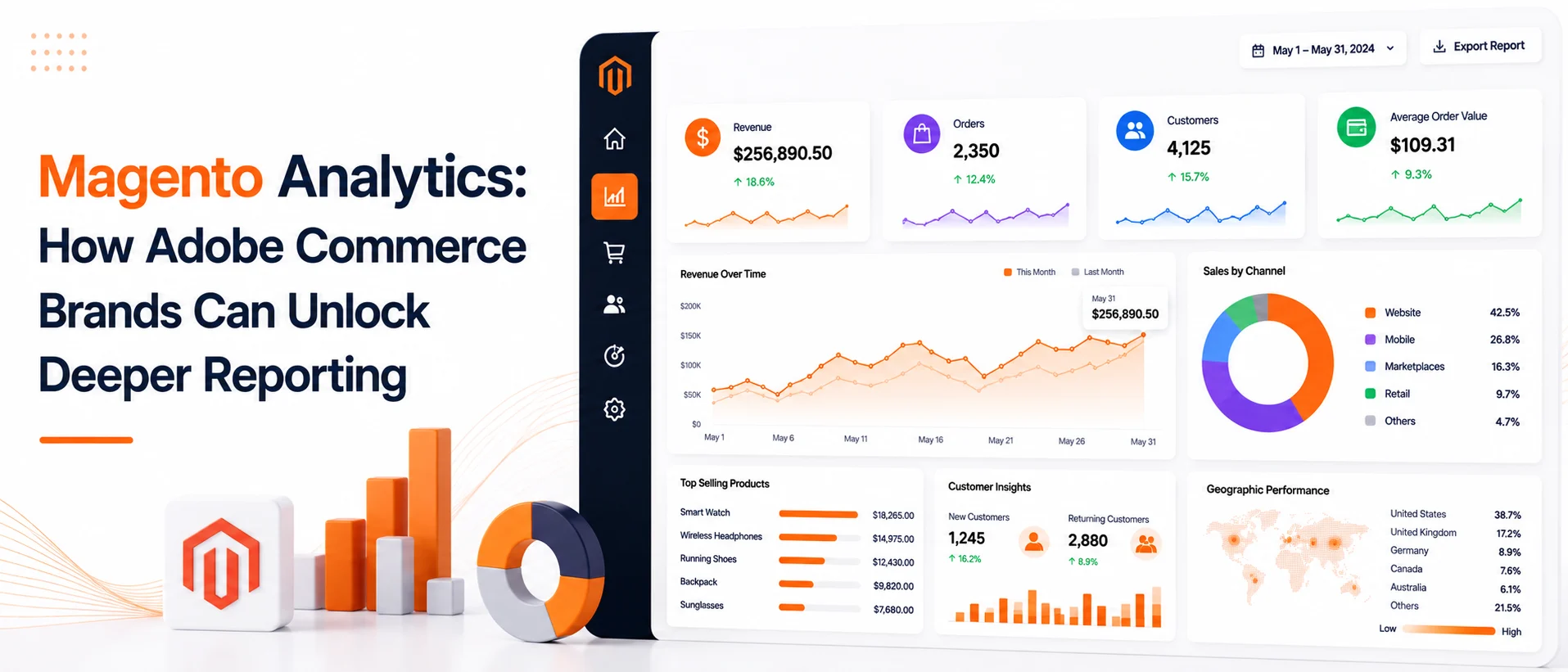
You have an Adobe Commerce store, orders are streaming in, and campaigns are running on various channels. However, when your leadership team asks, “Which products are leading our most loyal customers?” or “What will our revenue be next quarter?” you’re left with CSVs, spreadsheets, and guesswork.
This is the pain point most Magento (Adobe Commerce) brands face today. The platform’s native reporting provides operational visibility but lacks the depth required for strategic business intelligence. Without an analyst spending hours and hours in the backend, there is no way to easily tie customer behavior to revenue trends and predict inventory demand, or answer a business question.
Modern analytics platforms address these limitations by combining business intelligence, AI, and unified reporting. The right Magento analytics setup, with native tools, advanced BI, and AI-powered analytics platforms, can change the way you make decisions, from reactive reports to truly proactive decision-making. This blog explains how to do just that, what tools are important, and how ProactiveAI fits in.
What Is Magento Analytics and Why Does It Matter?
Magento Analytics combines reporting, business intelligence, and performance metrics to measure ecommerce operations across revenue, customers, products, and marketing. This ranges from order and revenue tracking, customer lifetime value, and product performance to marketing attribution.
A 2023 Salesforce report revealed that 73% of customers expect businesses to know their needs, something only possible with clean, connected data. With Adobe Commerce brands, Magento analytics isn’t simply a reporting tool, and it’s a competitive edge.
If your analytics stack is functioning properly, you can find answers to questions such as:
- Which customers have the highest repeat purchase rate?
- What products are trending before reaching the peak of demand?
- What are the drop-off issues in the checkout funnel?
- What is the growth compared to last year for your line of revenue this week?
- If you don’t have analytics in place, you’re operating blind.
What Does Magento Provide Natively?
The built-in reporting section under the Admin panel in Adobe Commerce covers the basics. The native reporting suite includes the following capabilities:
Standard Magento Reporting Tools:
- Sales Reports: All orders, invoices, shipping, refunds, and tax reports
- Product Reports: Views, bestsellers, low stock, and ordered products.
- Customer Reports: New Customers, Order Counts, and Customer Activity.
- Marketing Reports: Abandonment reports, search terms, and coupons
- Reviews & Wishlist Reports: Customer engagement indicators
The Magento reporting tools are truly helpful for operational checks throughout the day. You can view yesterday’s order count and which SKUs are out of stock from the native dashboard.
There is also an enhanced integration with Adobe Analytics for behavioral tracking, including page views, session paths, funnel analysis, and A/B test data, that goes far beyond what is available in the basic admin panel for Adobe Commerce (Cloud) customers.
What Are the Limits of Magento’s Built-in Reporting?
This is where most emerging brands get stuck. Native Magento dashboards primarily support transactional reporting and provide limited predictive or strategic business insights.
These are the most common restrictions:
- No cross-channel attribution. There is no correlation between ad spend data and actual revenue outcomes across native reports, whether provided by Google or Meta.
- Limited customer analytics. You can view order history, but accessing cohort analysis, churn prediction, and lifetime value segmentation requires additional tools.
- No predictive capability. No revenue forecasting or demand prediction is built-in.
- Poor data visualization. The default Magento ecommerce metrics interface provides operational reporting, but isn’t designed for executives to tell a story or quickly extract insights.
- Siloed data. Your email system, CRM, ERP, and ad accounts each reside in entirely different systems.
- No self-service to non-technical users. Each custom report usually needs to be developed or involve a certain level of SQL.
These limitations may be acceptable for early-stage ecommerce businesses. These gaps are a reality for any brand that’s grown beyond seven figures.
Key Components of a Strong Adobe Commerce Analytics Stack
A good data analytics platform for ecommerce is not built from a single tool, and it’s composed of several capabilities working together:
|
Layer |
Function |
Example Tools |
| Data Collection | Capture transactions, events, customer behavior | Adobe Commerce, Google Tag Manager |
| Data Warehouse | Store and consolidate data from all sources | BigQuery, Snowflake, Redshift |
| BI / Reporting | Visualize and explore historical data | Adobe Commerce Intelligence, Looker |
| AI Analytics | Predict, explain, and surface insights automatically | ProactiveAI, Adobe Experience Platform |
| Activation | Act on data to personalize, retarget, and automate | Klaviyo, Salesforce, Meta Ads |
Imagine these layers are like the floors of a building. The top floors of the building (AI analytics and activation) are only valuable once it has a solid foundation (data collection and storage). If you skip layers, you’ll get a split, disparate report, which most brands struggle with.
What Is Adobe Commerce Intelligence (Formerly Magento BI)?
Adobe Commerce Intelligence (ACI) was previously Magento BI and prior to that RJMetrics, Adobe’s built-in business intelligence layer for Commerce customers. It’s a data warehouse and visualization platform built specifically for ecommerce transaction analysis.
What ACI does well:
- Computes customer lifetime value (CLV) and cohort retention rates
- Customizes revenue, AOV, and product performance automated reports
- Allows SQL-based custom metrics and calculated columns
- Includes support for connecting to Adobe Analytics for merged behavioral dimensions.
Technically, how ACI works:
ACI is a tool that moves all Adobe Commerce tables (orders, customers, products) into a managed data warehouse. You create dashboards based on metrics, SQL-calculated fields, and definitions. It’s more capable than the built-in Admin reporting and is also used in the Adobe environment, though not much.
The difference is in what Adobe Commerce Intelligence stores and what Adobe Analytics stores. The difference is: Adobe Commerce Intelligence stores what you sold and to whom, while Adobe Analytics stores what visitors did before and after they bought. Mature teams leverage both in tandem: Adobe Analytics for behavioral and funnel analysis, and ACI for business performance metrics.
How Do You Connect Magento to an Advanced Analytics Platform?
The integration of a brand’s data with an advanced analytics platform is usually one of these:
Option 1: Direct Database Connection
You can use tools such as Zoho Analytics to tunnel into your Magento MySQL database or connect to it via a read replica. This is suitable for smaller stores, but can load production databases.
Option 2: API-Based Integration
Most analytics platforms offer REST API endpoints to retrieve Magento order, customer, and product data on a scheduled basis. This approach offers greater scalability but requires implementation and ongoing maintenance.
Option 3: AI-Powered Analytics Platform (Recommended)
Platforms such as ProactiveAI integrate with your Adobe Commerce data and integrate other data sources like Google Ads, Meta, email platforms, and more into a single ecommerce analytics dashboard. You don’t need to build pipelines yourself, and you’re provided with pre-built connectors, automated data sync, and AI-generated insights on top.
The Magento eCommerce dashboards from ProactiveAI bring all Magento sales analytics, customer behavior, marketing attribution, and inventory tracking into a single view, with no SQL required, and are specifically designed for Magento and Adobe Commerce brands.
Magento vs Shopify Analytics: A Quick Comparison
It is a frequent scenario, particularly when brands are considering platforms or running multiple stores.
| Feature | Magento (Adobe Commerce) | Shopify |
| Native Reporting Depth | Moderate (better with ACI) | Good for basics |
| Customization | High SQL, API, custom metrics | Limited without apps |
| Third-Party Integrations | Extensive but requires setup | Large app ecosystem, easier setup |
| AI Analytics Support | Via third-party tools | Via third-party tools |
| Data Ownership | Full (self-hosted or cloud) | Shopify controls data layer |
| Scalability | High enterprise-grade | Good but limited at extreme scale |
Shopify is a winner when it comes to simplicity. Magento offers greater flexibility, customization, and scalability for enterprise ecommerce operations than Shopify. However, in terms of advanced analytics, neither platform addresses the challenge natively, and each requires its own Magento data analytics platform and/or third-party integrations.
Best Analytics Tools for Magento Stores
Here’s how some Adobe Commerce brands use these tools for each of the use cases:
For Business Intelligence:
- The Adobe Commerce Intelligence native BI layer, SQL-based.
- For teams that have a data warehouse and data analysts, consider using Looker or Tableau.
For Behavioral Analytics:
- Adobe Analytics (deep behavioral tracking, native integration).
- Google Analytics 4 (popular, free)
For AI-Powered ecommerce Analytics:
- ProactiveAI is a conversational AI analytics platform, offering pre-built Magento dashboards, a forecasting engine, and self-service business intelligence for ecommerce teams.
To use with Data Pipeline / ETL:
- Fivetran, Stitch, or custom scripts (engineering teams)
For CRM + Commerce Sync:
- Zoho Analytics (good for SMBs) with Magento connector.
- Salesforce + MuleSoft (enterprise-grade)
ProactiveAI is a standout on this list, especially because it is designed for the non-technical ecommerce operator. No data engineer or SQL knowledge is required, and the platform will do the heavy lifting, so your team can focus on decision-making, not data wrangling.
How Does AI Analytics Improve Reporting for Magento Stores?
Regular BI tools let you know what happened. AI analytics will tell you why it happened, what is likely next, and what you should do about it. It’s a significant edge for any Adobe Commerce brand looking to remain competitive.
Let’s see what AI has to offer for Magento customer analytics in particular:
1. Conversational AI Analytics
If you have a question, ask it, and don’t construct a report. With the power of conversational AI analytics, your team can ask questions such as “What was the return rate on the product category with the most returns last month?” and receive immediate, accurate answers without having to navigate the dashboard. This is the practical usage of conversational AI in the ecommerce sector.
2. AI Sales Forecasting
Forecasting Engine creates ecommerce sales forecasts by leveraging machine learning techniques and your real-world historical data, market signals, and seasonal patterns. You can have revenue projections, demand forecasting for stock purchases, and even scenario modeling without a data science team.
3. Automated Anomaly Detection
With a 30% decline in conversion rate on a Tuesday afternoon, you don’t want to know two days later when your weekly report comes around. Your key metrics are tracked around the clock by AI analytics, which alerts you to any pattern of abnormality as soon as it arises.
4. Customer Segmentation at Scale
AI can automatically segment your customers by their purchase behavior, lifetime value potential, and churn risk, and continuously update these segments as new orders are placed. This means that your Magento customer analytics become actionable.
5. Self-Service BI for the Whole Team
Any team member, whether in marketing, operations, or leadership, can dive into the data on their own using Self-Service Analytics. No tickets to the data team, no waiting for a report to be built. Self-service Business Intelligence, just for ecommerce.
Why Choose ProactiveAI for Your Adobe Commerce Reporting?
ProactiveAI is a dedicated AI-powered analytics platform designed for ecommerce brands, such as Adobe Commerce and Magento stores. It provides insights specific to ecommerce companies, rather than general BI tools.
Our platform comes with pre-designed dashboards that provide sales performance, customer analytics, marketing attribution, and inventory insights. This enables teams to access important metrics without having to build them from the ground up.
The ML-powered forecasting engine can forecast sales, demand, and inventory trends, helping finance and operations teams make better planning decisions based on reliable data.
Along with this, our self-service analytics allows business users to create custom reports, filter and export data without relying on other users. Additionally, it integrates with Magento, Google Ads, Meta, email marketing tools, and CRMs to provide businesses with a consolidated view of ecommerce performance, ideal for both growing and enterprise brands.
Conclusion
While Magento provides you with important reporting features, expanding ecommerce enterprises require more information than what the native dashboards can deliver. The Magento analytics strategy emerges from a blend of historical reporting, AI-driven forecasting, customer analytics and marketing attribution, and self-service reporting to enable swift, data-driven decisions.
You can integrate your data from your ecommerce platform to advertising systems, CRM, and marketing systems to get a full picture of the business and find growth opportunities. It can be much easier with platforms such as ProactiveAI, which offer pre-built ecommerce dashboards, conversational analytics, and predictive insights tailored for Adobe Commerce and Magento brands.
With competition rising, investing in deeper Magento analytics will help businesses become more efficient, deliver a better customer journey, and make better decisions with ease.
Frequently Asked Questions
What analytics does Magento (Adobe Commerce) provide natively?
Adobe Commerce offers out-of-the-box reports on the following areas: sales, products, Customers, marketing, and search terms. Adobe Commerce Intelligence (formerly Magento BI) offers SQL-based data warehousing, cohort analysis, and lifetime value tracking. Adobe Analytics can be used to access behavioral data, such as session paths and funnel drop-offs.
What are the limitations of Magento's built-in reporting?
Native Magento reporting is missing cross-channel attribution, predictive analytics, and real-time anomaly detection. Lacks the ability to integrate with ad platforms or CRMs easily, has limited visualization capabilities, and usually requires developer effort to come up with any custom or complex reporting for business teams.
How do you connect Magento to an advanced BI or analytics platform?
The integration can be done directly through the database (MySQL), through a REST API, or through a dedicated analytics platform, such as ProactiveAI. AI-powered tools provide pre-built Magento connectors and automatically synchronize data, eliminating the need for custom engineering and ensuring your reporting is always up to date.
What is Adobe Commerce Intelligence (formerly Magento BI)?
Adobe Commerce Intelligence is the native BI layer for Commerce customers available from Adobe. It maps your store transactions into a managed warehouse, provides SQL-based analytics support, and includes pre-built ecommerce reports such as revenue, cohorts, AOV, and customer lifetime value. It is best used in conjunction with Adobe Analytics for behavioral data.
How does AI analytics improve reporting for Magento stores?
AI analytics augments your Magento data with predictive capabilities, automation, and natural-language access. Conversational capabilities such as asking questions, receiving AI-driven sales forecasts, automatic anomaly detection, and behavior-based segmentation are unique features offered by platforms like ProactiveAI that are not natively available in standard BI tools or Magento reporting.
You might also like
Handpicked articles for your reading list.

Get the latest insights on Conversational AI
Stay ahead of the curve with weekly updates on data analytics, AI trends, and eCommerce growth strategies delivered straight to your inbox.
Join 5,000+ industry leaders. Zero spam, just pure insights.