
 SparxIT
 SPXCommerce
 What's Your A


eCommerce
Marketing
ROAS vs ROI: Key Differences Explained with Examples
-
Vikash Sharma
- Apr 24, 2026
- 10 mins read
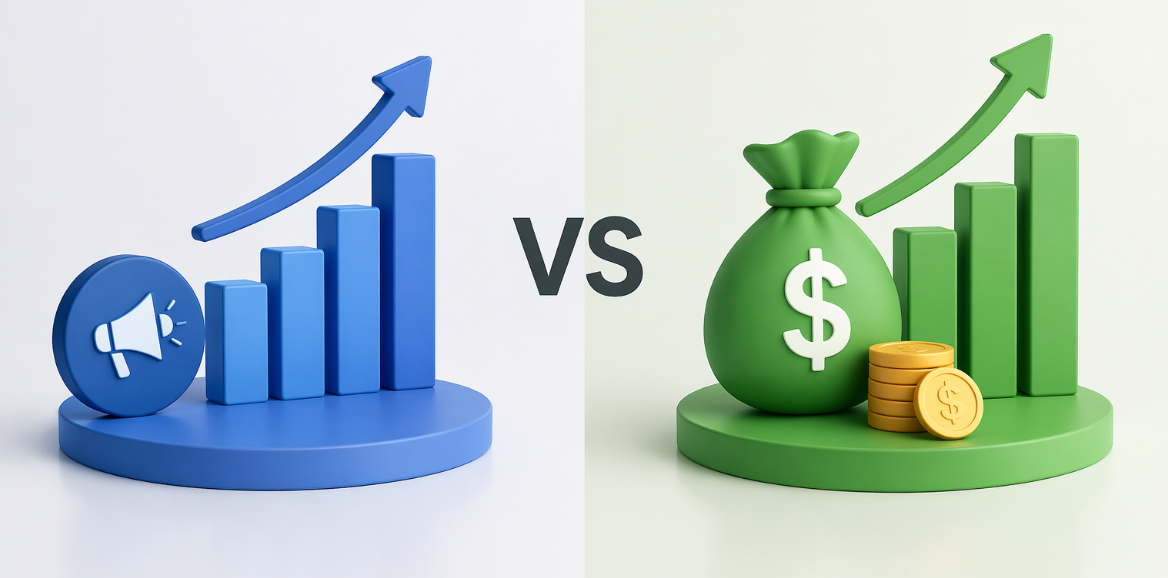
You run a Google Ads campaign generating $8 in revenue for every $1 spent. Your ROAS is a 800%. However, your business is hardly profitable by the end of the quarter. But how could that be so?
This is the most widespread and likely the costliest misunderstanding in eCommerce marketing analytics: equating ROAS vs ROI as the same measure.
They’re not the same. They are provided in totally different ways, computed in different ways, and are treated as if they were mutually exclusive, with one maximized and the other ignored. It is a quick way to delude yourself over the real performance of your marketing.
Whether you’re a performance marketer with paid search budgets to maintain, a CMO to justify marketing spend to the board, or an influencer marketing manager to review creator campaigns, the ROI vs ROAS difference is not an option but a prerequisite.
This guide provides plain-language definitions of both metrics, accurate formulas, worked examples, and explanations of when each applies.
What Is ROAS?
ROAS (Return on Ad Spend) is a marketing effectiveness ratio that informs you of the amount of revenue generated by your business per dollar expended on advertising. It is a campaign-level measure, scoped to your ad spend and the revenue it directly drives.
Consider ROAS a fuel-efficiency gauge. It tells you how far your advertising budget is going in terms of revenue generated, but it does not tell you the overall cost of running the car.
ROAS Formula
ROAS = Revenue of Ad Campaign / Cost of Ad Campaign.
Expressed as a ratio (e.g., 4:1) or multiplied × 100 for a percentage (e.g., 400%)
What Is a Good ROAS?
There is no single “good” ROAS, as it depends heavily on your industry, margins, and business model. With that said, a typical benchmark in both ecommerce and paid search is a 4:1 ratio (400%). However:
- Businesses with high margins (SaaS, digital products) can maintain lower ROAS levels, even 2:1 can be profitable.
- An 8:1 or greater ROAS might be required in low-margin businesses (grocery, commodity ecommerce) to cover COGS (Cost of Goods Sold) and be profitable.
- Brand awareness may be willing to forego high ROAS in favor of the value of long-term customer acquisition.
What Is ROI?
ROI (Return on Investment) is a more inclusive measure of profitability that determines the net financial return of an investment relative to its total cost.
In contrast to ROAS, ROI considers all expenses incurred to run a campaign, not just ad spend, including software costs, creative development, agency costs, employee time, and overhead.
ROI answers a critical question: Is this investment profitable? Where ROAS will inform you how effectively your advertisements were used to raise revenue, ROI will inform you whether the revenue was converted into actual profit.
ROI Formula
ROI = [(Revenue – Total Costs) ÷ Total Costs] × 100
Total Costs = Ad Spend + Creative + Tools + Staff + Overhead.
Alternative ROI Formula (Profit-Based)
ROI = (Net Profit/Total Investment Cost) x 100]
Net Profit = Revenue-Cost of Goods-All Operating Costs.
What is a Good ROI?
An investment with a positive ROI (greater than 0) is profitable. A negative ROI indicates a loss. In the case of digital marketing investments, the majority of businesses are aiming at an ROI of at least 100-200%, that is, they increase their total investment two or three times. The precise target depends heavily on the channel, business maturity, and growth stage.
ROAS vs ROI: The Key Differences and Explanations
|
Dimension |
ROAS |
ROI |
| Full Name | Return on Ad Spend | Return on Investment |
| What It Measures | Revenue per dollar spent on advertising | Profit per dollar invested |
| Core Input | Ad spend only | All costs (ads + COGS + operations + tools + staff) |
| Output | Revenue ratio or % | Profit ratio or % |
| Scope | Campaign-level | Business-level |
| Best Used By | PPC managers, campaign teams, media buyers | CMOs, finance teams, and leadership |
| Decision It Informs | Is this campaign generating revenue efficiently? | Is this a profitable investment for the business? |
| Can One Look Good While the Other Looks Bad? | Yes, this is the core risk of tracking only one | Yes, both must be evaluated together |
| Applicable To | Paid search, social ads, display, influencer marketing | Any business investment or initiative |
| Time Horizon | Short-term / campaign | Medium to long-term |
Side-by-side Examples: Seeing the Gap in Action
The best way to understand the difference between ROAS vs ROI is to consider a situation in which they tell entirely different stories. Consider this example:
Example 1: The Misleading ROAS.
Situation: Skincare Company on a campaign with Google Shopping.
|
Metric |
Value |
| Total Revenue from Campaign | $100,000 |
| Ad Spend (Google Ads) | $25,000 |
| Cost of Goods Sold (COGS) | $45,000 |
| Staff, Tools & Overhead | $35,000 |
| Total Costs | $105,000 |
| ROAS = $100,000 ÷ $25,000 | 4.0× (400%) ✓ |
| Net Profit = $100,000 − $105,000 | -$5,000 |
| ROI = (−$5,000 ÷ $105,000) × 100 | -4.76% ✗ |
The Trap:
This company enjoys a strong ROAS of 400%, well above the 4:1 threshold. This campaign can be reported as a success by a media buyer. However, the ROI is negative. The company is incurring a loss in each campaign period. This loss may go unnoticed for months without monitoring ROI alongside ROAS.
Example 2: Both Metrics in Healthy Alignment.
Scenario: SaaS Company Advertising on LinkedIn to generate leads.
|
Metric |
Value |
| Attributed Revenue (Pipeline) | $150,000 |
| Ad Spend (LinkedIn Campaigns) | $18,000 |
| Employees + Equipment + Other Expenses | $22,000 |
| Total Costs | $40,000 |
| ROAS = $150,000 ÷ $18,000 | 8.3× (833%) ✓ |
| Net Profit = $150,000 − $40,000 | $110,000 |
| ROI = ($110,000 ÷ $40,000) × 100 | 275% ✓ |
Healthy State:
In this case, high ROAS and high ROI are heading in the same direction. SaaS products with high margins and controlled overhead enable ad efficiency to be directly converted into business profitability, a virtuous cycle.
ROAS vs ROI in Paid Search: What is More Important?
In ROAS vs ROI in paid search scenarios, Google Ads, Microsoft Ads, and Shopping campaigns are essential metrics but serve different purposes.
ROAS is the lifeblood of campaign managers and media buyers. It has a direct impact on bid strategies, allows them to allocate budget on ad groups, and identifies poor-performing keywords or placements to pause or reorganize.
The Smart Bidding system by Google is constructed around ROAS targets. You specify a ROAS target, and the algorithm will optimize bids to that target.
Finance and marketing leadership teams require ROI. They are considering the overall cost of the paid search investment, including tool costs, agency fees, and personnel, and whether it is worth its slot in the marketing budget compared to other channels.
The Paid Search Framework: Work ROAS, Assess ROI.
- Campaign and ad group ROAS goals are set to optimize on a day-to-day basis.
- Consider paid search as a channel on its own or in comparison to SEO, email, or organic social, and review ROI monthly or quarterly.
- When ROI is lower than ROAS, research overheads such as agency fees, platform fees, and internal headcount before reducing ad spend.
- In cases of high ROI/low ROAS, consider whether your margin structure can accommodate lower ROAS than industry standards imply.
ROAS vs ROI Formula Influencer Marketing
The issue of influencer marketing introduces a new dimension, making the distinction between ROAS vs ROI increasingly important. It is more difficult to attribute costs because they are more diverse, and the value created can extend far beyond transactional revenue at the point of sale.
Calculating ROAS in Influencer Campaigns
In influencer campaigns, ROAS is commonly computed as the total tracked revenue (discount codes, UTM-tagged links, affiliate tracking pixels, etc.) divided by the overall influencer fee billed.
Influencer ROAS Formula
Influencer ROAS = Campaign Tracked Revenue/Influencer Fee.
e.g., $30,000 tracked revenue ÷ $5,000 influencer fee = 6× ROAS
ROI in Influencer Campaigns
The influencer ROI should encompass the entire investment: influencer charges, agency/management, seeding the product, licensing content, and time spent on internal coordination. It must also consider brand lift value in case your campaign objective is more than immediate conversions.
Influencer ROI Formula
Influencer ROI = (Revenue + Brand Value – Total Costs)/Total Costs x 100.
Total Costs = Influencer Fee + Agency + Product + Creative + Management.
The Attribution Challenge:
Many influencer campaigns generate significant revenue that cannot be directly traced, as customers who view the post do not make a purchase right away but ultimately do so through a search or a direct referral.
Influencer ROAS is likely to underestimate real influence. ROI models that include brand lift studies, view-through windows, and post-campaign search uplift are likely to provide a more comprehensive picture.
Influencer Marketing Example
|
Category |
Notes |
Value |
| Campaign Type | — | Lifestyle Brand x Mid-Tier Instagram Creator |
| Tracked Revenue (Promo Code) | Direct attributable revenue | $22,000 |
| Influencer Fee | Paid to the creator | $4,000 |
| Agency + Product Seeding + Management | Additional campaign costs | $3,500 |
| Total Investment | $4,000 + $3,500 | $7,500 |
| Brand Lift Estimate Value | Estimated intangible impact | $8,000 |
| ROAS | $22,000 ÷ $4,000 (fee only) | 5.5× (550%) |
| ROI | [($22,000 + $8,000 − $7,500) ÷ $7,500] × 100 | 300% ✓ |
When to Use ROAS vs ROI
ROAS and ROI serve different but complementary purposes in marketing. ROAS helps you optimize campaign performance in real time by measuring revenue efficiency. ROI evaluates overall profitability by factoring in total costs, ensuring you balance short-term performance with long-term business success.
|
Use ROAS When… |
Use ROI When… |
| Optimization of bids and budgets in running campaigns | Supporting the marketing budget to the board or the CFO |
| Performance comparison across ad sets, channels, or creatives | Paid search vs SEO vs email comparison |
| Establishing Google Smart Bidding or Meta Advantage+ goals | Assessing the decision to expand, reduce, or change marketing investment |
| Tracking the launch of certain campaigns or seasonal offers | Determining the actual cost of customer acquisition (CAC) |
| Communicating campaign efficiency in the short term to the media department | Estimating next quarter/year profitability |
| Conducting speedy A/B tests on ad copy or segments | Assessment of influencer relationships or agency relationships |
The Right Answer:
Track both, always. ROAS without ROI generates black holes on the business level. In the absence of ROAS, ROI renders it impossible to optimize at the campaign level. The most successful marketing departments employ ROAS in their day-to-day and weekly campaign management, and ROI in monthly and quarterly strategy reviews.
Why choose ProactiveAI to monitor ROAS/ROI?
At ProactiveAI, you don’t need to choose between ROAS and ROI, as they complement each other. That is why we unite both metrics into a single, unified picture and tie your ad platforms, revenue information, and your entire cost infrastructure in a real-time AI dashboard.
We do not simply follow the amount spent on advertising and revenues. We include all the factors that influence profitability, such as creative costs, tools, agency fees, and internal resources, so your ROI reflects true business performance rather than biased information.
As marketers, we optimize campaigns by extracting granular ROAS data to improve performance more quickly and intelligently. In leadership, we provide visibility into ROI to make confident budget and growth decisions.
Our biggest advantage is clarity. We help you identify when high ROAS is masking poor profitability, or when low ROAS is still producing high returns.
With ProactiveAI, you receive precise, practical automated insights that match the actual business performance with marketing performance.
Best Practices in monitoring ROAS Vs ROI in marketing
Effective monitoring of ROAS and ROI requires a structured approach that balances campaign-level efficiency with overall business profitability. By aligning how and when you track each metric, you can avoid misleading conclusions and make more informed marketing decisions.
Define your cost boundaries clearly before calculating either metric
Omitting costs, especially internal staff time, tool subscriptions, and agency retainers, is the most typical mistake in calculating ROI. Before you make any calculations, prepare a complete cost inventory.
Set ROAS targets based on your margin structure, not industry benchmarks
It is no use having a 4:1 ROAS measure when your gross margins are 20%. Calculate the minimum ROAS required to reach breakeven by working backward along your margin, and then establish targets at levels that are higher than your breakeven.
Review ROAS at campaign frequency, along with the ROI at business frequency
Daily and weekly bid optimizations should be informed by ROAS. ROI should be a part of monthly marketing reports and quarterly budgeting, and not a parameter on the daily dashboard, where it inherently causes deceptive variations.
Use cohort analysis for influencer and longer-cycle campaigns
When the time between the initial ad exposure and your customer’s purchase is measured in weeks, a 7-day ROAS window will systematically underreport revenue. The D7, D14, D30, and D60 cohort windows can be used to monitor ROAS development over time as attribution matures.
Never optimize ROAS at the expense of volume without checking ROI impact
This is simply done by cutting the budget and running only to your best-converting audiences to achieve a higher ROAS. However, when that decision lowers the total revenue and profits, it has enhanced a measure at the expense of the business, which is a typical metric-gaming failure.
Use attribution modeling to improve accuracy for both metrics
Systematic overvaluation of direct-response ads and undervaluation of awareness channels in last-click attribution warps ROAS and ROI of upper-funnel investments. Both metrics can be better represented by data-driven or time-decay attribution models at the entire funnel.
Conclusion
The ROAS vs ROI marketing argument is not about choosing one over the other. It’s about recognizing that every metric has its purpose and that you should have both to orient yourself within marketing performance.
ROAS is your roadmap to campaign success: it tells you, in real time, whether your advertising spend is driving revenue efficiently. It is strategic, quick-paced, and necessary for any team running active campaigns in any of the following areas: paid search, social advertising, or influencer placements.
ROI reflects overall business profitability; it informs you with full accounting integrity whether your investment in marketing is truly creating a profitable company. It is tactical, slower, and a necessary part of the budget allocation process for all leaders involved.
Applying ROAS without ROI creates the illusion of successful campaigns, even as the business sustains a financial loss. ROI alone will not tell you how to optimize your campaigns, as it will only show that something is not working, not where to improve.
The idea is to have both metrics monitored as one, in a single location. ProactiveAI enables marketing teams to have a single view by linking your ad platform data to your revenue records and cost base. ROAS and ROI are always at your side, in real time, without spreadsheet acrobatics.
Frequently Asked Questions
Is it possible that ROAS could be high, and ROI negative?
Yes, high ROAS only demonstrates the efficiency of the revenue spent on ads, not overall profitability. When the cost of items such as COGS, tools, or salaries is high, then your business may make a loss even when your campaign performance is high.
Which metric should you prioritize to make a decision?
It will depend on your objective. ROAS should be used to optimize daily campaign performance and track, whereas ROI should be used to inform strategic decisions such as budgeting, channel investment, and overall marketing effectiveness.
How does ProactiveAI perform better at tracking ROAS and ROI?
ProactiveAI incorporates ad data and full cost inputs, including latent operating costs. This ensures that ROAS and ROI are calculated in their full context, providing you with a more reliable, accurate view of performance.
Is ROAS the same as ROI?
No, ROAS and ROI are not the same tools; they serve different purposes. ROAS is revenue generated from ad spend alone, whereas ROI is profitability based on total costs, including production, tools, and overhead.
You might also like
Handpicked articles for your reading list.

Get the latest insights on Conversational AI
Stay ahead of the curve with weekly updates on data analytics, AI trends, and eCommerce growth strategies delivered straight to your inbox.
Join 5,000+ industry leaders. Zero spam, just pure insights.