
 SparxIT
 SPXCommerce
 What's Your A


eCommerce
AI & Analytics
What is Self-Service Analytics: How Ecommerce Brands Stop Relying on Data Teams
-
Vikash Sharma
- Apr 22, 2026
- 9 mins read
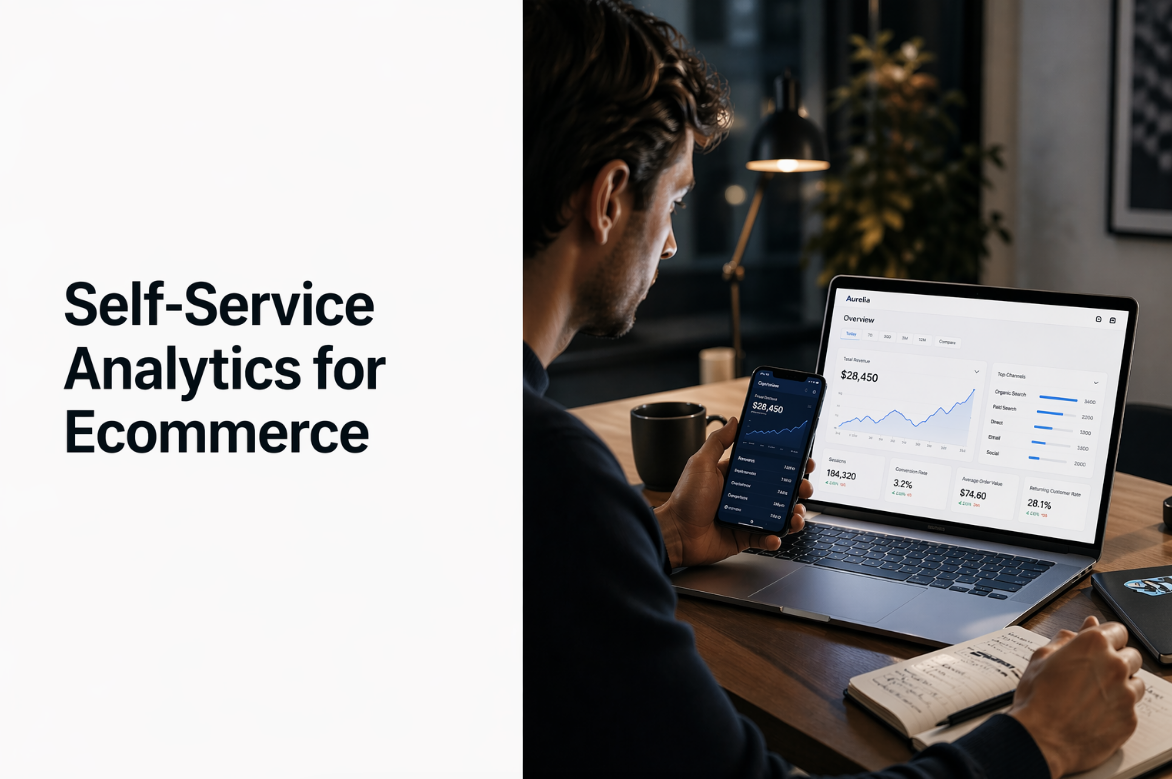
Ecommerce brands today operate in a real-time environment where every second directly impacts revenue, making instant access to actionable data not just important, but business-critical. From tracking campaign performance to optimizing product pricing and managing inventory, businesses need instant access to insights. However, many organizations still rely heavily on data teams for reporting, which creates delays and limits agility.
Self-service analytics is changing that by enabling teams across the organization to access and analyze data independently, removing bottlenecks and empowering faster, smarter decision-making without relying on IT.
When combined with a strong business intelligence (BI) framework, it becomes a powerful driver of growth, efficiency, and competitive advantage.
What is self-service analytics?
Think of self-service analytics as giving your team direct access to answers, instead of making them wait for someone else to find them. It’s a type of business intelligence that allows everyday users, like marketers, product managers, or operations teams, often called citizen analysts, to explore data, build reports, and uncover insights on their own, without relying on data analysts or engineers every time.
Instead of raising a request and waiting for a dashboard, you can simply open a tool, check real-time data, apply filters, and understand what’s happening, right when you need it. Whether it’s tracking campaign performance, analyzing sales trends, or spotting a drop in conversions, everything is available in just a few clicks.
What makes this powerful is how it changes the way teams work. Decisions become faster, more confident, and grounded in actual data rather than assumptions. Over time, it creates a culture where people don’t wait for insights but actively seek them out, making the entire organization more agile and truly data-driven.
What can users actually do with self service analytics?
With the right setup, self service analytics goes far beyond just “viewing dashboards.” It actually gives teams the ability to explore, question, and act on data in real time, without any technical dependency.
Here’s what that looks like in practice:
-
Access real-time, up-to-date data
No more relying on outdated reports. Users can see what’s happening right now, whether it’s live sales, campaign performance, or user activity.
-
Build reports using drag-and-drop reporting
Instead of requesting custom reports, users can create exactly what they need using simple drag-and-drop interfaces.
-
Customize dashboards based on what matters to them
A marketing manager and an operations lead don’t need the same view. Self-service analytics lets each team tailor dashboards to their specific goals and KPIs.
-
Perform ad-hoc analysis (ask questions on the fly)
Users can dig deeper into data instantly, filtering by time, geography, audience segment, or product category to uncover insights in seconds.
-
Drill down into granular insights
Start from a high-level metric (like total revenue) and quickly break it down into channels, campaigns, or individual products to understand why something is happening.
-
Compare performance across time periods or segments
Easily analyze trends, like week-over-week growth, campaign comparisons, or seasonal performance shifts, without needing separate reports.
-
Identify trends, patterns, and anomalies early
Spot sudden spikes, drops, or unusual behavior before they turn into bigger problems (or missed opportunities).
-
Collaborate and share insights across teams
Dashboards and reports can be shared easily, helping teams stay aligned and make decisions based on the same data.
And the best part? All of this can be done without writing code or using complex tools, which means more people can confidently use data in their day-to-day decisions, not just specialists.
The Real Problem: Why Traditional Data Setups Break in Ecommerce
Let’s break this down in a way that actually reflects what’s happening inside most ecommerce businesses.
Your data is everywhere. Your ads run on one platform, your customer data sits in a CRM, website behavior is tracked elsewhere, and inventory lives in a completely different system. None of these tools naturally “talk” to each other in a way that gives you a clear, unified picture.
So what happens next?
You rely on analysts to pull everything together. They extract data from multiple sources, clean it, combine it, and finally turn it into a report. And while that sounds fine in theory, in reality, it takes time. Sometimes hours, sometimes days.
And by the time that report lands in your inbox, things have already changed.
- Maybe a campaign that looked great yesterday is now underperforming.
- Maybe a product that was selling fast is suddenly slowing down.
- Maybe you’ve already spent more budget than you should have.
That’s the real issue. There’s a gap between what’s happening right now and when you actually find out about it.
And in ecommerce, that gap isn’t just inconvenient but expensive.
Because every delay means:
- Missed opportunities to scale what’s working
- Slower reactions to what’s not
- Decisions based on outdated information
In a space where everything moves fast, relying on static, delayed reports just doesn’t keep up anymore. This is why many brands are now looking for ecommerce reporting without analyst dependency, so they can move faster without waiting.
What Changes with Self Service Analytics?
The biggest shift is simple, but powerful: you move from a “request-and-wait” model to a “see-and-act” model. With a self-service dashboard ecommerce setup, teams don’t just view data—they interact with it in real time and take action instantly
Earlier, getting answers looked like this:
You ask → the data team pulls data → builds a report → sends it → then you act
Now, it looks like this:
You check → you understand → you act (instantly)
What really changes isn’t just speed but how decisions are made. You’re no longer reacting to what already happened. You’re responding to what’s happening right now.
- A campaign underperforming? You pause it immediately.
- A product suddenly trending? You push it harder.
- A drop in conversions? You investigate and fix it before it impacts revenue further.
The delay between insight and action is reduced to near zero. And that’s where the real impact shows up:
- Marketing ROI improves because budgets are adjusted in real time, not after the damage is done
- Inventory efficiency increases because demand patterns are visible as they happen
- Conversion rates grow because issues are identified and resolved faster
In short, self service analytics doesn’t just give you data faster but helps you act faster, smarter, and with more confidence, which is exactly what ecommerce demands.
The Hidden Hero: Business Intelligence (BI)
Here’s an important clarification: self service analytics isn’t a magic solution on its own. It only works when there’s a strong business intelligence (BI) foundation behind it. Without BI, giving everyone access to data can actually create more confusion than clarity. But when done right, self-service BI quietly powers everything, making sure the data people see is accurate, consistent, and actually useful for decision-making.
1. It Cleans the Chaos
In most ecommerce businesses, data is scattered across multiple platforms, ads, website analytics, CRM systems, logistics tools, and more. Each tool captures a different piece of the story, but none of them gives you the full picture on their own.
This is where BI steps in. It brings all that fragmented data together into one centralized system, cleans it, and organizes it in a way that actually makes sense. So instead of jumping between tools and spreadsheets, teams get a single, unified view of the business.
2. It Standardizes Metrics
One of the biggest hidden problems in growing teams is inconsistency in how metrics are defined. Marketing might calculate revenue one way, finance another, and operations something else entirely.
BI solves this by creating standardized definitions for key metrics like revenue, conversion rate, and customer lifetime value. That means everyone, from marketing to leadership, is looking at the same numbers, calculated in the same way. This alignment is critical for making confident, organization-wide decisions.
3. It Prevents “Bad Decisions at Scale.”
Here’s the risk with self service analytics: if you give everyone access to unstructured or inconsistent data, you’re not just enabling decisions but enabling wrong decisions, faster.
BI acts as a safeguard. It ensures the data being accessed is accurate, validated, and governed. So as access to data scales across teams, what you’re actually scaling is clarity and accuracy, not confusion.
The Real Benefits of Self-Service Analytics
Self service analytics isn’t just about “access to data”; that’s the surface-level benefit. The real value lies in how it changes the speed, quality, and confidence of decision-making across your entire ecommerce business. This is where analytics without IT truly shines; teams no longer depend on technical experts and can drive decisions through business user analytics.
-
Faster Decisions, Better Outcomes
One of the biggest advantages of self-service analytics is speed. When teams don’t have to wait for reports, they can act instantly, whether it’s optimizing a campaign, fixing a drop in conversions, or adjusting inventory. In ecommerce, where timing is critical, faster decisions often lead directly to better results.
-
Higher Marketing ROI
With real-time access to performance data, marketing teams can make smarter budget decisions on the go. They can quickly identify what’s working, pause underperforming campaigns, and double down on high-performing ones. This reduces wasted spend and improves overall return on investment.
-
Stronger Ownership Across Teams
When data is easily accessible, teams no longer rely on others to make decisions. Marketing, operations, and product teams start owning their numbers and outcomes. This shift creates a more accountable, data-driven culture across the organization.
-
Reduced Bottlenecks for Data Teams
Self-service analytics frees up data teams from handling repetitive reporting requests. Instead, they can focus on more strategic work like forecasting, advanced analytics, and building better data systems, adding more value to the business.
-
Better Visibility Across the Business
Everyone in the organization gets a clear, real-time view of performance. This reduces miscommunication and ensures that all teams are aligned and working with the same data, leading to more cohesive decision-making.
-
Smarter, More Confident Decisions
When data is readily available and easy to understand, teams make decisions with greater confidence. Instead of relying on assumptions or gut feeling, they act based on actual insights, which leads to more consistent and reliable outcomes.
-
Scalable Growth Without Confusion
As ecommerce businesses grow, data becomes more complex. Self service analytics ensures that this growth doesn’t lead to chaos. Instead, it creates a structured system where insights scale smoothly across teams, keeping decision-making clear and efficient.
Why ProactiveAI is Built for Modern Self Service Analytics?
Most self-service analytics tools still rely on dashboards that require manual exploration. You log in, explore, filter, and try to find answers yourself. While that’s a step forward from traditional BI, it still requires time, effort, and a certain level of data understanding.
ProactiveAI takes this a step further by rethinking how users interact with data altogether. Platforms like ProactiveAI are also enabling embedded analytics self-service, where insights are integrated directly into workflows instead of living in separate dashboards.
-
From Dashboards to Conversations
Instead of navigating multiple dashboards, users can simply ask questions in plain English and get instant answers.
Users get direct answers without manual analysis.
Whether it’s:
- “What’s driving today’s revenue?”
- “Which campaign is underperforming?”
- “Why did conversions drop this week?”
The platform responds with clear insights and visualizations, making analytics feel less like a task and more like a conversation.
-
Built for Real Ecommerce Use Cases
Unlike generic BI tools, ProactiveAI is designed with ecommerce in mind.
It connects different parts of your business, marketing, sales, customer data, and operations, so teams can:
- Track performance in real time
- Understand customer behavior
- Measure ROI across channels
- Make faster, data-backed decisions
All without needing a complex setup or technical expertise.
-
From Reactive to Proactive Insights
Most tools wait for you to ask questions.
ProactiveAI doesn’t.
It continuously monitors your data and surfaces insights automatically, highlighting trends, anomalies, and opportunities before you even go looking for them.
This means teams don’t just react to data but stay ahead of it.
If self-service analytics is about giving users access to data, platforms like ProactiveAI are about making that access effortless and intelligent.
Conclusion
Self-service analytics is no longer just a “nice-to-have” for ecommerce brands but is becoming essential. In a space where decisions need to be made in real time, relying on delayed reports and constant back-and-forth with data teams simply doesn’t work anymore.
But the real takeaway is this: self-service analytics isn’t just about access to data but about how easily and quickly teams can turn that data into action. When backed by a strong business intelligence foundation and the right tools, it empowers every team to move faster, think smarter, and make decisions with confidence.
As analytics continues to evolve, the focus is shifting from dashboards to more intuitive, proactive ways of interacting with data. And the brands that adapt to this shift won’t just keep up, they’ll lead.
Because in the end, it’s not about who has the most data.
It’s about who can use it, understand it, and act on it faster than everyone else.
You might also like
Handpicked articles for your reading list.

Get the latest insights on Conversational AI
Stay ahead of the curve with weekly updates on data analytics, AI trends, and eCommerce growth strategies delivered straight to your inbox.
Join 5,000+ industry leaders. Zero spam, just pure insights.