
 SparxIT
 SPXCommerce
 What's Your A


eCommerce
Marketing
What is Last-Click Attribution? Pros, Cons & Smarter Alternative
-
Vikash Sharma
- Apr 27, 2026
- 8 mins read

Your paid search advertisement is a conversion machine. But what about organic social, blog content, and retargeting ads that influenced the customer earlier? They are receiving no credit. That’s the last-click attribution problem quietly distorting your marketing performance.
Last-click attribution is a common starting point because it’s simple: the final touchpoint gets full credit. It has been a default of Google Analytics over the years. It can be easily described in a board meeting, optimized around, and often over-relied upon.
It is not the issue that the last-click attribution is incorrect, but rather, it is incomplete. In a world where the B2B purchasing process involves 6–10 touchpoints on average, and consumers browse products across multiple channels before buying, journeys are increasingly complex.
An incomplete view of this process can lead to hundreds of thousands of dollars in misallocated marketing budget.
In this guide, we will demystify the last-click attribution model, examine its strengths and weaknesses, compare it with other models such as data-driven and multi-touch attribution, and show you when to apply it and when to outgrow it.
What Is Last-Click Attribution?
The last-click attribution model is a marketing measurement system in which all credit is attributed to the last touchpoint a customer had before converting. This conversion can include a purchase, a form submission, a demo request, or a sign-up.
Think of it as a race where only the final runner gets the gold medal. The anchor leg is important, of course. However, it would not be there without the other legs preceding it.
Practically, when a customer first discovers your brand through an organic blog post, then engages with a LinkedIn ad three days later. They ultimately convert via a Google Search ad, and the last-click attribution model assigns 100% of the conversion credit to that final touchpoint. Nothing is given to the blog post and LinkedIn ad.
How the Last-Click Attribution Model Works?
Understanding how the model works reveals both its strengths and limitations. The following is an example of a customer journey and the way last-click attribution makes sense of it:
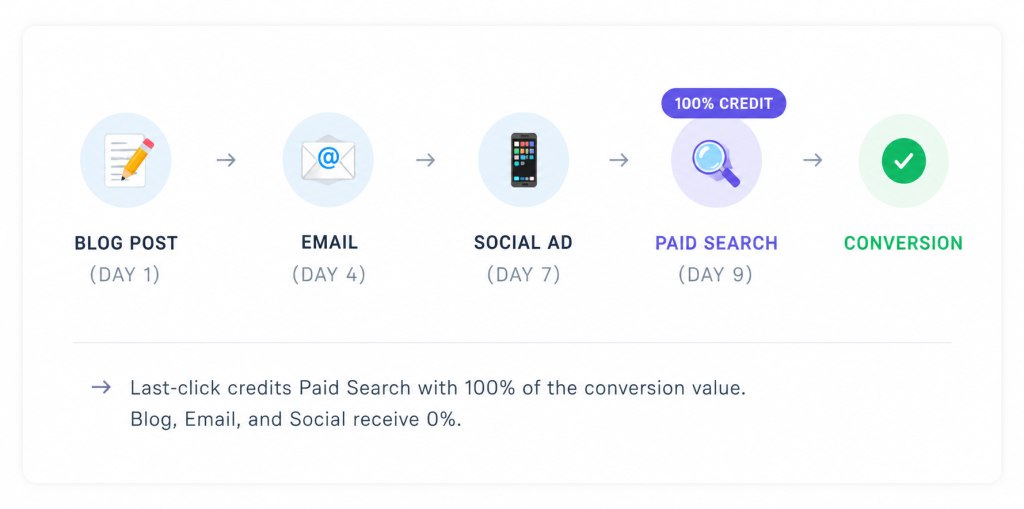
The model is intentionally not very complicated. It does not need any statistical modeling, machine learning, or sophisticated data pipelines. All analytics systems, such as Google Analytics and HubSpot, have it built in, which is why many teams default to it..
Where Last-Click Applies by Default
- Google Analytics 4 (default is last non-direct click)
- Google Ads conversion tracking (last-click).
- The majority of the simplest CRM conversion reports.
- Facebook Ads Manager (last touch during the attribution window)
- Simple email platform conversion reporting.
Advantages and Disadvantages of Last-Click Attribution
The last-click attribution model has deserved its status as the industry default on real grounds – and has deserved real criticism on real grounds. This is a straightforward evaluation:
| Pros | Cons |
| Easy to use, available as a default feature in most analytics tools | Disregards all awareness and consideration touchpoints |
| Simple to communicate with stakeholders and non-technical teams | Underestimates top-of-funnel channels like SEO, social, and display |
| Clearly identifies the channel that closed the deal | Overvalues bottom-of-funnel channels like branded search and direct traffic |
| Works well for short customer journeys | Leads to reduced budgets for demand-generating channels |
| Requires no additional data infrastructure or complex modeling | Breaks down for long, complex B2B or considered purchase journeys |
| Provides a clear “winner” for budget allocation | Does not track cross-device or offline interactions |
| Strong starting point for teams new to attribution | Distorts ROAS measurement on paid marketing channels |
First Click vs last-click Attribution: What is the difference?
When a channel that closed the deal is credited under last-click attribution, first-click attribution works in reverse: the channel with the first touchpoint in the customer journey receives 100% of the conversion credit. Both are single-touch models, and both have the same basic weakness, namely, they do not recognize anything between.
| Dimension | First Click Attribution | last-click Attribution |
| Credit Assignment | 100% credit to the first touchpoint | 100% credit to the final touchpoint |
| Primary Use Case | Identifying discovery and awareness channels | Identifying closing and conversion channels |
| Best For | Brand awareness and top-of-funnel campaign analysis | Direct response and bottom-funnel performance analysis |
| Overvalues | Awareness channels (organic, display, social) | Closing channels (branded search, retargeting) |
| Undervalues | Closing channels | Mid and top-funnel channels |
| Middle-Funnel Credit | None | None |
| Complexity | Simple | Simple |
| Recommended Stage | Early funnel optimization | Conversion rate optimization |
Attribution Model Alternatives to Last-Click
The marketing measurement scene has transformed significantly beyond single-touch models. These are the main options and how they are different:
Linear Attribution
Distributes credit across all touchpoints in the journey. Simple multi-touch. An excellent starting point when teams move beyond single-touch models.
Time-Decay Attribution
Gives more credit to touchpoints closer to conversion, with earlier interactions receiving less credit. Is aware of recency, however, biases closing channels.
Position-Based (U-Shaped)
Allows 40% credit to the initial touch, 40% to the final touch, and divides the remaining 20 percent among intermediate touches. Discovery vs. conversion signals.
Data-Driven Attribution
Applying machine learning to examine the real conversion routes and giving credit according to the actual statistical contribution of each channel. The most precise model – and the most data-hungry.
W-Shaped Attribution
B2B variant that attributes first touch, lead creation, and opportunity creation, 30/30/30, with 10/10/10 allocated to other interactions.
The Marketing Mix Modeling (MMM)
Statistical regression methodology that quantifies the general effect of the marketing channels on revenue, even offline channels. Needs a volume of historical data.
Data-Driven Attribution vs last-click: Which Is More Accurate?
It is among the most critical comparisons in modern marketing analytics, and the answer does not lie in the statement that data-driven is always better. It is more subtle than that.
DDA is a machine-learning-based method for analyzing thousands of conversion paths and calculating the true statistical contribution of each touchpoint.
The version offered by Google, found in Google Analytics 4 and Google Ads, is the Shapley value, a game-theoretic approach that fairly assigns credit to each channel based on its marginal contribution to conversions.
| Factor | Last-Click Attribution | Data-Driven Attribution |
| Accuracy | Moderate | High |
| Setup Complexity | Very Low | Moderate |
| Data Volume Required | Any volume | Typically 3,000+ conversions per month |
| Top-Funnel Credit | None | Included |
| Cross-Channel Clarity | Low | High |
| Explainability | Very High | Moderate |
| Privacy Resilience | Moderate | Model-dependent |
| Best For | Simple journeys and early-stage teams | Complex, multi-channel programs at scale |
How to Use Non-Last-Click Attribution Effectively
Going beyond the last-click attribution isn’t merely a tool setting, but it demands a change in the way your team views marketing performance. This is how non-last-click attribution can be applied:
Audit your current attribution setup
Determine all places of conversion reports and the model used. Many teams operate on last-click attribution in Google Ads, the last-touch in CRM, and others in email, creating conflicting performance perspectives across the channels.
Map your actual customer journey length
Last-click is justified when your average customer makes a purchase on their first visit. Multi-touch attribution is essential for accurate measurement when typical journeys span sessions across days or weeks.
Choose a model appropriate to your data volume.
For fewer than 1,000 monthly conversions, start with position-based or time-decay. Test data-driven attribution, 3,000+ conversions each month. With offline channel spend and 50,000+, look at Marketing Mix Modeling.
Run parallel reporting during the transition
Don’t switch away from last-click overnight. Test the new model for 60-90 days with last-click. Determine which channels earn credit and which do not, and act on these results by providing evidence-based budget changes.
Align attribution models with business objectives
If the objective is demand generation, emphasize first-touch. If it is revenue optimization, give it a weight toward conversion-proximate touches. When both are important, consider a full-path model or unified attribution view of ProactiveAI.
Last-Click Marketing Attribution Software: What to Look For
The model is just one dimension when it comes to assessing last-click marketing attribution software or any attribution platform. The following is what really differentiates mediocre tools and high-value attribution platforms:
- Multi-model support: Support last- click, first-click, linear, time-decay, position-based, and data-driven models in the same location and compare them.
- Cross-channel data integration: Native integrations with Google Ads, Meta, LinkedIn, email, CRM, and offline data.
- Adjustable attribution windows: 7-day, 30-day, and custom lookback windows to fit your actual buying cycle.
- Path visualization: Visualization of typical conversion paths such that you can view the entire route, not only the destinations.
- Real-time reporting: Dashboard updates that do not need overnight data processing.
- AI-driven insights: Automated anomaly detection, channel recommendation, and budget optimization suggestions.
- Privacy compliance: First-party data architecture, server-side tracking, and preparedness for cookieless measurement.
Best Practices for Attribution Modeling
Attribution modeling is not about finding a perfect source of truth, but about understanding how different models distribute credit across touchpoints. Since each model carries inherent bias, performance interpretation should always be contextual rather than absolute.
Do not apply any one attribution model separately
Test at least two models at the same time, last-click and a multi-touch model, to understand where credit allocation goes astray. The discrepancy between models indicates where bias resides.
Select your model and match it to the funnel length
Last-click can withstand short e-commerce funnels (same-session purchase). Multi-touch or algorithmic attribution is required in complex B2B or considered-purchase funnels that involve journeys over several weeks.
Incorporate offline touchpoints wherever feasible
In businesses with elements of sales calls, events, and in-store visits along the journey, attribution that ignores offline channels is conceptually incomplete, no matter which model you use.
Define the conversion logic based on your definition of conversion
Attribution is meaningful only when the conversion event it measures provides real business value, not a click or a page visit.
Train your stakeholders about the limitations of attribution
There is no ideal model. A better way to help the leadership make trade-off decisions is to avoid overreacting to information from a single model and to make more nuanced choices.
How to Choose the Right Attribution Model?
| Business Situation | Recommended Model | Reason |
| Single-session e-commerce purchases | Last-click or last non-direct click | A short customer journey makes the final interaction a reliable indicator |
| Considered purchase (7–30 day cycle) | Time-decay or position-based | Multiple touchpoints where timing and entry point both influence decisions |
| B2B SaaS (30–90 day sales cycle) | W-shaped or data-driven | Long journeys with multiple stakeholders and channels |
| Brand awareness campaign measurement | First-click or linear | Ensures visibility into top-of-funnel contributions |
| High-volume DTC (3,000+ conversions/month) | Data-driven attribution (DDA) | Sufficient data available to train accurate machine learning models |
| Multi-channel and offline touchpoints | Marketing Mix Modeling + ProactiveAI | Requires a holistic view across both online and offline interactions |
Conclusion
Last-click attribution has earned its status as the default reasonably enough, and it’s obvious, immediate, and it’s simple, immediate, and widely used. It is an ideal starting point for businesses with simpler, brief customer journeys and less analytics.
However, given the size of your marketing program, the increasingly complicated customer paths, and budget decisions made based on more than a gut sense of which channel is apparently performing, last-click attribution is a limitation, not a solution.
It systematically undervalues the input of those channels that generate demand, and over-rewards the channels that only reap it.
The solution is not to abandon last-click entirely. It is to overlay smarter models on top of it, multi-touch, position-based, time-decay, or data-driven, and to work with a platform that provides the whole picture of how each marketing touchpoint drives revenue to your team.
ProactiveAI is designed precisely to provide AI-based attribution intelligence that transcends any single model, integrates with your entire marketing stack, and delivers insights that actually drive budget decisions and improve conversion rates.
Frequently Asked Questions
What is last-click attribution?
Last-click attribution is a model in which all credit for a conversion is given to the last interaction before the desired action, and all preceding marketing touchpoints that could have influenced the decision are not counted.
How is using non-last-click attribution different?
Non-last-click attribution allocates credit to numerous customer journey touchpoints, emphasizing the importance of the awareness and consideration pathways, and offers a more precise, balanced perspective on marketing effectiveness throughout funnel stages.
Which reports show first-click attribution value for channels and campaigns?
You can use a first-click model in reports, such as attribution models or comparison tools in analytics platforms, to demonstrate the contribution of initial interactions to conversions, and to measure the contribution of top-of-funnel channels.
How is using non-last-click attribution different in practice?
In practice, non-last-click attribution reveals the impact of previous touchpoints, such as SEO or social, which often shifts credit toward bottom-funnel channels and leads to better-informed budget allocation throughout the entire customer experience.
How is using non-last-click attribution conversions useful?
It helps businesses understand the role of different channels in conversions at every stage, make better decisions, spend marketing wisely, and ensure that efforts in demand generation and demand capture are not undervalued.
How is using non-last-click attribution conversions measured?
Conversions are quantified by attributing proportional credit to each touchpoint using a selected model, e.g., linear or data-driven, enabling marketers to measure each touchpoint’s contribution to the overall result.
Is Google Analytics last-click attribution?
Google Analytics uses a default last non-direct click attribution model that ignores direct traffic when other channels were used, but allows users to switch to alternative attribution models in the tool.
You might also like
Handpicked articles for your reading list.

Get the latest insights on Conversational AI
Stay ahead of the curve with weekly updates on data analytics, AI trends, and eCommerce growth strategies delivered straight to your inbox.
Join 5,000+ industry leaders. Zero spam, just pure insights.