
 SparxIT
 SPXCommerce
 What's Your A

eCommerce
eCommerce
eCommerce Pricing Analytics: How Data Should Drive Your Pricing Strategy
-
Varun Kumar
- Aug 07, 2026
- 10 mins read
Many ecommerce businesses launch products with carefully planned pricing strategies, expecting sustainable revenue growth. However, sales performance often falls short of business expectations. You start monitoring your competitors and see they’re always getting more aggressive than you are, and they’re not that much more than just enough to get the click. Or even, you’re the lowest-priced, and you’re not converting, which means you’re losing margin for nothing.
That’s the common experience of most eCommerce operators. Prices are decided on instinct, from time to time taking a look at the competition, or perhaps because of cost-plus formulas that haven’t been modified in months. The market, on the other hand, evolve continuously.
Successful pricing strategies depend on data rather than assumptions. It’s moving from a guess-and-check to a real-time data-driven process for determining, monitoring, and modifying prices in ecommerce. With the right tools and data, the pricing decisions can be pulled with confidence.
In this blog, we’ll cover all this from scratch, to tools and techniques that make it a reality.
What Is eCommerce Pricing Analytics?
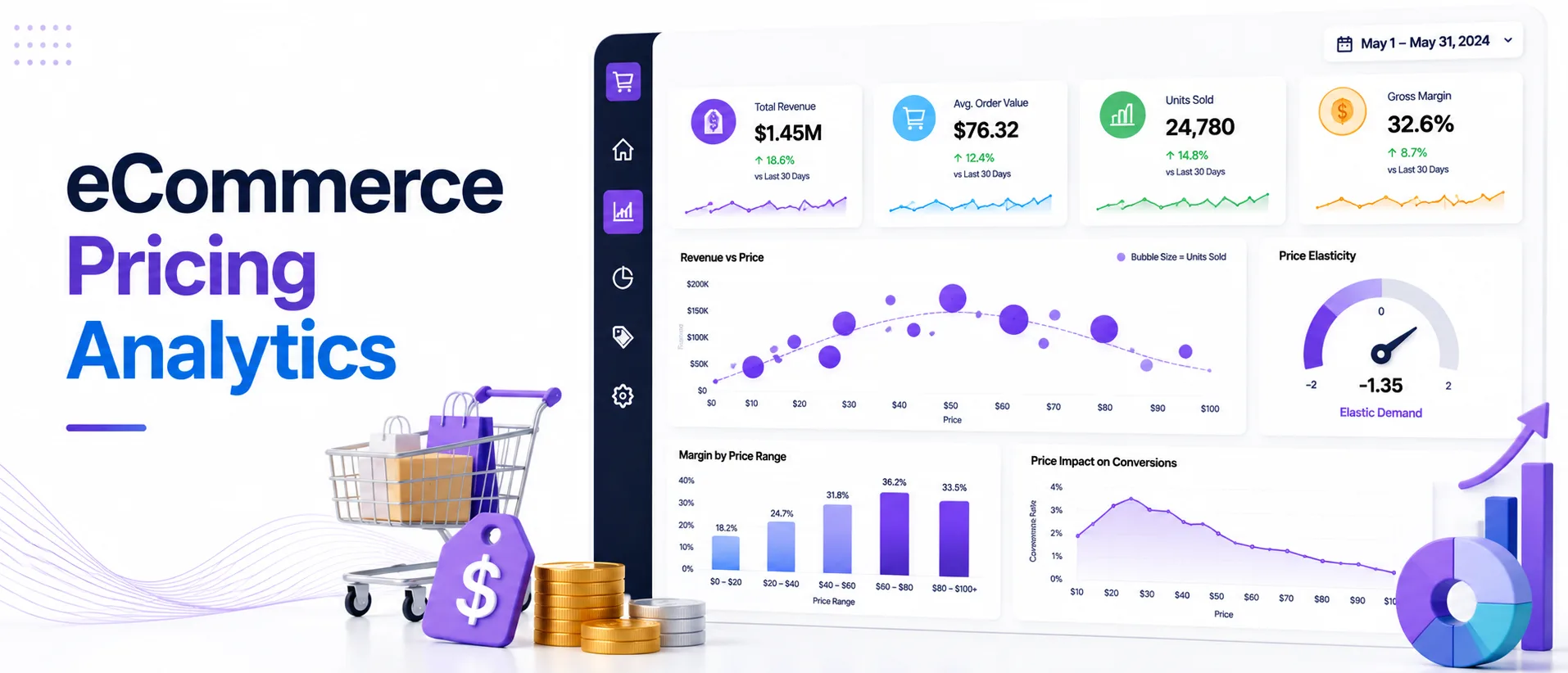
eCommerce pricing analytics is the process of gathering, analyzing, and using pricing data to inform pricing decisions across your product catalog, enabling you to make more intelligent and profitable decisions throughout your catalog. From the basics of comprehending the impact of price changes on customers (price elasticity) to the automation of price changes based on demand signals, competitor actions, or stock levels.
A 1% improvement in pricing can increase operating profits by an average of 8.7%, assuming sales volume remains stable. Yet many eCommerce brands still treat pricing as a fixed input rather than a strategic growth lever.
Pricing analytics transforms this approach into a data-driven decision-making process. It provides visibility into pricing consistency across all channels, the comparative market price, and the downstream impact on conversion, margin, and customer retention.
The cheapest or most expensive isn’t the only thing it’s about. It’s about being just right in a given situation and what “right” is, in a given moment.
What Are the Core Components of a Pricing Analytics Stack?
There are multiple levels that make up a pricing analytics stack. They all exchange data and insights.
1. Data Collection Layer
This layer collects raw pricing data from internal operations, competitors, and broader market signals. The inputs are transaction data, competitor price feeds, stock levels, search demand signals, and customer behavior data (CTR, add-to-cart, purchase rates).
2. Data Processing and Normalization
Raw data is messy. This layer does its job of cleaning it, matching SKUs from sources, eliminating outlier SKUs, and organizing it for consistent analysis.
3. Analytics and Modeling Layer:
Strategic pricing analysis takes place within this layer. Price elasticity is calculated using statistical models, products are segmented by the margin tier, A/B test results are run, and patterns are surfaced over time, across geographies, or across a product’s customer segment.
4. Decision and Automation Layer
This means that analytical results are turned into pricing actions, which can be either recommendations you see on a dashboard or rules-based actions you have automated and are sent directly to your store or marketplace listings.
5. Reporting and feedback loop.
All changes in pricing create new information. A good stack does this, feeds it back into the models, and continually improves suggestions over time based on real results.
The continuous feedback loop improves pricing accuracy by learning from every pricing decision and customer response. The more accurate the data that goes in, the more accurate the pricing that comes out, and it will, over time, learn to price your catalog and customers.
What Is Dynamic Pricing in eCommerce and How Does It Work?
Dynamic pricing in eCommerce is the ability to adjust prices (either semi-automatically or automatically) in response to real-time signals, rather than setting them to a static price and leaving them there for an extended period.
This practice is long-running in the airline industry, and the price you see this morning may not match the price you’d see tonight. The same thinking has been applied to eCommerce, and tools have made it possible for even mid-market brands to get in on the action.
The typical precipitating factor of a dynamic price adjustment is:
- A competitor reduces their price for the same or a similar product.
- Low stock level on a desired item may be a stock-out problem
- Demand increase (seasonality, “trending moment”, popular social media posts)
- As input costs increase, the product margin is being squeezed.
- When conversion rate weakens at a certain price point, indicating resistance
Dynamic pricing focuses on maximizing profitability rather than continuously reducing prices. When done right, it also allows you to increase your prices when demand’s high and supply is low, thus securing margins you might otherwise have lost.
So, a consumer electronics store sees on Black Friday Eve that a particular model of laptop is all but sold out, and other stores have already posted “limited availability. Dynamic pricing logic would allow prices to increase slightly, helping maintain margins during peak demand.
Poorly managed price fluctuations can erode customer trust and negatively affect brand perception. When customers experience unexplainable price fluctuations, it can quickly lead to losing them. The most successful dynamic pricing models adjust pricing at the SKU and channel levels and are not easily discernible to individual customers but are noticeable at a macro level, spread across thousands of transactions.
How Does Gross Margin Connect to Your Pricing Tier Strategy?
Gross margin by price tier is one of the most overlooked metrics in pricing strategy analytics.
Patterns that flat margin analysis does not capture at all can be discerned by applying a segmentation process to your catalog and then calculating the actual gross margin for each segment or tier (budget, mid-market, premium).
For example, if returns and shipping are deducted from a budget-tier product, you may discover that the product actually has a negative gross margin. Or that those higher-margin items are not as often as your lower-margin ones, but they offer 3x that margin.
Here is a basic guideline for tier analysis of markup:
| Price Tier | Avg. Selling Price | COGS | Gross Margin % | Return Rate |
| Budget (<$30) | $22 | $18 | 18% | 14% |
| Mid-Market ($30–$100) | $65 | $42 | 35% | 8% |
| Premium (>$100) | $145 | $80 | 45% | 5% |
If you consider fulfillment, packaging, and support costs, the budget tier is probably eroding value, as you can see in that table. This is brought to light by pricing analytics, and you can then choose to increase pricing at that tier, eliminate low-margin SKUs, or shift marketing dollars to the profitable tiers.
Margin-aware pricing ensures promotional strategies protect profitability while driving sales. However, if the GM is 22% and you run a 20% price discount, you end up at break-even or worse. This is why it’s important to link pricing data to your margin data (not do it as a separate exercise).
What Role Does Competitor Price Monitoring Play?
Competitor price monitoring is the systematic process of collecting price data on competing products or services and applying it to your pricing strategy.
At its most basic level, competitor monitoring determines whether product pricing remains competitive. However, at a higher level, it can show competitor pricing trends, how far they cut prices, whether they are trialing price points before making a final decision, which products they seem to be favoring, and more.
It has the greatest impact on commodity or near-commodity categories such as electronics, consumables, apparel basics, where price is one of the three key considerations for buyers. The 8% higher price in those categories without a differentiation message will cost you the click.
Competitor monitoring also contributes to ecommerce price testing. If you see someone raise the price on the same product, and your sales velocity is unchanged (or higher), then it’s a natural experiment that you can move your price.
Per competitor, and per SKU, you should track:
- Trends in current and historical prices over time.
- Promotional frequency and depth are one of the key areas of focus.
- Whether they’re winning or losing on buy boxes in marketplace platforms
- A pricing opportunity for you when an event goes out of stock
For more than 50 SKUs, manual tracking becomes unmanageable in a spreadsheet. This is where competitor price monitoring software, such as ProactiveAI, becomes an absolute necessity, not a luxury.
What impact does AI and Self-Service Analytics have on Pricing Decisions?
The Traditional pricing analytics model required a data analyst, a SQL-based query database, and a few days’ turnaround time. The report was completed when the market had already turned.
Self-service analytics has made this possible. With modern eCommerce analytics platforms, merchandising and pricing teams can find their own answers without opening a ticket with the data team.
ProactiveAI takes this a step further. Its AI-powered conversational analytics interface allows users to pose simple questions in plain language, such as those below, and instantly receive a response, without having to learn SQL or create a report from scratch.
This is very important for price agility. At 9 am, a category manager can ask a question and have an answer at 9:02 am. Pricing decisions are done at the speed of the market, not the speed of the analytics backlog.
AI-powered pricing platforms provide predictive insights that extend beyond traditional reporting capabilities:
- Demand forecasting: Forecasting demand for products and pricing them accordingly by keeping them in stock
- Price elasticity modeling: It is a process that involves determining customers’ price elasticity at the SKU level.
- Cannibalization detection: Identifying when discounting one product suppresses sales of a higher-margin alternative
- Anomaly alerts: Alerts if there is an unexpected move outside of a product’s historical price, margin, or conversion range
AI-driven eCommerce sales forecasting is especially useful in this arena. A predictive analytics layer allows pricing teams to incorporate demand signals, seasonality, trend data, and past purchase behavior into pricing, providing a heads-up on what customers are looking for rather than just what they have already.
What Are the Best Tools for eCommerce Pricing Analytics?
The choice of the appropriate tool will be dictated by catalog size, technical resources, and the complexity of the price approach. Here are some comparisons between the great categories.
|
Tool Type |
Best For |
Examples |
| Competitor Monitoring | Tracking rival prices at scale | Price2Spy, Prisync, Wiser |
| Dynamic Repricing | Automated price adjustments | Feedvisor, Repricer.com |
| Full Analytics Platform | Strategy + monitoring + forecasting | ProactiveAI, Intelligence Node |
| BI / Self-Service | Custom reporting on pricing KPIs | Looker, Tableau |
| AI Pricing | ML-driven optimization | Revionics, Boomerang Commerce |
For teams seeking pricing intelligence seamlessly integrated into a comprehensive eCommerce analytics solution, ProactiveAI stands out as a notable player in this space. You don’t need two separate tools to run a repricing tool and a BI dashboard. Its ecommerce analytics dashboard puts pricing data, margin analysis, competitor monitoring, and demand forecasting all in one place, and on top of that, conversational AI so that non-technical users can access it without any trouble.
Key ProactiveAI features that relate to pricing:
- Competitor price feeds in real-time, and alerts automatically.
- Gross margin by product, category, and price segment
- The price elasticity figures indicate the EL estimates generated by the ML models.
- AI-driven Ecommerce Price Testing Workflows
- Demand forecasting systems that are connected with pricing recommendations.
- Natural language query interface (query using natural language and ask questions in plain English)
For brands using Shopify, WooCommerce, or major marketplaces, ProactiveAI integrates seamlessly with your transaction data and begins surfacing pricing insights without a months-long implementation delay.
What Are the Pricing Data Best Practices Every eCommerce Team Should Follow?
Smart pricing decisions are driven by reliable data and ongoing optimization. These best practices help eCommerce teams improve margins, respond to market changes, and create pricing strategies that support long-term growth.
1. Connect pricing to margin data from day one
Pricing decisions without margin context provide limited business value. All pricing decisions will be judged on the margin impact – both before and after.
2. Run ecommerce price testing systematically
A/B testing different price points, even small variations like $49 vs. $47 vs. $51, generates real elasticity data specific to your audience. Don’t rely on industry benchmarks alone.
3. Monitor competitors on a schedule, not just ad hoc
Set up automated alerts for top competitive SKUs at least once a day. Market conditions evolve rapidly, making manual spot-checking inconsistent and unreliable.
4. Segment your catalog by pricing sensitivity
Not all products are equal with respect to pricing consideration. Prioritize high-revenue, high-traffic SKUs for active optimization. Run long-tail products on rule-based repricing.
5. Keep pricing and inventory data in sync
“Stock out” should be written as “stockout.” Create alerts to link inventory levels with pricing policies.
6. Review pricing strategy quarterly, not annually
Markets change more rapidly than planning on an annual basis can accommodate. Review tier structures, margin targets, and competitive positioning on a quarterly basis.
7. Watch what customers tell you with behavior, not just surveys
Cart abandonment rates, product-level page exit rates, and add-to-cart/purchase ratios all indicate price resistance. Price according to behavioral data as much as competitive data does.
Conclusion
In today’s competitive online environment, eCommerce Pricing Analytics is no longer a luxury; it is essential for achieving sustainable profit growth. Businesses can use assumption-based pricing with real-time data to make more informed pricing decisions and boost revenue and margins.
With competitor monitoring, demand forecasting, margin analysis, and AI-powered insights, brands can adapt quickly to market shifts without compromising customer trust. Every pricing adjustment is supported by data rather than assumptions, improving consistency and business outcomes..
In conclusion, eCommerce Pricing Analytics empowers businesses to fine-tune their pricing strategies, ensure profitability, and gain a competitive edge. But by using the right tools and a constant data-driven strategy, pricing strategies can be a competitive advantage that will help achieve your eCommerce success over the long run.
Frequently Asked Questions
What is eCommerce pricing analytics?
eCommerce pricing analytics involves using data to understand, track, and fine-tune pricing strategies for products on various digital platforms. It includes a discussion of competitive benchmarking, measuring price elasticity, margin analysis, and dynamic pricing, which can help businesses set prices that reflect the true market signals and can maximize revenue and profitability.
How do you measure price elasticity for your product catalog?
Price elasticity is determined by observing the change in sales volume for your SKUs when you change their price. For a more accurate approximation of the elasticity of your customers and catalog, you can use controlled price tests to make a price change on a product, then examine the conversion and volume data that ensues.
What data do you need to implement dynamic pricing?
To implement dynamic pricing effectively, you need real-time competitor price feeds, along with your own sales velocity and inventory, historical demand trends, and your customers’ price point conversion data. With all of these inputs combined on one platform, automated pricing rules can adjust to market changes in minutes rather than days.
How does pricing affect gross margin and customer retention simultaneously?
Over-discounting can drive short-term conversions but negatively impact gross margin and brand value, resulting in long-term loss of retention. Pricing Analytics ensures you hit the sweet spot. Do you have targeted promotions for at-risk segments, or is there a risk of losing margin in other segments that are primarily price-sensitive yet remain loyal customers with high LTVs?
Can AI analytics tools recommend optimal pricing for eCommerce products?
Yes. Tools such as ProactiveAI use AI to recommend price points based on your goals (e.g., margin, conversion, or revenue) and other factors, including demand signals, price elasticity, competitor pricing, and historical performance. These suggestions are continually updated depending on market conditions, eliminating the manual work of pricing optimization.
You might also like
Handpicked articles for your reading list.


Get the latest insights on Conversational AI
Stay ahead of the curve with weekly updates on data analytics, AI trends, and eCommerce growth strategies delivered straight to your inbox.
Join 5,000+ industry leaders. Zero spam, just pure insights.