
 SparxIT
 SPXCommerce
 What's Your A

eCommerce
AI & Analytics
What is Predictive Analytics? How It Works, Benefits, and Applications
-
Diksha Singh
- Jul 21, 2026
- 10 mins read
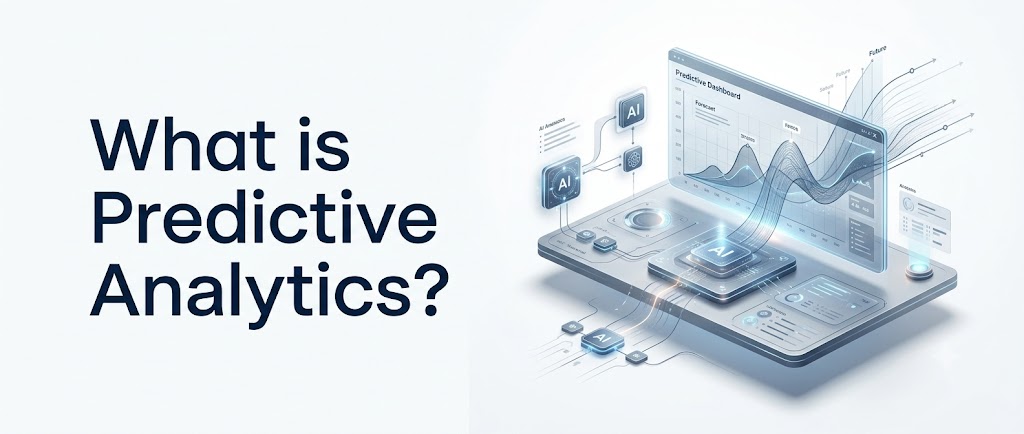
Most business decisions are still based on hunch and on the spreadsheet from last quarter. Business leaders need answers to critical questions, such as whether sales will decline next month or which customers are most likely to churn. Who are your next churners? Historical reports alone cannot provide the forward-looking insights organizations need to make proactive decisions. It’s the difference between “What happened” and “What is likely to happen” that businesses lose when their competitors get the idea first.
Predictive Analytics fills in that gap. It’s powered by historical data, statistical models, and machine learning to help organizations make decisions ahead of a problem, not after. The outcome: fewer unexpected expenses, more efficient resource use, and data-driven decision-making. Platforms such as ProactiveAI go further by putting the power of AI predictive analytics in conversation and at the fingertips of teams rather than requiring a data science department to get answers.
What is Predictive Analytics?
Predictive analytics is an area of advanced analytics that involves analyzing past data, applying machine learning algorithms, and leveraging statistical methods to predict future outcomes. It gives answers – but not definite answers; it gives probabilistic answers that allow for a data-informed perspective on what is likely to occur and why.
The basic explanation for predictive analytics is identifying patterns and forecasting the future to make better choices.
The global predictive analytics market is expected to increase from $18.9 billion in 2024 to $82.3 billion by 2030 at 28.3% CAGR. This growth reflects the increasing adoption of predictive analytics as a strategic capability across modern enterprises.
At the core of this growth is big data predictive analytics. Organizations collect more data than ever, and they’re getting data from transactions, customer interactions, IoT sensors, and web interactions. The ability to make sense of the data for forward-looking signals is a critical part of how market leaders outperform followers.
How Does Predictive Analytics Work?
Think of it like a weather forecast for your business. Instead of guessing, meteorologists put decades of information about the atmosphere into models that recognize patterns and generate probabilities. Predictive data analytics is similar, except it is used for business outcomes.
These are the stages of the typical process:
1. Data Collection
Data is sourced from various platforms such as CRM systems, sales data, website interactions, social media, third-party databases, and operational logs. The broader and higher-quality the dataset, the more reliable the predictions.
2. Data Preparation
Raw data typically requires preparation before it can be used for predictive modeling. This stage entails error correction, treatment of missing values, elimination of duplicate data, and variable transformation for algorithms to process. This is also where feature engineering (new variables from existing variables with meaningful implications) often occurs.
3. Model Selection
There are various types of problems that require various kinds of models. A churn prediction problem calls for a classification model. Time-series analysis can be applied in sales forecasting. Model selection depends on the type of data, the question being asked, and the required accuracy.
4. Model Training
Historical data is used to train the selected model. It learns patterns, correlations, and relationships, such as customers who haven’t opened an email in 90 days but have had a recent support ticket are 4x more likely to cancel.
5. Model Validation
The model is tested before deployment on data that it has not seen. Metrics such as accuracy, precision, recall, and RMSE provide an idea of how true your predictions are. A model that looks good during training but is not doing well on test data is overfitting, and it needs adjusting.
6. Deployment
The validated model is put into place within business workflows, such as a CRM dashboard, an inventory management system, or a marketing automation platform. At this stage, predictive insights begin supporting real-time business decisions.
7. Monitoring and Retraining
Business conditions change. If a model is not updated with the new data, it will drift from the pre-pandemic data. Predictions are carried out on a regular basis and monitored over time to ensure accuracy.
What Are the Main Predictive Analytics Models?
Different predictive analytics models address different business challenges. Here are the distinctions of the common ones:
| Model Type | Best For | Example Use Case |
| Regression Analysis | Forecasting numeric outcomes | Predicting monthly revenue |
| Decision Trees | Classification and branching logic | Loan default prediction |
| Neural Networks | Complex, non-linear patterns | Customer sentiment analysis |
| Time Series Analysis | Sequential data over time | Demand forecasting, stock trends |
| Random Forest | High-accuracy classification | Fraud detection |
| Logistic Regression | Binary outcomes | Will a customer churn? Yes/No |
| Clustering | Segmentation before prediction | Customer grouping for targeted campaigns |
In practice, many predictive analytics solutions utilize multiple of these. Time-series analysis could be applied for demand forecasting, clustering could be applied for customer segmentation, and logistic regression could be applied to forecast the probability of purchase by segment.
What Are the Most Used Predictive Analytics Tools?
The software you’ll choose for predictive analytics will depend on the technical sophistication of your team, data infrastructure, and the speed at which you need insights.
Enterprise Platforms
- IBM Watson Studio: Interactive, complete predictive analytics platform that includes AutoML.
- SAS Advanced Analytics: Long-standing enterprise standard for statistical modeling.
- Microsoft Azure Machine Learning: Predictive modeling with deep integration into the Microsoft ecosystem, at the cloud-native level.
- Google Cloud AI Platform: Reliable for existing GCP teams, scalable and model-agnostic
Mid-Market & Self-Service Tools
- Tableau with Einstein Discovery: AI-powered predictions that can be plugged into existing dashboards and let users explore the future in addition to past data.
- DataRobot: Automated ML (AutoML) platform that makes predictive modeling easier and less dependent on in-depth data science knowledge.
- RapidMiner: Visual workflow builder for predictive analytics, machine learning, and data preparation without much coding.
- ProactiveAI: AI-driven analytics platform that fuses conversational insights with predictive analytics, giving business users the ability to get forecasts and automated reports without needing SQL skills.
Key Applications Where Predictive Analytics Is Used?
Predictive analytics is widely used across industries to forecast trends, identify patterns, and support data-driven decision-making. Its applications help organizations improve efficiency, reduce risks, and deliver better outcomes by using historical and real-time data insights.
1. What is Predictive Analytics in Marketing?
Predictive analytics for marketing can help teams end the guessing game about who to target and when. Predictive models analyze past campaign performance, purchase history, and behavioral data to assign a score to leads based on how likely they are to convert, pinpoint customers who are likely to drop out, and suggest the best time to make an offer.
A retailer with predictive customer analytics may discover that those who buy a product in category A within 30 days of signing up have a 68% chance of becoming customers with a high LTV, which means a specific onboarding sequence is triggered automatically.
2. What is Predictive Analytics and How do they use it in the Supply Chain?
The problem of over-stocking or under-stocking at the wrong time is one of the oldest and most expensive problems in operations and one that predictive analytics in supply chain management is trying to solve.
These AI sales forecasting models consider seasonality, promotional calendars, economic indicators, and supplier lead times to ensure products are optimally stocked in distribution channels. This translates to reduced stockouts, reduced dead stock, and reduced carrying costs all at once.
3. How Is Predictive Analytics Used in Retail?
Retail predictive analytics covers a range of applications, from demand forecasting and price optimization to customer segmentation and loss prevention. Retailers can leverage it to forecast products that will be in higher demand before they actually are, for dynamic pricing based on forecasted demand curves, and for real-time identification of suspicious transactions.
4. What is the significance of Predictive Analytics in Healthcare?
In healthcare, predictive models can be used to analyze patient data and identify individuals who are at risk for developing certain conditions, such as sepsis, readmission, or diabetes, even before they have any symptoms. It’s deployed in hospitals to ensure staffing is right, predict equipment maintenance needs, and minimize redundant admissions.
5. What is it used for in finance?
Predictive analytics runs a number of processes such as credit scoring, fraud detection, and risk management. A bank’s fraud model is trained with hundreds of attributes associated with transactions, then in mere milliseconds, it assigns a risk score, flagging abnormal activity before it processes. Revenue forecasting supports CFOs in creating a more reliable financial forecast.
6. How can predictive analytics be used in manufacturing?
One of the most obvious ROI scenarios for predictive maintenance is using sensor data from machines to anticipate failure windows, enabling maintenance when the line is expected to be down. The resulting savings are significant: some manufacturers estimate that maintenance costs can be reduced by as much as 25-30%.
What Are the Benefits of Predictive Analytics?
Moving from descriptive intelligence to predictive intelligence means that things become possible in an organization:
1. Better Decisions, Faster
Rather than going through what has transpired in the quarter, teams preview what may happen next week and take action. Inventory can be pre-ordered using procurement. Marketing can turn off a campaign that is expected to fail.
2. Reduced Risk
Predictive analytics can reveal risk before it turns into loss in the following ways: Fraud detection, credit risk assessment, and supply chain disruption modeling.
3. Revenue Growth
When it comes to sales, predictive analytics can prioritize potential sales opportunities and deliver the most likely deals to revenue teams, uncover upsell opportunities in existing customers, and minimize churn before it occurs.
4. Operational Efficiency
By forecasting equipment failures, demand surges, and labor requirements, you can prevent reacting to events. Fewer emergencies, more resource usage.
5. Competitive Differentiation
Firms that take proactive steps instead of reactive action based on the past are clearly ahead of the curve. The benefit builds up as time passes.
Predictive Analytics vs. Prescriptive Analytics: What’s the Difference?
These terms are mixed up, but they address different questions.
Predictive Analytics Questions: What will most likely happen? Prescriptive analytics is the question, “So what should we do, given what is more likely to happen?
Predictive analytics provides organizations with forecasts, while prescriptive analytics recommends the best course of action. Prescriptive analytics feeds that prediction into optimization logic to suggest a specific treatment: “churn risk is high for this segment” becomes “send this treatment to this segment at this time.
As organizations become more data mature, most begin with predictive and progress to prescriptive. Self-service analytics tools such as ProactiveAI are built to help shorten that path by enabling both layers to be available to non-tech users.
How to Choose the Right Predictive Analytics Solution?
There are several things that are frequently not considered in vendor demos that dictate the right predictive analytics platform:
1. Data Readiness
Evaluate the quality, completeness, and accessibility of your existing data. In some platforms, you’ll need a lot of data engineering before the first model runs. Other solutions, such as ProactiveAI, are built to integrate with existing data sources and begin creating insights rapidly.
2. Team Technical Depth
A data science platform will not be utilized by a marketing team. Seek solutions to match your team’s current capacity, not potential capacity.
3. Time to Value
Enterprise platform implementations may take 6-12 months. In an emergency, that time frame is important if you need something. The time required for a cloud-based predictive analytics solution to get a pilot up and running can be as short as weeks.
4. Integration Requirements
Will predictions surface in your CRM? Your ERP? An existing ecommerce analytics dashboard? The degree of integration determines if predictions actually factor into decisions or remain unused in some separate tool.
5. Explainability
Does your group know “Why” the model predicted? Black-box models contribute to compliance risk and user distrust. Explainable AI (XAI) is becoming a crucial consideration in regulated sectors and beyond.
6. Scalability
A solution that works for 100,000 customer records might not work for 100 million. Assess infrastructure needs based on existing storage and future expansion.
Why Choose ProactiveAI for Predictive Analytics?
ProactiveAI is designed to be easy for business users, not data analysts, to use for predictive analytics. It features AI-powered conversational analytics that enables teams to ask questions in natural language and get insights supported by predictive models.
The platform blends historical data and predictive analytics, empowering organizations to foresee trends, mitigate risks, and make informed choices. Proactive alerts identify potential issues and opportunities before they affect business performance, allowing for quicker action.
Self-service analytics allows non-technical users to explore data and create predictive insights without involving the data teams. Its reporting dashboard automatically generates reports, updated with current performance and future projections, keeping stakeholders informed at all times.
If you’re seeking to progress from static dashboards to more proactive decision-making, ProactiveAI can provide a realistic solution to implementing AI-based predictive decision-making.
Conclusion
The power of predictive analytics lies in its ability to move beyond historical data to predict future trends, effectively changing the landscape of decision-making in business. Historical data, machine learning, and statistical models can be used together to uncover opportunities, minimize risks, optimize operations, and enable quicker and more informed decision-making within organizations.
But the real power of predictive analytics lies in how accessible the insights are to teams, and how they can leverage them. Advanced analytics don’t just need to be for businesses that have a data scientist. Conversational analytics, automated reporting, and proactive insights are enabling predictive intelligence to become more accessible on modern AI-powered platforms.
With more data being created by organizations every day, predictive analytics will be an essential feature to keep them competitive. Incorporating AI into business operations can be challenging, but platforms such as ProactiveAI can help bring the complexity down to a more manageable level, allowing teams to shift from reactive reporting to proactive, data-driven action.
Frequently Asked Questions
What is predictive analytics in simple terms?
Predictive analytics leverages data from the past and machine learning to forecast the likelihood of future events, such as which customers are more likely to churn or what inventory you’ll need next quarter, so that businesses can be proactive instead of reactive.
How is predictive analytics different from traditional reporting?
Traditional reporting tells about things that have already occurred. Predictive analytics can anticipate what’s likely to occur, instead of simply looking back.
What industries use predictive analytics the most?
Top adopters include retail, financial services, healthcare, manufacturing, e-commerce and marketing, and adoption is increasing quickly in logistics, energy, telecom, and the public sector.
What data do you need for predictive analytics?
You’ll require historical data that’s related to the result you are forecasting, transaction data, customer move actions logs, operational data, and so on. Clean data is important, more important than volume: well-labeled, consistent, and clean data is better than a large and messy data set.
Is predictive analytics the same as AI?
Not exactly. Predictive analytics is a field in data analytics, and AI (in particular machine learning) is one of the ways predictive models are created. It varies from one instance to another: some predictive analytics takes simpler statistical methods, which are not considered AI, but some others use deep learning extensively.
Is it possible for small businesses to leverage predictive analytics?
Yes. Platforms and tools such as ProactiveAI, which are based on the cloud, have made it much easier. You don’t need a data science team or on-premises infrastructure; you just need clean data and a question you want to answer for your business.
You might also like
Handpicked articles for your reading list.
Get the latest insights on Conversational AI
Stay ahead of the curve with weekly updates on data analytics, AI trends, and eCommerce growth strategies delivered straight to your inbox.
Join 5,000+ industry leaders. Zero spam, just pure insights.