
 SparxIT
 SPXCommerce
 What's Your A
eCommerce
eCommerce
DTC vs Wholesale: Which Ecommerce Model Is Right for You?
-
Vikash Sharma
- Jun 10, 2026
- 9 mins read
You have a product that you can sell. That question plagues founders, brand managers, and ecommerce strategists as they sleep at night: Should I sell directly to customers, or sell inventory through wholesale retail partners?
It’s not a simple either/or. A mistake in this area can result in lost marketing dollars with no returns, brand loss to a retailer, or unsold inventory and lost cash flow. Most brands do not fail because of their product, but rather, they select the wrong distribution model at the wrong time in their development.
But if you know how the DTC vs wholesale decision works, the operational requirements, data ownership, and growth potential of both options, you can make a decision based on your brand objectives, team size, and target customers.
This guide explains both models in simple terms, with real-world examples, a side-by-side comparison, and a framework to assist decision-making or to consider using both.
What Is the DTC Ecommerce Model?
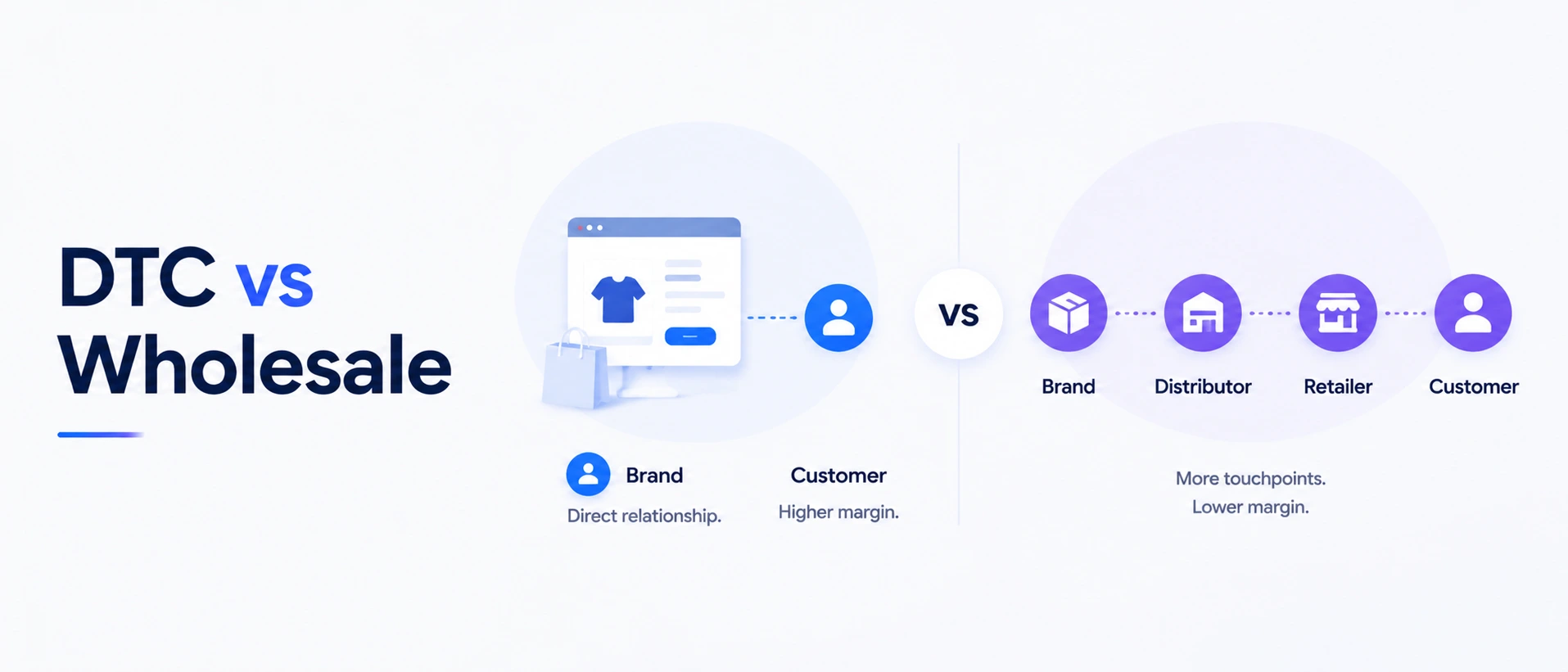
Direct-to-consumer (DTC) refers to selling directly from your brand to the final consumer, with no intermediaries, retail shelves, or distributor markup. You’re in charge of everything from the website and packaging to the follow-up email and return policy to the narrative you’re putting out about your brand.
Consider Warby Parker, Dollar Shave Club, Glossier, or Bombas. These brands are not known for targeting products at Target. They created their own audiences, sold on their own digital platforms, and leveraged customer data to refine all facets of the experience.
In a DTC ecommerce model, your brand:
- Strives to keep the entire customer relationship in one’s hands
- Carries out full retail prices (no wholesale price reduction).
- Gathers information about first-party purchases, browsing history, emails, and preferences
- Regulates the messages, positioning, and pricing of controls.
- Manages own fulfillment, returns, and customer service
When brands wish to focus on building a loyal community, rapidly iterating on customer feedback, and maximizing lifetime value, the model of choice is DTC.
What Is the Wholesale Ecommerce Model?
Wholesale is the sale of commodities in bulk at 40-60% below retail price to retailers, distributors, or B2B purchasers, who subsequently resell them to end consumers. The retailer owns the sale, and the sale provides him/her with income.
It’s the classic retail concept. A skin care company selling to Sephora, a food company selling to Whole Foods, or an apparel company selling to department stores are all on a wholesale ecommerce business model (or brick-and-mortar wholesale variation).
For a wholesale model, your brand is:
- Purchases on a large scale with regular quantities
- Hands off the last-mile logistics to the retailer
- Does not have the power to determine pricing and shelf positioning
- Does NOT store information about its customers
- Retailer distribution network and foot traffic come in handy
Wholesale is the option for brands seeking quick market entry, geographical distribution, and less complexity in the logistics at the cost of margin.
DTC vs Wholesale: Head-to-Head Comparison
Direct-to-Consumer (DTC) and wholesale are two distinct retail models, each offering unique advantages in terms of control, profitability, and market reach. The comparison below highlights the key differences to help businesses determine which approach best aligns with their growth and sales objectives.
| Attribute | DTC (Direct-to-Consumer) | Wholesale |
| Customer Relationship | Direct, personal, data-rich | Indirect retailer-managed relationship |
| Profit Margins | Higher gross margin per unit sold | Reduced per-unit margin (typically 40–60% discount) |
| Brand Control | Complete control over pricing, messaging, and UX | Shared or limited control retailer sets shelf terms |
| Market Reach | Built from scratch via owned marketing channels | Immediate access to the retailer’s customer base |
| Customer Data | Full first-party data ownership (rich insights) | Limited or no access to customer data |
| Cash Flow | Based on direct sales volume (can be variable) | Predictable cash flow via bulk purchase orders |
| Operational Load | Medium (individual orders, returns, customer support) | Low per-unit operational load (bulk shipping, fewer touchpoints) |
| Scalability | High CAC efficiency potential; scalable with a strong brand | Fast scaling through retail distribution but margin pressure later |
| Startup Cost | Generally lower initial investment (no retail dependency) | Lower upfront marketing cost but higher dependency risk |
| Ideal For | Brand-building, community-driven, long-term value (LTV focus) | Rapid distribution, market penetration, scale-focused growth |
Financial Realities: Margins, CAC, and Cash Flow
Now is when things get real.
DTC Financials: Higher Margin, Higher Burn
Yes, DTC brands get the full retail price. A product with a $12 DTC manufacturing cost and a $60 selling price appears to have a 5x return. But, before you factor in:
- Customer Acquisition Cost (CAC): Influencer campaigns, paid social, Google Ads, and content are not free. The average CAC for each DTC category is $40 to more than $200 per customer.
- Fulfillment costs: Individual orders pick, pack, and shipping costs are much higher in bulk freight.
- Returns: Typical DTC return rates are 20-30% in areas such as apparel and electronics, which eat into that gross margin.
- The tech stack: Shopify subscriptions, email platforms, CRM tools, analytics, it’s all real expenses.
The DTC model is effective when Customer Lifetime Value (LTV) is much higher than CAC. That’s the sweetheart of a healthy DTC brand.
Wholesale Financials: More predictable, less margin
If a wholesaler sells the same product at $60 to the retailer at $28-$30, then they earn about half of the revenue per unit. But:
- No advertising expenses to get each consumer
- The overall logistics cost for bulk is much cheaper per unit.
- Payment terms (Net 30/60) provide a predictable cash flow.
- Returns are typically negotiated at the retailer level, not order-by-order
The risk in wholesale is margin compression over time as your brand becomes dependent on one or two large retail accounts, and they have leverage to push prices down.
Brand Control and Customer Data: Who Actually Owns the Relationship?
This is the most underrated dimension of the direct-to-consumer vs. wholesale debate.
In DTC, your brand owns the conversation. You have an idea of who purchased what, when, how often, and what they browsed before they converted. A reorder reminder can be sent precisely when you need it. You can introduce a new product to your most valuable customer first. You can try your messaging and view results in 48 hours.
In wholesale, that customer is the retailer’s customer. You receive a Purchase Order, not a Customer Profile. If your product is discontinued by the retailer, you have no way to reach the people who loved it.
This is not about marketing, it’s a long-term valuation issue. In acquisition, brands with good first-party data have been able to achieve the highest multiples not only for SKU lists but also for audiences.
Real-world example: Casper is a company that went DTC first before going wholesale, gaining a loyal customer base first. Later, when it expanded its product line into Target, it already had brand equity it could leverage in the retail negotiation, and it didn’t need Target.
Operational Complexity: What Each Model Demands From Your Team
Operational complexity varies significantly across AI deployment models and directly impacts staffing, infrastructure, governance, and ongoing maintenance requirements.
DTC Operations Demands:
- Ecommerce platform management (Shopify, WooCommerce, custom).
- Individual order fulfillment, via in-house warehouse or 3PL.
- Return and inquiry/exchange systems for customers
- SKU-level inventory forecasting on multiple channels
- An omnichannel marketing stack includes email marketing, SMS marketing, paid advertising, and organic marketing.
Wholesale Operations Demands:
- EDI compliance (Electronic Data Interchange) with major retailers
- Vendor compliance guidelines, labeling, palletizing, and routing
- Longer payment cycles (Net 30/60/90 terms)
- Sales team or broker relationships for account management
- Demand forecasting based on retailer sell-through data
Neither model is the easiest to operate. These, however, call for vastly different skill sets. Performance marketing and CX design are essential for an ideal founding team who are well-suited for DTC. Wholesale First may be a good fit for a team with a strong background in sales and logistics.
DTC vs Marketplace vs Wholesale: Where Do Platforms Fit?
Many brands consider Amazon, Walmart Marketplace, and other such platforms a “middle option”. This is something to keep in mind regarding the DTC vs. marketplace debate.
Marketplaces are NOT equal to DTC. You sell on Amazon (via Seller Central), but Amazon controls the customer relationship, and it is Amazon who has the review data and who can change the algorithm, fees, or policies at any time. It is more similar to a wholesale adjacent model in terms of the risk of brand control.
| Channel | Margin | Data Ownership | Brand Control |
| Own DTC Website | Highest | Full | Full |
| Amazon (Seller Central) | Medium | None | Limited |
| Amazon (Vendor Central) | Lowest | None | Minimal |
| Wholesale Retail | Low – Medium | None | Low |
The cleanest path to brand equity and customer data is your own DTC channel, even if the volume is lower early on.
The Hybrid Model: Running DTC and Wholesale Together
Here’s the strategic insight most growing brands eventually reach, so you don’t have to choose.
The most successful mid-market brands operate both DTC and wholesale, each doing a different job:
DTC Channel: Introduces new products, cultivates community, gathers data, tests messaging, making repeat purchases
Wholesale channel: Volume for core products, geographic expansion, brand awareness in new markets
The key to making the hybrid model work:
- Keep your DTC pricing protected, and never allow it to be undermined on your site by wholesale.
- Present DTC data to gain better wholesale terms, presenting retailers’ sell-through velocity and customer demographics
- Don’t suffer from a channel conflict by differentiating SKUs or packaging, if possible
- Monitor performance on a per-channel basis, accurately attributing to each channel where analytics tools are necessary.
A powerful ecommerce analytics tool can provide a unified source of truth to help brands analyze channel profitability, customer behavior, and operational effectiveness.
How ProactiveAI Powers Smarter Ecommerce Decisions
ProactiveAI is an ecommerce analytics solution that empowers ecommerce brands to convert disjointed data into actionable insights that propel growth. It combines DTC, marketplace, and wholesale performance into a single dashboard, eliminating the need to switch between multiple reports and spreadsheets and giving you a full picture of your revenue, margins, and trends.
The platform’s feature enables brands to gain insights into their CVA by source, allowing them to better understand which channels, campaigns, and products deliver the most value to customers. That’s a way to help teams focus on long-term growth instead of short-term victories.
We also help brands plan their inventory smarter through demand forecasting, avoiding stockouts and excess inventory while reducing unnecessary costs. It monitors the performance of retailers for wholesale businesses, reveals the sell-through patterns, and provides early reordering opportunities.
By using advanced attribution modeling, brands can gain deeper insights into the interplay between DTC and wholesale channels, enabling more informed, profitable, and data-driven business decisions.
How to Choose the Right Model for Your Brand?
Apply this decision process:
Choose DTC if:
- You have a different story that makes direct marketing investments worthwhile
- Your product has high repeat-purchase potential for things that users consume or wear (consumables, apparel, supplements)
- You’ll want to have the data of your own customers and establish long-term brand value.
- Your target customer is a digital native and can be found through paid/social channels.
- It’s possible to have a complete marketing and fulfillment stack for your team or budget.
Choose Wholesale if:
- You have a product with a high physical visibility (grocery, hardware, beauty)
- Getting products to market quickly and without a large marketing team.
- Your margins will be 40-60% wholesale and still be profitable
- You are switching over to a new geography or demographic through the retail partner’s established audience
- This is a very important time in your growth because cash flows are predictable.
If you choose a Hybrid Model:
- You have an established DTC base and want to scale volume via retail
- Channel pricing protection and control SKU differentiation.
- You have the analytical platform (such as ProactiveAI) in place to monitor performance on both fronts.
Conclusion
There is no right answer to the DTC vs wholesale discussion: there is only a right answer for your brand, at your stage, using your resources.
DTC is where you get the customer, the data, and the margin, but you need to put in the marketing and operations. With Wholesale, you get reach and predictability, at the expense of control and customer ownership. The hybrid way, if done well, offers you both.
Not only was it the choice of model, but it was the understanding of trade-offs and the tight monitoring of performance across all channels that made the difference between brands that scale and those that stall.
ProactiveAI is designed to bring all your ecommerce analytics, LTV modeling, inventory intelligence, and wholesale account tracking into a single platform. Powered by AI business intelligence, it is customized for today’s brands that rely on data-driven decision-making.
Frequently Asked Questions
What is the difference between DTC and wholesale?
DTC (Direct-to-Consumer) brands are those that can be purchased directly by customers, either online or through the brand’s retail locations or channels. Wholesale brands are those sold in bulk to retailers or distributors, who resell them to end consumers.
Which model has better margins: DTC or wholesale?
Most of the time, there is a larger profit margin at DTC because brands maintain the retail price. But it comes with higher marketing, fulfillment, and customer acquisition costs, too, compared with wholesale.
Can ecommerce brands do both DTC and wholesale?
Yes, there are plenty of ecommerce brands that utilize a hybrid model, with both wholesale and DTC. This will enable you to boost revenue, reach a wider market, diversify sales channels, and minimize reliance on a single sales channel.
What are the challenges of switching from wholesale to DTC?
The transition to DTC will necessitate ecommerce infrastructure, digital marketing, fulfillment, and customer support investments. Brands also need to establish direct customer relationships and address potential conflicts with retail partners.
You might also like
Handpicked articles for your reading list.


Get the latest insights on Conversational AI
Stay ahead of the curve with weekly updates on data analytics, AI trends, and eCommerce growth strategies delivered straight to your inbox.
Join 5,000+ industry leaders. Zero spam, just pure insights.