
 SparxIT
 SPXCommerce
 What's Your A

eCommerce
eCommerce
Zero-Party Data for eCommerce: How to Collect Customer Preferences and Personalize at Scale
-
Vikash Sharma
- Jul 08, 2026
- 10 mins read
You’ve been working on your email list for months, optimizing your ad targeting and product pages. Then suddenly, like, overnight, your best campaigns begin to perform poorly. Open rates drop. ROAS shrinks. Customers feel they are being followed rather than assisted. Sound familiar?
The reality is that the data infrastructure most eCommerce brands have relied on for years is quietly crumbling, including third-party cookies, cross-site tracking, and borrowed audience signals. The days of traditional personalization methods are coming to an end, with major browsers already banning third-party cookies and privacy laws becoming increasingly stringent globally.
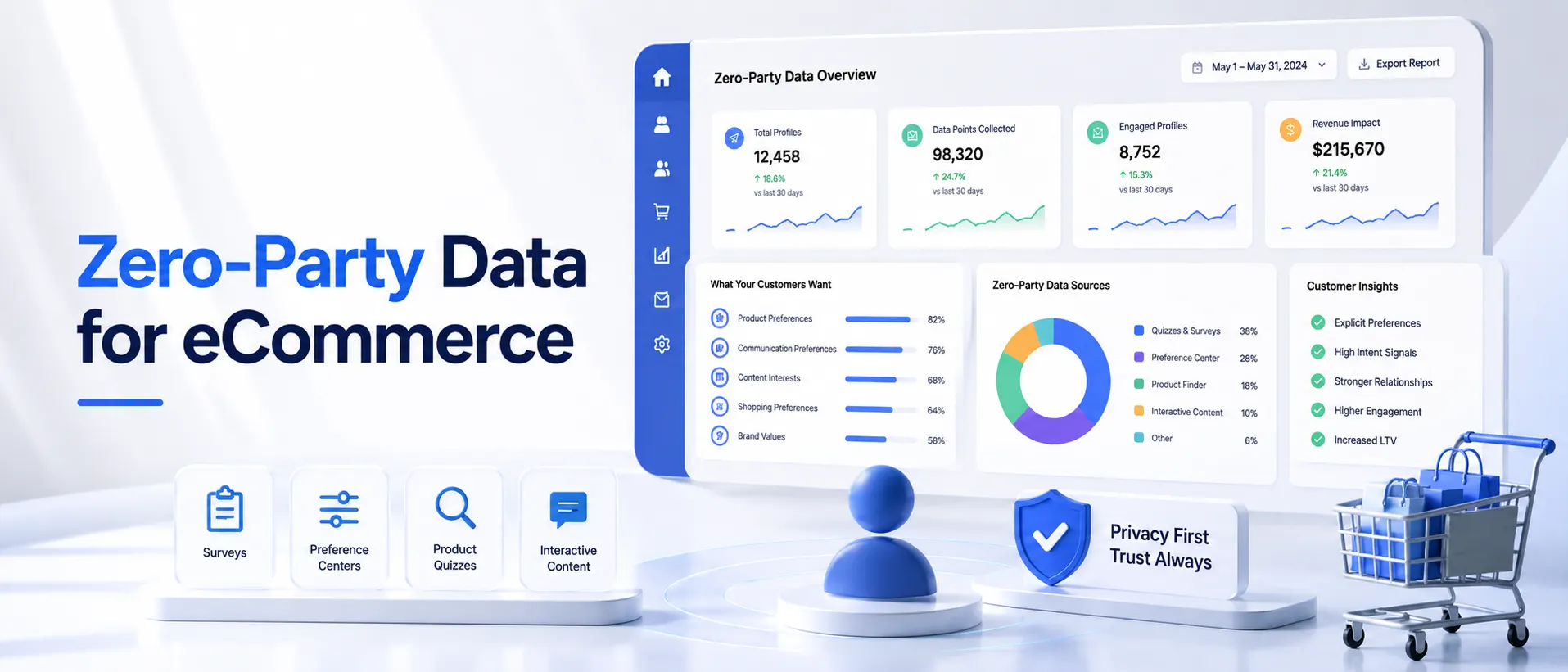
The answer lies in zero-party data strategies for eCommerce, which go directly to customers and ask them what they want. Personalization is not an act of surveillance; it’s an act of service when customers willingly share their preferences, purchase motivations, and interests.
The brands that are successful in this cookieless world are not the ones with high ad spend. After all, they are the ones who directly connect with their customers using data and apply it to personalize their experience.
What Is Zero-Party Data?
The zero-party data definition is from Forrester Research, which coined the term to refer to “data a customer intentionally and proactively shares with a brand. Compared with behavioral tracking (where intent is inferred from clicks and browsing behavior), zero-party data captures customer intent directly. Customers clearly communicate their preferences and expectations.
Think of it this way: first-party data is watching as a customer walks through your brick-and-mortar location. Zero-party data is asking them, “What are you looking for today?” and then they answer.
Zero-party data for eCommerce is defined by the following factors:
- Data gathered from a product preference quiz onboarding (“Do you prefer minimalist or statement jewelry?”)
- Brands can collect wishlist or style preference data to understand purchase intent.
- The personal context was collected using post-purchase survey questions (“What occasion were you shopping for?”).
- Customers can also specify their preferred communication channels, frequency, and topics of interest.
This type of data is particularly useful because it can be accurate (self-reported), consensual (voluntarily provided), and persistent (cross-session and device). It remains resilient in a cookieless future and helps brands comply with evolving privacy regulations. And it gets more valuable the more you collect.
Zero-Party vs First-Party Data in eCommerce
Prior to any data strategy, it’s crucial that you have a clear understanding of the difference between zero-party data for ecommerce and first-party data for ecommerce. Both data types remain inaccessible to third parties and support privacy-first marketing strategies, but they’re used for different things and have different degrees of reliability.
| Dimension | Zero-Party Data | First-Party Data |
| Source | The customer explicitly states it | Gathered from customer actions on your channels |
| Collection Method | Quizzes, surveys, preference centers, and onboarding forms | Purchase history, website analytics, email clicks, and browsing behavior |
| Accuracy | High, self-reported intent | Moderate, inferred from behavior |
| Privacy Risk | Very low | Low |
| Example | “I have oily skin, and I’m looking for a moisturizer.” | The customer viewed the moisturizer page 3 times and abandoned the cart before purchasing. |
| Best For | Personalization, customer segmentation, product recommendations | Retargeting, behavioral analysis, lookalike audiences |
The key difference: First-party data tells you what customers have done, and zero-party data tells you what customers want. The combination is strong, yet zero-party data is where intent resides in eCommerce personalization.
If a customer has only been on the website twice, and they hovered over the running shoes twice, an eCommerce brand could be tempted to infer that they are interested. But if there was no zero-party data, they’d know: “I am training for my first 5K, I pronate, and my budget is less than 120 dollars. This level of insight enables highly accurate product recommendations.
Zero-Party Data Examples in eCommerce
For a better understanding, here are some Zero-Party Data for eCommerce examples for verticals across leading brands:
Beauty & Skincare
A skincare company develops a “Find Your Routine” quiz. Customers choose their skin type, concerns (such as acne, dullness, and aging), and lifestyle (stress levels, sleep hours). The brand uses this to suggest a tailored program and labels each subscriber with the collected attributes for future email segmentation.
Apparel & Fashion
An online clothing retailer: When a customer registers for an account, they create a style profile that includes fit preferences (relaxed, tailored), preferred colors, and shopping occasions. All email campaigns automatically retrieve products based on each individual’s stated preferences.
Health & Wellness
A supplement company’s follow-up survey is: “What health benefit did you seek when you purchased our supplements?” They’re then guided to enter the answers (energy, immunity, sleep) into their CRM, which, in turn, triggers a series of personalized educational emails over the next 90 days.
Home Decor
A company that sells furniture can take the preferences for interior style in a room design quiz. This enables a customer-preference data ecommerce model that dynamically updates the product carousels on the homepage and/or the browse and target recommendations based on the user profile.
In all instances, the information was shared openly, utilized properly, and returned to the consumer. That’s the zero-party data contract, and it’s one where customers are happy to give to the brand when it’s keeping up its end.
How to Collect Zero-Party Data for eCommerce?
Let’s find out the best and most scalable ways of collecting zero-party data for the eCommerce context:
1. Quiz Funnels at Acquisition
A quiz funnel ecommerce strategy is when the quiz is sitting on the first page of the funnel in an ad, pop-up, or landing page before a customer even submits their email address to become a subscriber.
With tools such as Octane AI quiz ecommerce functionality, there is no need to write your own code to create product-recommendation quizzes that gather data, recommend products, and capture email/SMS opt-ins as well. The quiz converts cold visitors into segmented leads while enabling brands to understand customer preferences within minutes.
A good quiz for an eCommerce business tends to collect the following information:
- The main objective or issue that the customer wants to resolve.
- Relevant lifestyle and demographic information
- Preferences that curtail the choice of products
- Communication channel preferences
2. Post-Purchase Surveys
A post-purchase survey ecommerce implementation is one of the most underused data collection opportunities. The buyer is a good customer at the point of sale and is happy to promote. Data from a 2–3-question survey is impossible to surface alongside behavioral data. This will show you the main reason your customers bought today, how they heard about you, and their greatest challenge with [product category.
The surveys will inform your marketing segmentation and your product development path. They also help let the client know that you’re interested in their experience beyond the sale.
3. Preference Centers
A preference center is an opt-in, self-serve portal that allows subscribers to control what information they receive from you, including product types, frequency, topics of interest, size, and format. It’s all about customer preference data and ecommerce, and it significantly reduces unsubscribes because the customer feels in control, not overwhelmed.
4. Onboarding Flows
Include a brief onboarding process to gather basic preference information from a new account holder or subscriber to your list. This is normal, slippery, and contextually suitable. It’s like a concierge service. “Tell us a bit about yourself so we can make it better.
5. Loyalty Program Interactions
Incorporate zero-party data collection into program mechanics if you have a loyalty or rewards program. Reward customers with points for completing a style profile, responding to periodic customer preference surveys, or joining a customer feedback panel.
How Post-Purchase Surveys and Quizzes Generate Zero-Party Data for eCommerce
The idea behind both post-purchase surveys and quiz funnels is similar: they turn passive visitors into active data contributors by making it seem like a worthwhile exchange.
The Quiz Funnel Flow:
- Customer gets into a quiz (“Find your perfect skincare match”)
- Answers 4–6 questions about their skin type, goals, and budget
- Is offered tailored product suggestions
- Customers can opt in to receive quiz results via email or SMS
- Brand captures: preference tags, product affinity, contact info
Every response captured through the quiz becomes a valuable zero-party data signals. The quiz collects data when you are acquired, so you can personalize your experience from the first email, even before you have any purchase history.
The Post-Purchase Survey Flow:
- The customer makes a purchase.
- A 2-3-question survey is included on the Confirmation page or in the Day-1 email.
- Customer responses: “I bought it as a gift” / “I found you on Instagram” / “I’m trying to prevent breakouts.”
- Answers go into CRM and follow the right flow of actions
These 2 mechanisms form a flywheel: quizzes capture intent before purchase, and surveys provide validation and a deeper understanding after purchase. This leaves a continually enriched customer profile that enables better customer segmentation at every touchpoint.
How to Use Zero-Party Data for Personalization at Scale?
Zero-party data is only valuable if it is used. Zero-party data personalization is available in 3 important channels:
Email Personalization
Brands can dynamically populate email content blocks with products, educational content, and CTAs based on the customer’s known attributes defined in a profile. This is more than just personalization to first names, and it is contextual at scale.
Address declared preference segments, set up appropriate drip sequences, and align content and copy with stated goals. Response rates to preference-matched emails are consistently 20–40% higher than those of generic broadcasts.
SMS Campaigns
Zero-party data enables cookieless personalization in ecommerce via SMS, a channel where there is no way to rely on browsing behavior whatsoever. When you know that a customer prefers to shop for athletic wear and would appreciate weekend messages, you can time and frame your SMS campaigns to make them feel like a service rather than an invasion.
On-Site Experience
Declared preference profiles can be used to feed dynamic homepage carousels, personalized search results, and product widgets. If a customer identifies as preferring minimalist, monochromatic fashion, the brand should present a homepage experience aligned with those preferences.
Paid Retargeting
You can use declared preferences in retargeting ads without using behavioral cookies. Divide your audience into zero-party segments and make ad sets that target their expressed motivations.
Tools That Make Zero-Party Data Actionable
There are a number of platforms that enable zero-party data collection and activation:
- Octane AI: Industry-leading quiz funnel builder for Shopify, with native integrations to Klaviyo and SMS platforms. The Octane AI quiz ecommerce functionality is the gold standard for preference-based product recommendation.
- Typeform / Jotform: Customizable survey tools for post-purchase and onboarding.
- Klaviyo: Email/SMS platform that offers high-quality profile enrichment and conditional content blocks for personalization, based on declared attributes.
- Yotpo: Loyalty program with an in-built profile collection feature.
- ProactiveAI: An AI analytics platform designed to sit on top of all your data sources to turn collected zero-party signals into actionable intelligence. Your marketing team can ask questions of the ProactiveAI conversational AI analytics feature, such as “Which quiz segment has the highest LTV?” or “What’s the conversion rate of customers who completed the onboarding flow vs. those who didn’t?” without typing a single SQL query.
ProactiveAI’s eCommerce analytics dashboard presents your zero-party data segments along with purchase behavior, cohort performance, and campaign metrics, all in one place, providing a full picture of declared preferences and their impact on actual revenue.
The forecasting engine uses AI sales forecasting at the segmentation level, so you can forecast which preference segments are likely to buy in the next 30 days, and you can focus your campaign spend on those segments.
For teams that prefer to work with their own data without relying on analysts, ProactiveAI’s self-service analytics empowers marketers, merchandisers, and growth managers to create custom reports, explore zero-party segments, and answer questions independently. This makes data a shared asset across the organization instead of a bottleneck, enabling faster decisions, greater collaboration, and more agile, data-driven growth.
Best Practices for Zero-Party Data Collection
1. Explicit value exchange
When customers believe they will receive what they want in return, they are more likely to provide their information. Make it clear that you’re doing the quiz or survey for a purpose: “You are taking this quiz/survey to discover what products will work for your skin type.
2. Be brief and sequential
Begin with 3–5 questions at the acquisition level. Progressively profile over time (add one or two questions with each interaction, rather than loading a long form that leads to high drop-off rates).
3. Use the data right away
You can’t tell if a customer likes a minimalist design, and then you send them an email with all the bells and whistles. When a customer says they like a minimalist design and your next email is full of bells and whistles, trust is lost. The payoff from personalization must come after data collection. Value is demonstrated by immediacy.
4. Make preferences editable
Provide a preference center where customers can update their preferences at any time. This helps cultivate trust, improve data quality, and reduce unsubscribe rates.
5. Centralize your data
As long as zero-party data is gathered in Octane AI, Klaviyo, your Shopify CRM, and your post-purchase survey tool without being consolidated to a central analytics layer, it’s just not helpful. That’s where a platform like ProactiveAI becomes essential, aggregating signals from all sources in one place so your team can respond more effectively to a unified data resource.
6. Show transparency in usage
Tell customers why you’re collecting the data and how it will improve their experience. Transparency isn’t just about compliance, but it’s also a trust-building tool.
Conclusion
The movement to zero-party data for eCommerce isn’t limited to the cookie deprecation, and it’s a more effective way to create customer relationships. In the event that customers communicate what they want, brands provide exactly that, everyone wins: customers receive relevance, brands receive loyalty, and most importantly, the data that drives it is accurate, consensual, and durable.
The brands that will dominate the next decade of eCommerce personalization don’t necessarily have the most advanced tracking scripts. It’s they who learned to ask, created systems to listen and remember, and responded to what their customers said.
Start small. Launch a quiz. Include a follow-up survey. Create a preference center. Afterward, share signals on a platform that enables your entire organization to improve its decision-making and make personalization your strongest competitive edge.
Frequently Asked Questions
What is Zero-Party Data in Ecommerce?
Zero-party data is data that customers willingly give a brand, such as their preferences, motivations, or interests in products. For eCommerce, it is collected using quizzes, surveys, and preference centers. Its accuracy, consensus, and privacy protection qualities make it the bedrock of modern personalization strategies.
How is zero-party data for eCommerce different from first-party data?
First-party data is behavioral data gathered from your own touchpoints and channels, such as site visits, clicks, and purchases. Zero-party data is declarative, and customers tell you what they want. First-party data will tell you what they have done, while zero-party data will tell you what they’re going to do, and it’s more accurate for personalization.
What are the best ways to collect zero-party data for eCommerce customers?
Quiz funnels in acquisition, surveys after purchasing, preference flows during onboarding, loyalty program rewards, and self-serve preference centers are the most effective options. At every touch, they are to receive something in exchange for their preferences: more specific recommendations, communications, etc.
How do post-purchase surveys and quizzes generate zero-party data?
Quizzes gather stated preferences before customers buy by asking questions that guide them to the correct product. Post-purchase surveys measure intentions and context, post-purchase, why they made the purchase, how they discovered you, and what they are looking to accomplish. Both generate explicit and actionable customer profile attributes.
How do you use zero-party data to personalize email and SMS campaigns?
Developed segmented flows for email and SMS based on map-declared attributes such as skin type, style preference, and purchase motive. Align creative and copy to each segment’s goals with dynamic content blocks. It enables personalization without cookies while remaining privacy-friendly and far more relevant than behavioral personalization.
You might also like
Handpicked articles for your reading list.


Get the latest insights on Conversational AI
Stay ahead of the curve with weekly updates on data analytics, AI trends, and eCommerce growth strategies delivered straight to your inbox.
Join 5,000+ industry leaders. Zero spam, just pure insights.