
 SparxIT
 SPXCommerce
 What's Your A




eCommerce
eCommerce
eCommerce Conversion Rate Optimization (CRO): How to Turn More Visitors Into Buyers
-
Vikash Sharma
- Jul 03, 2026
- 8 mins read
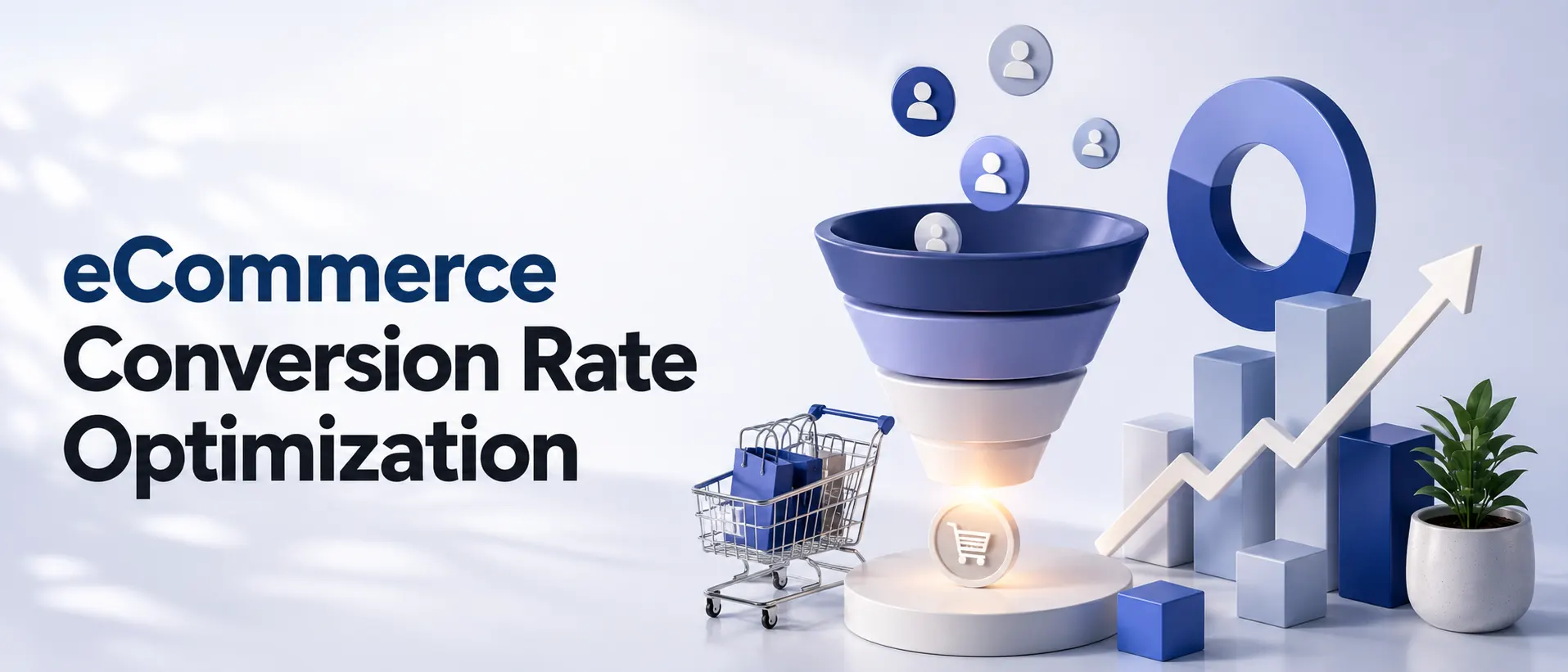
You are advertising thousands of dollars. Your traffic is booming! However, all of this goes down the drain at the end of the month, as far as your revenue goes.
It is the silent problem that plagues every eCommerce brand, with a lot of people visiting the site and very few converting into buyers. The conversion rate for the average ecommerce store is around 2-4%. That means that up to 98% of your hard-earned visitors will leave without buying anything. Each non-optimized page, slow-loading product image, and clunky checkout step is costing you real dollars.
The good news? There is no need for any extra traffic. You must maximize the potential of the traffic that you already have. This is the job of ecommerce conversion rate optimization (CRO), and it’s done systematically.
When implemented strategically, CRO delivers one of the highest ROI opportunities for online retailers. Today, when AI-powered analytics platforms enable quicker, smarter data-driven decision-making, it’s never too late to take conversion funnels to the next level.
What is eCommerce Conversion Rate Optimization?
Conversion rate optimization for ecommerce is a systematic approach to boosting the conversion rate of website visitors into actual customers, typically by driving sales. It integrates behavioral data analysis, UX design enhancements, persuasive copywriting, and ongoing testing to make passive shoppers active buyers.
The key to online stores’ CRO is not to guess. It is about real data: heatmaps, session recordings, funnel analytics, and A/B testing to see where your users drop off and why, and to tackle those drop-off points systematically.
Imagine your eCommerce funnel is a leaking bucket! The more the merrier, more water pours in, and it still leaks. CRO seals the holes, so no drop of traffic is lost.
eCommerce Conversion Rate Benchmark in 2026
First, you must have a standard to measure against to optimize.
| Industry / Category | Average Conversion Rate (2026) |
| Fashion & Apparel | 1.5% – 3.5% |
| Electronics | 1.0% – 2.5% |
| Home & Garden | 2.0% – 4.0% |
| Health & Beauty | 3.0% – 5.5% |
| Food & Beverage | 3.5% – 6.0% |
| Multi-category Retail | 2.0% – 4.0% |
In 2026, the average ecommerce conversion rate falls within the range of 3% to 5%, with some niche stores achieving consistently high rates of 8% to 10%. If your store’s conversion rate falls below 2%, significant optimization opportunities likely exist.
Conversion performance varies across traffic sources, devices, and geographies in an ecommerce analytics dashboard rather than relying on a single metric.
How to Calculate Your Conversion Rate?
The formula is easy:
Conversion Rate = (Total Conversions ÷ Total Visitors) × 100
For instance, if you had 50,000 visitors to your store in a month and 1200 made a purchase, then your conversion rate would be 2.4%.
Tracking Conversion Rate in Shopify
Shopify merchants can access this data natively in the Shopify dashboard under Analytics → Overview. However, segmenting performance by traffic source, campaign, device type, or landing page requires a more advanced analytics layer. That’s where a solution such as ProactiveAI’s eCommerce Pre-built Dashboards can give you a huge advantage: Segmentation-based conversion information in real-time, without having to report manually.
What are the Key Pillars of eCommerce Conversion Rate Optimization?
Effective eCommerce Conversion Rate Optimization (CRO) is built on several core pillars that work together to improve the customer journey and increase sales:
1. Product Page CRO
Your product page functions as your digital sales representative. If the page fails to build trust and purchase intent, conversions will decline significantly. Product page CRO is all about the elements that directly impact purchase intent.
- Quality photos and videos: Several angles, zoom, and brief demo videos help make the purchase more confident. Research has demonstrated that adding video to product pages can lead to conversions of 80% or higher.
- Copy that carries meaning and benefits: Avoid listing features. Respond to “What’s in it for me? Start by telling the user how your product will change or impact them.
- Social proof: Star ratings, verified reviews, and user-generated content are just a few of the best conversion levers on any product page.
- Urgency and scarcity signals: Stock countdowns, limited-time offers, and shipping cutoff timers: These elements encourage immediate action without appearing manipulative.
- Noticeable CTAs: Your “Add to Cart” button must be above the fold, stand out in color, and use firm, action-oriented language.
2. Checkout Optimization eCommerce
The checkout page is where intent turns to revenue, or it dries up altogether. The average eCommerce cart abandonment rate is about 70%. Checkout optimization is no longer optional.
Here are some of the key actions that need to be taken:
- Minimize form fields: Request only the necessary information. Every additional field increases the risk of abandonment.
- Allow guests checkout: One of the biggest cart abandonment culprits is that the customer is forced to create an account before checking out.
- Accept different payment methods: Credit cards, local payment methods, digital wallets (Apple Pay, Google Pay), and Buy Now Pay Later (BNPL) eases the payment process.
- Include trust indicators: SSL logos, payment logos, and money-back guarantees to eliminate last-minute doubts.
- Use a progress indicator: This will help to alleviate anxiety and the likelihood of abandonment.
- Offer exit-intent recovery: Pop-ups, cart abandonment emails, and retargeting campaigns bring hesitant buyers back.
3. Site Speed and Conversion Rate
Time is literally of the essence, and studies indicate that conversions can be as much as 7% lower on a page that takes 1 second longer to load. For the mobile shoppers, the bar is even lower.
Site speed and conversion rate go hand in hand, as slow pages signal untrustworthiness and negatively impact the user experience before a customer even views the product.
Practical improvements:
- Optimize and lazy load images with next-generation formats (WebP, AVIF)
- Try to eliminate third-party scripts and JavaScript bloating
- Enable browser caching and utilize a CDN.
- Upgrade from shared hosting to high-performance infrastructure when required.
- Regularly check Core Web Vitals in Google Search Console.
The 2026 goal for maintaining high conversion rates is a Largest Content Paint (LCP) target of less than 2.5 seconds.
4. Mobile Conversion Rate Ecommerce
An increasing number of people are accessing eCommerce sites via their mobile devices, and the mobile conversion rate in eCommerce is generally 30-40% lower. Ensure complete message consistency between advertisements and landing pages.
Mobile CRO priorities:
- Design that is ‘thumb-friendly’: Larger tap targets, CTAs are placed at the bottom, and significantly fewer horizontal scrolls.
- Easy navigation: Mega-menus are not suitable for mobile platforms. Incorporate clean category browsing and a sticky search bar.
- Accelerated checkout: The one-tap checkout feature with Apple Pay and Google Pay eliminates the top mobile conversion killer at the entry.
- Exemplary typography: Minimum 16px body size, good line spacing, high contrast.
- Test on real devices: Not all problems can be replicated with emulators. Test on iOS and Android platforms with various screen sizes.
5. eCommerce Landing Page CRO
When running paid campaigns, the ecommerce landing page conversion rate optimization will directly affect your ROI. For a high-converting landing page, you need to do:
- Get the ad to match the page precisely: If an ad says “50% off running shoes”, then the traffic that arrives should go to a page dedicated to running shoe sales, not to your homepage ad page.
- Have a single call to action: All elements should lead to one thing. The navigation menus must be removed so that there are no shortcuts out.
- Load quickly, look good: First impressions are made in milliseconds. Landing page speed is a conversion multiplier.
- Include proof elements: Customer reviews, media logos that feature them in their reports (“As seen in…”), and actual product photographs.
A/B Testing in eCommerce: What Actually Moves the Needle
A/B testing ecommerce is a way to get rid of the guesswork in conversion rate optimization. Instead of relying on assumptions, teams should validate decisions through controlled experimentation.
Highest-Impact A/B Tests by page type
|
Page Type |
Element to Test | Variation A |
Variation B |
| Product Page | CTA Button Text & Color | Add to Cart | Buy Now |
| Product Image Format | White Background Image | Lifestyle Image | |
| Price Presentation | Original Price Struck Through + % Discount | Discount Amount/Percentage Only | |
| Review Placement | Above the Fold | Below the Fold | |
| Checkout Page | Number of Form Fields | Fewer Required Fields | More Detailed Form Fields |
| Guest Checkout Prompt | Guest Checkout Hidden/Minimized | Guest Checkout Prominently Displayed | |
| Guest Checkout Toggle Prominence | Low Visibility Toggle | High Visibility Toggle | |
| Progress Indicator Design | Simple Progress Bar | Step-by-Step Progress Indicator | |
| Trust Badge Placement | Near Payment Section | Near CTA/Order Summary | |
| Landing Page | Headline & Value Proposition | Slogan Version A | Slogan Version B |
| Hero Section Media | Hero Image | Hero Video | |
| CTA Strategy | Single Primary CTA | Primary CTA + Secondary Soft CTA |
Your team can create customized experiment dashboards without engineering assistance. This helps you to monitor the performance of a/b tests across multiple campaigns in real time using ProactiveAI’s true self-service business intelligence workflow.
How AI Analytics Supercharges eCommerce Conversion Rate Optimization?
Artificial intelligence in eCommerce analytics workflows is the largest change in CRO over the last two years. Analyzing funnel data, heatmaps, and segment performance manually is time-consuming. With AI, it can be done in a flash.
With today’s conversational AI analytics platforms, eCommerce teams can start by asking simple questions, such as “What are the pages with the highest exit rate last month?” or “Where is the traffic coming from that is most likely to convert to checkout? on mobile? Then they’ll get instant, accurate answers without writing a single SQL query.
This alters the process of making CRO decisions. Teams can make changes every day, without waiting for reports or analysts.
The capabilities of AI-driven CRO are:
- Automated Anomaly detection: Alerts on any unusual conversion declines before they become a revenue problem.
- Predictive funnel analysis: Identifies visitors and segments most likely to convert using behavioral signals.
- Personalization at scale: Recommends personalized content, pricing, and product sequences based on user behavior.
- AI sales forecasting: Relates conversion rate patterns to anticipated income, helping to make informed inventory and campaign choices.
This is enhanced by the Forecasting Engine, which provides you with ML-based eCommerce sales forecasting, linking your ongoing CRO efforts to future revenue and giving you a sense of where your optimization efforts are headed.
Conclusion
Conversion rate optimization is not a one-time exercise but an ongoing practice in ecommerce. The stores that will win in 2026 are those that take CRO as a fundamental part of their business, with careful measurement, systematic testing, and data (not assumptions) guiding decisions.
Whether you’re optimizing your product page, making checkout more seamless, loading your site faster, or creating a mobile-first design, each improvement you make compounds. If you have a decent amount of traffic and can get a 1% boost in your conversion rate, you can earn tens of thousands of dollars each month.
A disciplined CRO framework combined with AI-powered analytics creates a sustainable competitive advantage. When it comes to closing sales, don’t leave money on the table.
Frequently Asked Questions
What is a good eCommerce conversion rate in 2026?
The best eCommerce conversion rate for 2026 is 3% to 5%. Stores with high-intent products, such as health, beauty, or food, routinely see 6–10% of stores be top performers. If you have anything below 2%, it means you have a huge optimization opportunity in your funnel, Landing Page, or checkout.
What are the highest-impact CRO changes for product pages?
The most effective product page CRO strategies include using video content, placing reviews from happy customers above the fold, making CTA buttons and copy more prominent, including scarcity signals such as low-stock indicators, and ensuring the page loads in less than 2.5 seconds, particularly on mobile devices.
How does site speed affect eCommerce conversion rate?
Site speed directly affects conversion rate, and a 1-second delay can cause up to 7% drop in conversions. Slow pages lead to higher bounce rates, loss of trust in your brand by your customers, and reduced SEO performance. The quickest ways to improve load times and regain lost conversions are to optimize images, minimize JavaScript, and use a CDN.
What A/B tests have the biggest impact on eCommerce revenue?
The most lucrative A/B tests for the eCommerce industry include hero image vs. hero video on landing pages, hero image enablement, guest checkout enablement, price presentation formats (discounts versus strike-through pricing), and checkout field reduction. Mobile-specific tests will often deliver the biggest gains because most mobile experiences are under-optimized.
How do you calculate and track conversion rate in Shopify?
The conversion rate is automatically calculated by Shopify (orders per session × 100) and is available on Analytics → Overview. To segment further by channel, device, or campaign, add a dedicated analytics layer such as ProactiveAI that provides real-time eCommerce dashboards and conversion tracking without any manual reporting or custom code.
You might also like
Handpicked articles for your reading list.

Get the latest insights on Conversational AI
Stay ahead of the curve with weekly updates on data analytics, AI trends, and eCommerce growth strategies delivered straight to your inbox.
Join 5,000+ industry leaders. Zero spam, just pure insights.