
 SparxIT
 SPXCommerce
 What's Your A


eCommerce
eCommerce
E-commerce Inventory Forecasting: How to Predict Revenue With AI in 2026
-
Vikash Sharma
- Apr 23, 2026
- 9 mins read
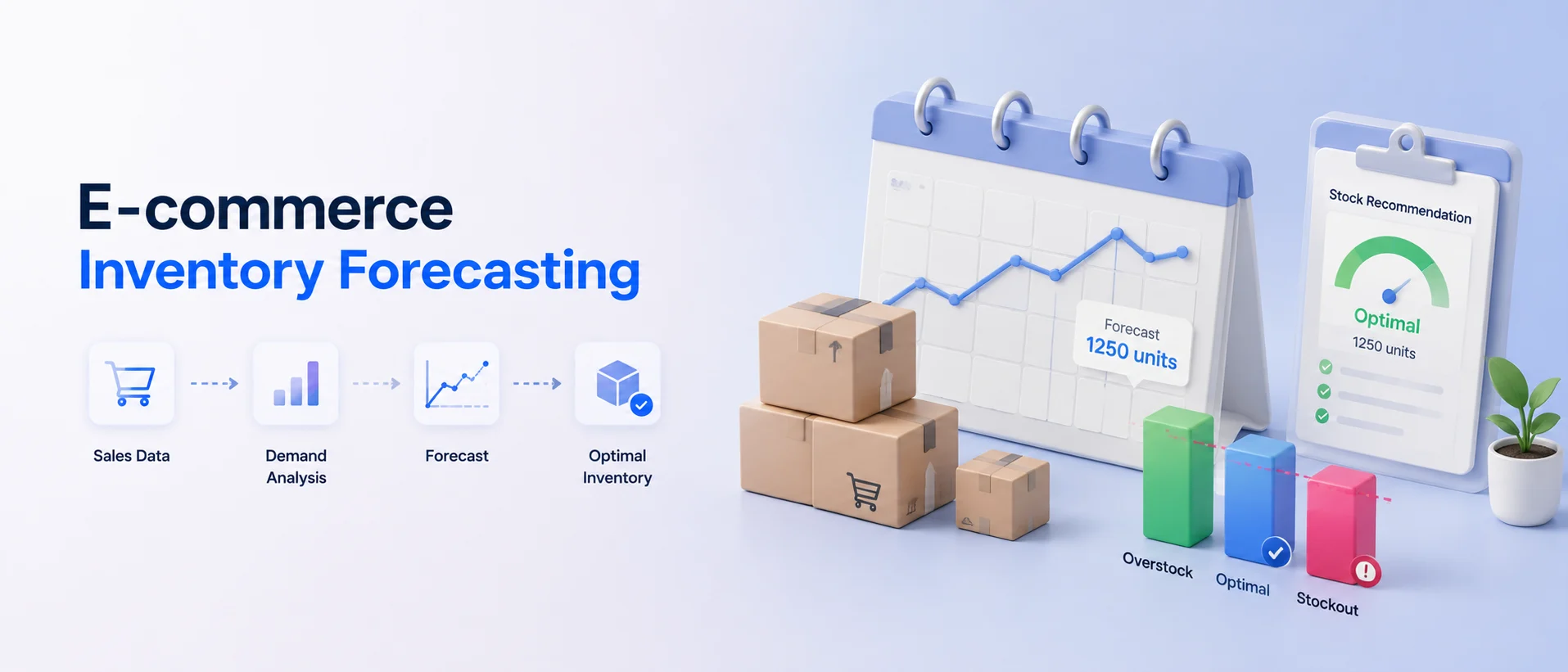
In the revolutionizing ecommerce industry, while revenue is driven by demand, it is determined by how accurately you can predict and respond to that demand. That is the norm of the age and a way of keeping the users in the loop.
Yet, it is seen that many ecommerce brands are still struggling with a critical blind spot. That stems from the inventory decisions that quietly erode revenue despite strong sales potential.
In such cases, it is seen that ecommerce sales forecasting is becoming an imperative part of the entire cycle. Nowadays, without accurate forecasting, businesses often find themselves stuck between two costly extremes. First, there are the stockouts that lead to missed opportunities, and the second is excess inventory that ties up working capital.
In fact, inventory distortion, caused by stockouts and overstock, costs retailers up to 8–10% of annual revenue on average, making it one of the largest hidden drains on ecommerce profitability.
Keeping the above in mind, the result is what can be described as inventory-driven revenue leakage, a considerable challenge that directly impacts profitability.
In 2026, this problem has only intensified as the consumer demand is more volatile than ever. It is being influenced by rapidly shifting trends, aggressive marketing campaigns, and multi-channel selling environments. To be fair, traditional methods of demand forecasting in ecommerce, often reliant on not-so-real-time historical averages and static data-based models, are no longer enough for ecommerce businesses.
To understand the needs of inventory forecasting in ecommerce brands, this blog will explore how modern forecasting works. Not only that, but also the impact and significant role of next-gen ecommerce solutions in revenue prediction for predictable, scalable growth.
What is Ecommerce Inventory Forecasting?
In layman’s terms, e-commerce inventory forecasting is the process of predicting future product demand to ensure that the right items are available in appropriate quantities. When we look at it in the broader parameter, it sits at the intersection of demand forecasting ecommerce and operational planning. This directly influences how businesses manage stock, fulfillment, and ultimately, revenue.
Prior to AI and embedded intelligence, this process relied heavily on historical sales data to estimate future demand based on past trends. Not to shed bad light, but the entire system relied on this approach, which works in stable environments. However, it falls short in modern ecommerce, where demand can shift regardless of the stability and escalate due to changing consumer behavior, promotions, and external factors.
With the introduction of intelligent technologies, ecommerce sales forecasting has shifted toward a more dynamic, data-driven discipline. In the current times, instead of relying solely on past performance, modern forecasting incorporates multiple variables such as:
- Real-time sales trends
- Marketing activity and promotions
- Channel-wise performance (marketplaces, D2C, retail)
- Seasonality and external demand signals
Another user-focused advancement in this space is SKU-level forecasting, which enables businesses to forecast at the individual product level. This way, ecommerce businesses can capture nuances in customer preferences, product lifecycles, and regional demand variations, ultimately improving accuracy and avoiding costly overstocking or stockouts.
Why Traditional Forecasting Methods are Failing the Modern Ecommerce Demands?
The era of ecommerce that aligns with demand and forecasting was once relying on spreadsheets, basic analytics tools, and historical averages to predict demand. Now we did explain that, prior to such traditional methods working in relatively stable environments, they have been struggling to keep up with the complexity of modern ecommerce.
1. Over-Reliance on Historical Data
To bring the idea of limitation, you must understand that ecommerce businesses earlier overly relied on past data. The old ways of predicting were based on the data that was relevant at a point in time, but may not be now. In reality, demand today is influenced by constantly changing variables, flash sales, influencer campaigns, platform algorithms, and shifting consumer preferences. This makes seasonal sales forecasting and trend prediction far less reliable when done manually.
2. Lack of Real-Time Adaptability
Ecommerce businesses used to operate on fixed cycles, weekly or monthly updates that created a lag between what’s happening in the market and how businesses respond. It was seen that by the time adjustments were made, the inventory-based stockouts or overstock situations had already impacted revenue because the trend was gone .
3. Inability to Handle Multi-Channel Complexity
The non-availability of a unified front had impacted the ecommerce businesses like nothing before. Because of the fact that brands operated across multiple channels, marketplaces, direct-to-consumer websites, and retail integrations, they struggled to unify all the data, which eventually resulted in fragmented insights. This makes the representation of accurate data significantly more difficult, as decisions are based on partial visibility.
4. Siloed Decision-Making
As mentioned above, in traditional setups, forecasting often exists in isolation, separate from marketing, pricing, and supply chain operations, which heavily impact the decisions. In better terms, such a lack of integration makes effective inventory demand planning difficult, as decisions are made without considering the full business context, and leaves the scope for modifying the revenue-based decisions.
How AI is Redefining Ecommerce Inventory Forecasting in 2026
As we have come to understand that ecommerce operations are becoming more complex with the heightened trend-focused user demands, forecasting is now about proactive business decisions.
The shift is powered by AI-first, BI-embedded ecommerce solutions that combine forecasting, analytics, and real-time intelligence.
Instead of treating forecasting as a standalone function, these e-commerce-based systems integrate data analytics, demand prediction, and decision-making into a unified workflow. Such integrated systems are fundamentally modernizing how businesses approach inventory and revenue planning.
The transformation can be understood across the following key dimensions:
| Capability Shift | Traditional Approach | AI-Driven Approach (2026) | Business Impact |
| Forecasting Model | Static, periodic forecasts based on historical data | Continuous, real-time AI sales forecasting that adapts to new data | Faster response to demand changes and reduced forecasting lag |
| Demand Visibility | Reactive analysis after trends stabilize | Proactive demand sensing using real-time signals (traffic, engagement, sales) | Early identification of demand spikes and better opportunity capture |
| Data Processing | Limited datasets, often siloed | Advanced predictive analytics in ecommerce across multiple data sources | Improved sales forecast accuracy in complex environments |
| Forecasting Granularity | Category-level or aggregated forecasts | Precise SKU-level forecasting for individual products | Better inventory allocation and reduced overstock/stockouts |
| Inventory Planning | Manual or rule-based planning | Integrated inventory demand planning with automated recommendations | Optimized stock levels and improved operational efficiency |
| Revenue Alignment | Forecasting disconnected from financial planning | Direct revenue prediction in ecommerce linked to demand, pricing, and availability | Stronger ecommerce revenue planning and predictable growth |
What are the Core Components of AI-Based Revenue Forecasting Systems?
Keeping the modifying needs of ecommerce business leaders to align with the user demands, effective AI-driven forecasting is built on an integrated system. Such systems have components that interconnect data, analytics, and decision-making layers that work together to turn insights into revenue outcomes.
To get an idea of how they function together, we must take a look at them and get in-depth with their criticality.
1. Unified Data & Integration Layer
Since we are aware that modern ecommerce businesses operate across multiple platforms like storefronts, marketplaces, marketing tools, and analytics systems, it is significant for them to have a unified layer.
Without this centralized foundation, even the most advanced models fail to deliver insights when it comes to decision-making for the inventory. These forecasting systems support cross-platform integration, automate data pipelines, and enable businesses to eliminate data-related silos and build a consistent base for demand forecasting in ecommerce.
2. Intelligent Analytics & Visualization Layer
To bring a wider view, it is safe to say that forecasting isn’t useful if insights remain locked behind complex ecommerce dashboards or technical queries. Decision-makers who chose to move ahead with e-commerce-based modern systems have been emphasizing self-service analytics, where business users can explore performance, identify trends, and act on insights without relying heavily on data teams.
3. Conversational & Interactive Intelligence
One of the imperative advancements in recent years is the rise of conversational AI analytics. This reflects that instead of navigating multiple reports, ecommerce and supply chain teams can directly go for prompt-based queries to their data, discover trends getting the limelight, and validate assumptions with the inventory in real time.
Step-by-Step: How AI Predicts Ecommerce Revenue
Now that we have understood quite a lot about the AI-driven revenue prediction and systems aligned with them, it is understandable that the implementation is a structured process. It combines data, forecasting models, and continuous learning to generate accurate, actionable insights.
Keeping that in mind, we must now take a look at how it functions well.
1. Data Aggregation Across Channel
The beginning of the ecommerce sales forecasting process starts with the brand’s team gathering data from all relevant sources.
This includes:
- Historical sales data
- Product-level performance
- Marketing campaigns and promotions
- Customer behavior signals
To gather all this and make it into a unified dataset ensures that forecasting models operate on a complete and consistent view of the business.
2. Data Cleaning and Normalization
The next step surrounds the raw data that is often inconsistent, incomplete, or duplicated. Before any forecasting begins, it must be standardized and structured for further forecasting.
During this step, you remove anomalies, align formats, and ensure that inputs are accurate, which lays the groundwork for high sales forecast accuracy.
3. AI-Driven Demand Forecasting
After standardizing the data, you embed ecommerce solutions like ProactiveAI into your systems. These data-focused AI models analyze historical and real-time data to forecast demand in ecommerce. The result is highly granular predictions, often at the SKU level, through SKU-level forecasting.
4. Inventory Optimization and Planning
Once demand is predicted, such AI-enabled systems align inventory levels with reorder point calculations, safety stock recommendations, and channel distribution. During this step, the AI-enabled ecommerce solutions ensure efficient inventory demand planning, minimizing both stockouts and excess inventory.
5. Revenue Modeling and Projections
AI systems combine demand predictions with pricing, conversion rates, and availability to enable accurate revenue prediction in ecommerce.
This allows businesses to:
- Forecast future sales revenue
- Plan budgets and investments
- Align growth strategies with expected outcomes
What are the Key Benefits of AI-Powered Forecasting Solutions?
Now, the question of benefits does not end with just improved predictions but brings us closer to the conclusion that it directly impacts how ecommerce businesses operate and grow. Combining the abilities of aligning demand signals with inventory decisions and financial planning, such an AI-enabled forecasting system enables companies to move from reactive execution to proactive strategy.
When these cognitive systems are implemented effectively, modern forecasting systems, especially those integrated with analytics and BI capabilities, deliver measurable improvements across the entire ecommerce value chain.
|
Benefit Area |
What Changes with AI |
Business Impact |
| Sales Forecast Accuracy | Continuous AI sales forecasting models adapt to real-time data and complex patterns | More reliable predictions and confident decision-making across teams |
| Reduced Stockouts | Improved demand forecasting in ecommerce anticipates demand spikes in advance | Fewer missed sales opportunities and higher customer satisfaction |
| Lower Overstock Costs | Smarter inventory demand planning prevents overestimation of demand | Reduced holding costs, less dead stock, and improved margins |
| Revenue Planning | Integrated revenue prediction in ecommerce connects demand with financial outcomes | Stronger, more predictable ecommerce revenue planning |
| SKU-Level Insights | Granular SKU-level forecasting provides product-specific demand visibility | Better assortment planning, targeted promotions, and lifecycle management |
| Faster Decision-Making | Real-time insights powered by analytics and automation | Increased agility in responding to trends, risks, and opportunities |
| Scalability | AI systems handle growing data complexity across channels and products | Consistent performance and accuracy as the business scales |
Conclusion
Ecommerce businesses have been associating success in 2026 with anticipating it.
Considering that markets are becoming complicated and customer behavior is turning dynamic based on trends, businesses relying on traditional forecasting methods will face uncertainty and inefficiencies.
However, the ones that are adopting AI-driven forecasting systems will be able to predict demand, optimize inventory, and plan revenue with confidence. And to bring a futuristic perspective, the shift is clear that forecasting will be considered a strategic capability.
Why Choose ProactiveAI as Your Intelligent Ecommerce Solution?
As per the conclusion, ecommerce businesses need an AI-first system that brings together data, insights, and decision-making in one place. Platforms like ProactiveAI are built around this idea, combining forecasting, analytics, and real-time intelligence into a unified experience. This allows teams to move beyond basic reporting and leverage AI sales forecasting, predictive analytics in ecommerce, and connected data to improve sales forecast accuracy and make faster, more informed decisions.
By enabling granular SKU-level forecasting, streamlined inventory demand planning, and clear revenue prediction in ecommerce, such systems help businesses turn uncertainty into structured growth. Instead of reacting to demand shifts, ecommerce teams can plan proactively, align operations with expected outcomes, and build a more predictable, scalable revenue engine.
Frequently Asked Questions
How accurate can AI-based sales forecasts be?
AI-based sales forecasting can achieve significantly higher accuracy than traditional methods, often improving forecast precision by 20–50%, depending on data quality and business complexity. By using real-time data and adaptive models, AI continuously refines predictions and reduces errors over time.
What data do I need for reliable forecasting?
Reliable forecasting requires a combination of historical sales data, product-level performance (SKU data), marketing and promotion inputs, customer behavior signals, and external factors like seasonality or trends. The more complete and clean the dataset, the better the forecast accuracy.
How does demand forecasting help with inventory?
Demand forecasting in ecommerce helps businesses align inventory with expected sales, ensuring products are available when needed. This reduces stockouts, minimizes excess inventory, and improves overall inventory demand planning and cost efficiency.
What is the difference between sales forecasting and demand forecasting?
Demand forecasting predicts customer demand for products, while sales forecasting estimates the actual revenue a business expects to generate. Demand forecasting focuses on what customers want, whereas sales forecasting reflects what is likely to be sold, considering factors like pricing, inventory, and conversions.
You might also like
Handpicked articles for your reading list.


Get the latest insights on Conversational AI
Stay ahead of the curve with weekly updates on data analytics, AI trends, and eCommerce growth strategies delivered straight to your inbox.
Join 5,000+ industry leaders. Zero spam, just pure insights.