
 SparxIT
 SPXCommerce
 What's Your A



eCommerce
Marketing
How to Optimize Ad Spend Across Channels: A DTC Guide
-
Varun Kumar
- Jun 09, 2026
- 8 mins read
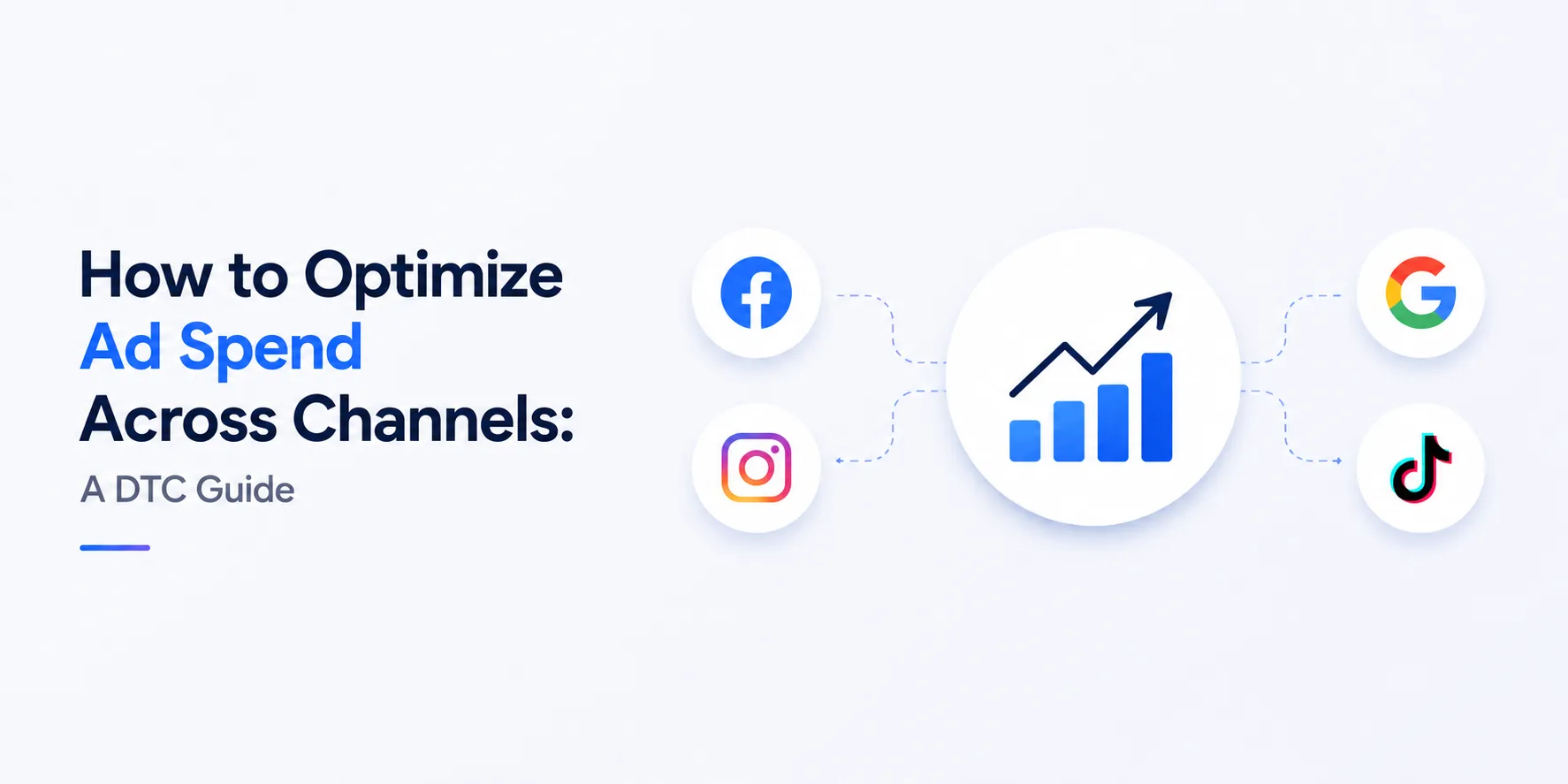
You’re spending money on Facebook, Instagram, Twitter, Google, and your mailbox, but you’re never quite sure what you’re looking at each month. You scale what appears successful, disrupt what’s costing your company too much, and somehow end up with higher CACs and lower ROAS. Sound familiar?
Optimizing ad spend across channels isn’t just a budget issue, and it’s a growth constraint for DTC brands. The biggest growth barrier that’s quietly cutting thousands of dollars from campaigns is the combination of siloed dashboards, inconsistent attribution windows, and last-click bias.
The right cross-channel ad optimization model, powered by real-time data, transforms the way ads are optimized. You aren’t making instinct-based budget decisions; you are basing them on real revenue contribution, customer LTV signals, and channel-specific efficiencies.
In this guide, you’ll discover practical tips to minimize wasted ad spend, boost ROAS, and utilize the tools, tests, and reporting systems high-growth DTC brands use to profitably scale.
What is Ad Spend Optimization?
Ad spend optimization is a structured approach that involves allocating, tracking, and shifting your ad dollars across channels to maximize your advertising return, whether in revenue, customer acquisition, or customer lifetime value. It’s not about saving money; it’s about spending money wisely.
The key to making your marketing budget run optimally includes answering three questions based on data:
- Which channels are actually good at generating profitable customers and not just clicks?
- What is the value of each touch point in a multi-touch funnel?
- Where should you allocate the next advertising dollar?
Why Cross-Channel Optimization Is Hard for DTC Brands?
DTC brands face several attribution challenges that make cross-channel ad optimization difficult:
- Walled gardens: Meta, Google, and TikTok all report attribution data in independent, self-serving attribution windows. Both platforms are credited with the same conversion.
- Cookie deprecation: Third-party cookies are being phased out, and cross-site tracking is becoming increasingly unreliable.
- Non-linear customer journeys: A customer may discover your brand on TikTok, search on Google, engage with Instagram retargeting, and convert through email. Yet a last-click model credits only the final email interaction.
- Budget rigidity: Many brands have rigid budgets that fail to be flexible or adapt to performance signals.
- Data silos: Marketing, finance, and ops are all on different dashboards, making it hard to make a unified decision.
Today, many fast-growing DTC brands are utilizing AI in business intelligence to unify attribution, campaign reporting, and profitability data across teams.
Key Components of a Multi-Channel Ad Budget Allocation Framework
There are five key principles for effective ad budgeting:
1. Unified Attribution Model
Move beyond last-click. Use data-driven attribution (DDA) or time-decay models that spread credit among all customer touchpoints. This will provide an accurate representation of channels that start, help, and end conversions.
2. Channel-Level ROAS Benchmarks
There are various cost models, purposes, and conversion periods for each channel. Set channel-specific minimum ROAS benchmarks before scaling spend. The blended ROAS target fails to capture the nuance of different channels contributing at different stages of the funnel.
3. Incremental Revenue Testing
To measure what channels produce real incremental sales, run geo-holdout tests and conversion lift studies. This approach provides a reliable foundation for multi-channel budget decisions.
4. Audience Overlap Analysis
When users spend money on the same audience on both Meta and Google, CPMs rise, resulting in double the spending. Identify audience overlap and sequence channels strategically across awareness, consideration, and conversion stages.
5. Real-Time Budget Flexibility
Design triggers for reallocating resources on a weekly (or daily) basis that are based on efficiency signals. When your Meta CPP is down 20% this week, you have a playbook to recalibrate your budget accordingly.
Channel-by-Channel Strategy: Where to Allocate Your Ad Budget
Before investing in ecommerce advertising, understand how each channel contributes to your growth objectives.
|
Channel |
Funnel Stage | Best For |
Budget Priority |
| Meta Platforms Ads | Top → Bottom | Discovering your audience, audience retargeting, and LTV | High |
| Google Search | Bottom Funnel | High-intent purchase capture | High |
| Google Shopping / PMax | Mid → Bottom | Product-level ROAS, catalog reach | High |
| TikTok Ads | Top Funnel | Viral reach, brand awareness, Gen Z | Medium |
| YouTube Ads | Top → Mid | Storytelling, long-form education | Medium |
| Email / SMS | Mid → Bottom | Customer satisfaction, customer loyalty, LTV | Retention |
| Top Funnel | Discovery for lifestyle, home, beauty | Niche |
A typical multi-channel strategy allocates 50-60% of budget to proven channels such as Meta and Google, 20-25% to testing and emerging channels like TikTok and YouTube, and 15-20% to retention channels such as email and SMS.
6 Actionable Steps to Optimize Ad Spend Across Channels
Optimizing ad spend across channels is no longer just about lowering costs, and it’s about maximizing efficiency and driving profitable growth. Brands that align creative, targeting, attribution, and conversion strategy across every platform consistently outperform competitors.
1. Audit Your Current Attribution Setup
To decide how to allocate a dollar, you need to know how each channel is being measured. Identify attribution window issues, multi-touch attribution gaps, and untracked channels. Tools like ProactiveAI’s centralized data analytics platform can immediately identify these gaps.
2. Define Channel-Specific KPIs and Benchmarks
Different channels serve different purposes and require distinct ROAS benchmarks. Break awareness stage KPIs from conversion stage KPIs (CPA, ROAS, add-to-cart rate). But when these leads are mixed, it results in early budget cuts to channels that are important for top-of-the-funnel tasks.
3. Implement a Consistent Data Layer
Make sure that your pixel, server-side events, and CRM data all ‘talk the same language’. Data driven by server-side tracking (available through data connectors) can greatly enhance signal quality, particularly in a post-cookie world, and enrich data for Meta CAPI and Google Enhanced Conversions.
4. Run Controlled Budget Experiments
Avoid large reallocations without using geo-holdout tests or A/B budget split tests to assess incremental impact. For instance: Turn off Google-brand search for two weeks in one geo & track the revenue difference from a control geo. That provides you with defensible information to base decisions on.
5. Build a Weekly Reallocation Cadence
Create a weekly “budget review” routine to compare channel-level CPP (cost per purchase) and ROAS against benchmarks. Channels that do not meet their targets are paused or scaled back, and those that do are scaled up. Take advantage of automation with real-time performance alerts for efficiency drops before it costs.
6. Close the Loop with Customer LTV Data
Calculating and optimizing on first-purchase ROAS is misleading. A channel that isn’t performing as well as it did in the past may be earning 3 times the 90-day LTV. Ensure that your post-purchase data is linked to your ad platform signals to maximize profitability for profitable customers, not just conversions.
Over time, sales predictive analytics can identify which channels will attract high-value repeat customers.
Tools & Technologies for Digital Advertising Optimization
The best digital advertising optimization stack includes attribution intelligence, data unification, and actionable dashboards. Here are the core components of a mature DTC technology stack:
|
Category |
Tools |
Role in Optimization |
| Analytics & Attribution | ProactiveAI, Northbeam, Triple Whale | Unified cross-channel reporting, multi-touch attribution |
| Paid Social | Meta Platforms Ads Manager, TikTok | Campaign execution, audience targeting |
| Paid Search | Google Ads, Microsoft Advertising | Keyword-level performance, shopping campaigns |
| Email / SMS | Klaviyo, Postscript, Attentive | Retention, automated flows, owned-channel revenue |
| CRO & Testing | VWO, Optimizely, Google Optimize | Landing page testing, post-click optimization |
| Data Warehouse | BigQuery, Snowflake, dbt | Raw data storage, custom reporting, and LTV modeling |
Best Practices to Reduce Ad Spend Waste
One of the quickest methods to boost your true ROAS for free is to shrink ad waste. Here are 8 tactics that have been proven in the field:
- Exclude existing customers from acquisition campaigns. Don’t pay to show top-of-funnel prospecting ads to your existing buyer list on Meta and Google, as it creates an echo chamber
- Set frequency caps on retargeting. Repeatedly retargeting the same person 15 times per week is inefficient and wastes brand equity. Limit ad frequency so each person sees your ads only 3–5 times per week.
- Review your match types for keywords. In Google Search, keywords can slowly eat away at your budget on irrelevant search queries. Check your Search Terms report weekly and aggressively add negatives.
- Combine ad accounts and campaigns. Algorithms collect less effective learning data from fragmented campaigns. Consolidated campaigns help ad sets exit the learning phase faster and optimize more efficiently.
- Link creative performance to revenue and not clicks. high-CTR ad that fails to drive conversions generates engagement without meaningful business impact. Use ProactiveAI’s creative analytics to directly tie creative performance to revenue outcomes.
- Reduce spend during low-intent hours. Day-parting matters. If conversion performance drops significantly between midnight and 6 AM, reduce or pause spend during those hours.
- Recover lost signal with server-side tracking. Ad Blockers and cookie restrictions block 20-40% of the conversions in browser-based pixels. Server-side events improve match rates and give platforms a stronger optimization signal.
- Test landing pages just as hard as ads! A 1% increase in conversion rate can be as valuable as a 1% decrease in CPC. However, most teams spend 90% of their optimization effort on ads rather than on landing pages.
How to Choose the Right Ad Optimization Strategy
No one-size-fits-all solution for optimizing your marketing spend, the best strategy will differ depending on your brand’s stage of the growth curve:
|
Business Stage |
Primary Goal |
Recommended Strategy |
| Early-stage DTC (< $500K/yr) | Find the right product-market fit and test channels | Focus on 1–2 channels, test aggressively, and optimize the CAC payback period |
| Growth Stage ($500K–$5M/yr) | Scale successful channels and diversify | Expand to 3–4 channels, set up multi-touch attribution, and create LTV models |
| Scale Stage ($5M–$50M/yr) | Increase channel volume and mature acquisition channels | Implement full cross-channel optimization, incrementality testing, and media mix modeling |
| Enterprise DTC ($50M+/yr) | Maximize marginal efficiency and operational scale | Use advanced MMM, real-time budget automation, and invest heavily in owned channels |
Conclusion
Making the most of your advertising budget isn’t just about campaign adjustments, and it’s a disciplined process that separates high-growth DTC brands from those that struggle to scale. The brands that succeed treat attribution as infrastructure, budget allocation as a dynamic process, and data as the foundation for decision-making.
Develop a common data infrastructure; establish performance targets for each channel; conduct controlled experiments; and establish a weekly reallocation cycle. Add LTV intelligence to the equation, and you’re not just optimizing for today’s ROAS, as you’re building a scalable and sustainable growth engine.
ProactiveAI was designed to demystify this kind of cross-channel intelligence for all DTC brands, at all times. Whether you’re looking for dashboards, multi-touch attribution, AI budget recommendations, or real-time alerts, our platform gives your team the visibility to move fast and spend smart.
Frequently Asked Questions
How do you optimize ad spend across multiple channels?
Monitor CAC, ROAS, and LTV per channel, allocate budget to the best-performing ads, regularly test ads, and apply attribution models to gauge each channel’s performance in driving conversions and revenue.
What percentage of revenue should DTC brands spend on ads?
The ad spend of most DTC brands ranges from 10-30% of revenue, depending on growth phase, profit margins, and scaling targets. In the early stages, brands tend to spend aggressively, whereas in maturity, they spend to maximize profitability and the efficiency of customer retention.
How do you decide which ad channel gets more budget?
Allocation is based on ROAS, CAC, conversion rates, audience quality, and scalability. Brands typically invest more in channels that drive profitable new customers and keep multiple marketing channels on the back burner to reduce reliance and volatility.
What tools help with cross-channel ad optimization?
Popular tools for cross-channel ad optimization include ProactiveAI, Google Analytics, Triple Whale, Northbeam, Hyros, and HubSpot for attribution tracking, reporting, performance analysis, and budget optimization across advertising platforms.
You might also like
Handpicked articles for your reading list.

Get the latest insights on Conversational AI
Stay ahead of the curve with weekly updates on data analytics, AI trends, and eCommerce growth strategies delivered straight to your inbox.
Join 5,000+ industry leaders. Zero spam, just pure insights.