
 SparxIT
 SPXCommerce
 What's Your A


eCommerce
Marketing
View-Through Attribution: What It Is & When to Use It
-
Varun Kumar
- Jun 07, 2026
- 8 mins read
Your display and video ads seem to be converting very little. You have a low click-through rate, but still gained more sales after a campaign flight. You cut back on the budget according to clicks, and then your performance suffers. The issue isn’t the ads. It’s time to revisit your attribution model.
The majority of marketers judge their success based on click-through attribution, which means they only attribute conversions to the ads a user has clicked before converting. So, the problem is that most people don’t click ads. They see them, remember them, and convert later. If the funnel isn’t measured with a view-through attribution model, you are flying blind on the top of the funnel and making budget choices that quietly erode your ROI.
This is where view-through attribution comes in. It credits impressions that led to a conversion, even if no click occurred. If done properly, it provides a much more accurate assessment of your campaign’s real results.
In this guide, we will dive into the meaning of view-through attribution, how it works, best practices, and platform-specific view-through settings to help you leverage the data.
What Is View-Through Attribution?
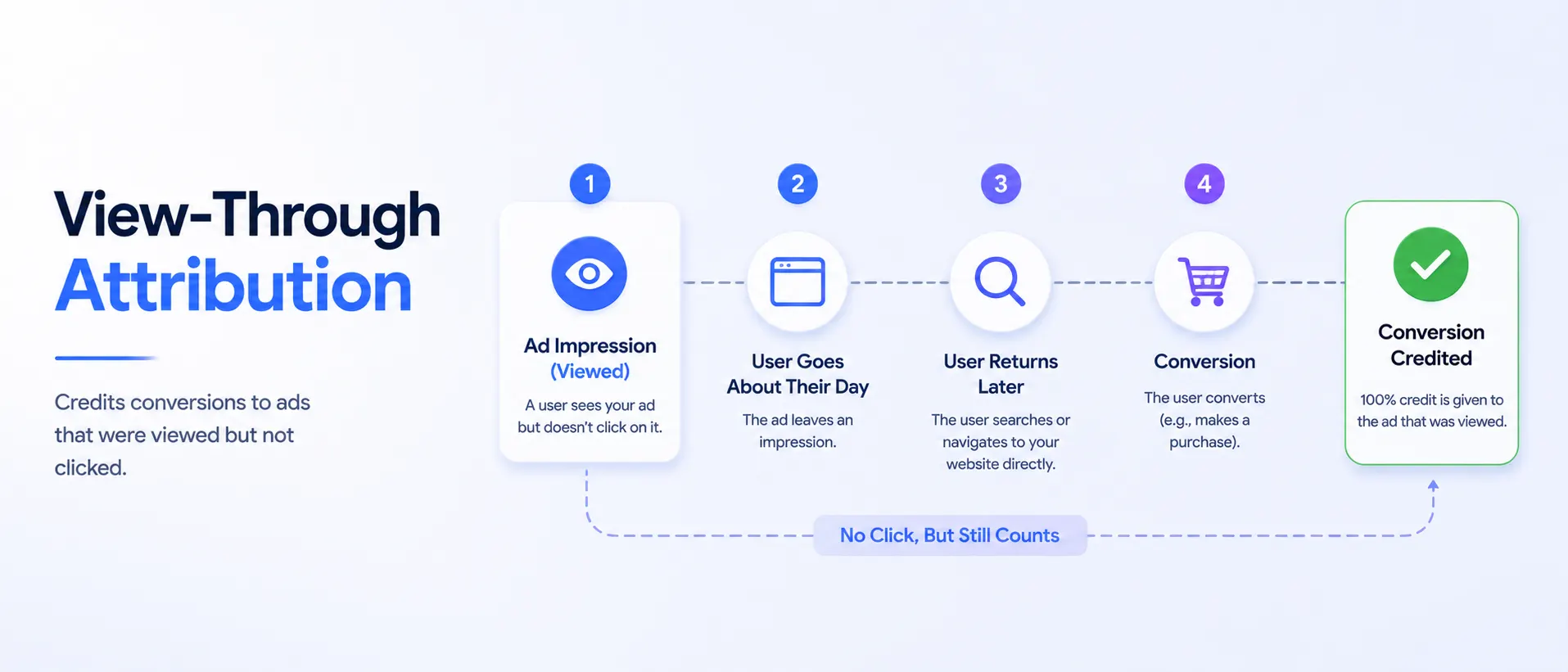
View-through attribution (VTA), also known as view-based attribution or impression attribution, is an attribution measurement approach that credits a conversion to an ad that was viewed, but not clicked.
If a person views your display or video ad and later converts without clicking it, the conversion may be attributed to that ad within the defined attribution window.
It’s like a billboard on the way to work. The advertisement that appears every morning for a week is for a new hotel. You don’t look at a QR code, but on Friday night, you choose to dine there. A click-through attribution would count no influence from those billboard exposures in the campaign. They would be rightly regarded as a catalyst in view-through attribution.
Why Does This Matter in 2026?
The click-only model often misses a significant portion of brand influence because many users convert without clicking an ad. Display ad click-through rates often remain below 1%. At the same time, users increasingly ignore or block advertising content.
View-through attribution bridges the missing measurement gap, particularly for awareness-phase campaigns, programmatic display, video, and connected TV (CTV).
Today, marketers are increasingly using AI in business intelligence and attribution modeling to discover the impact of non-click interactions on revenue across the customer journey.
How View-Through Attribution Works?
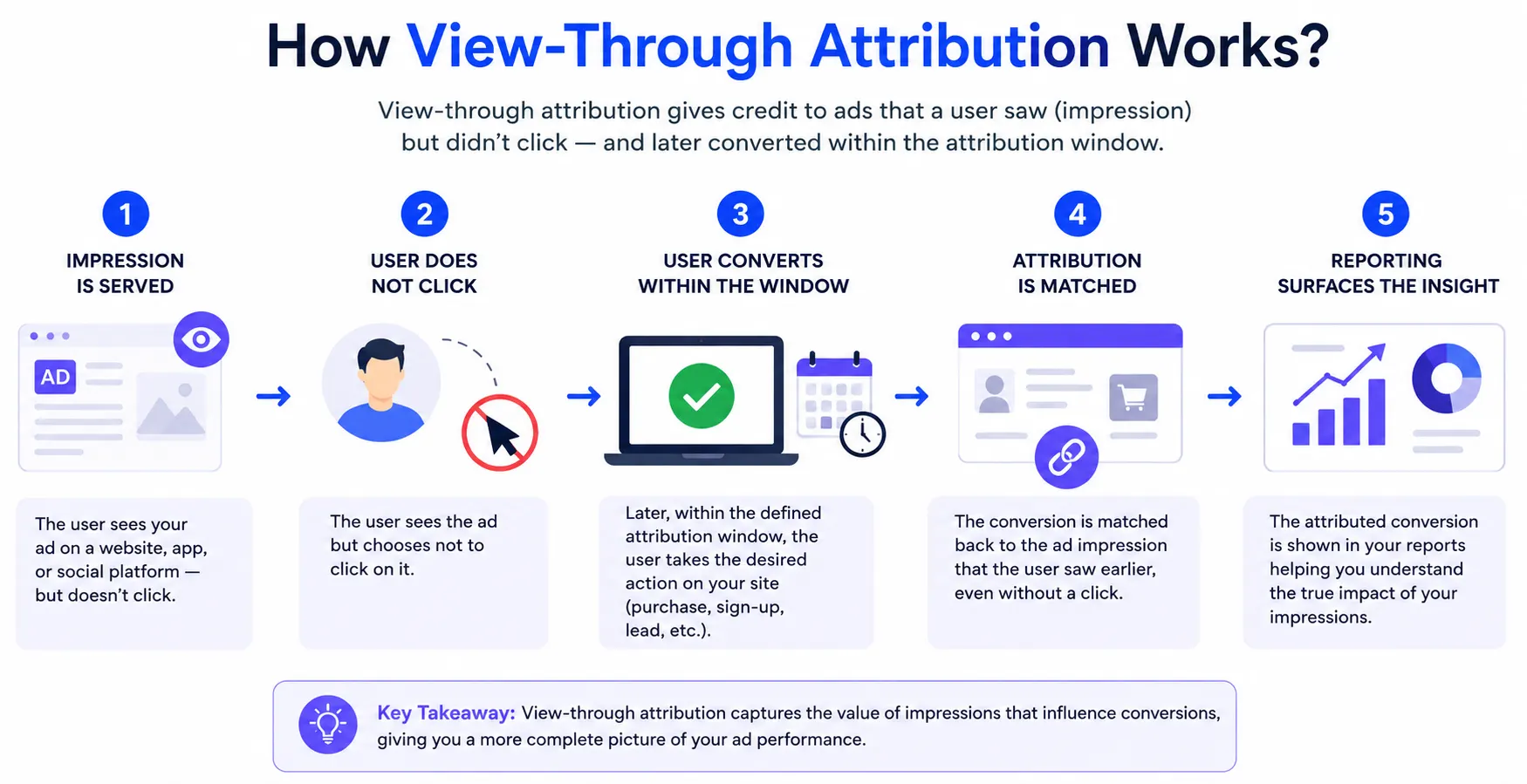
The mechanics of view-through attribution involve three components working together: impression tracking, an attribution window, and a measurement platform.
1. Impression is served
A user views your ad (display banner, video, native, or CTV). The ad platform sends an impression pixel or SDK event, marking the time of the impression to that particular user ID or device.
2. User does not click
The user scrolls past the ad or watches the video without clicking. No click event is triggered, but the impression record is kept.
3. User converts within the window
Later, the user returns through search, direct traffic, or another channel and completes the desired action: purchasing, installing an app, or registering.
4. Attribution is matched
The measurement platform (e.g., a mobile measurement partner or the ad platform) correlates the conversion event with the impression log stored with the ad. Within the window, the impression is given a view-through conversion.
5. Reporting surfaces the insight
This credited impression will appear in your analytics dashboard, allowing you to optimize your budget based on actual influence rather than last-click data.
These insights can then be presented on an ecommerce analytics dashboard, allowing teams to see the proportion of impression-assisted conversions against click conversions, so they can better optimize spend allocation.
Understanding the View-Through Attribution Window?
The view-through attribution window is the maximum duration that the ad impression will be attributed to the conversion. This is probably the most critical configuration choice for any VTA setup, because if it’s too long, you’re over-attributing, and if it’s too short, you aren’t getting influence.
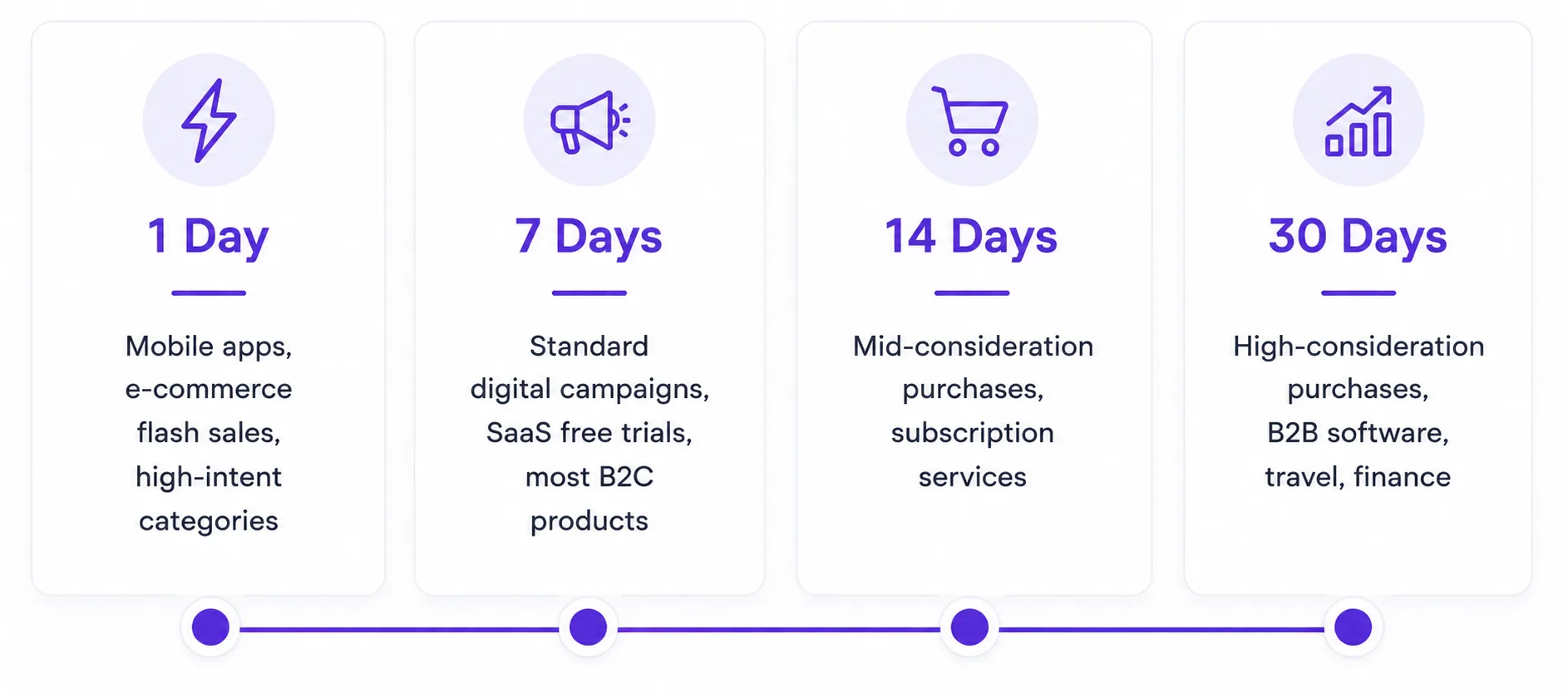
Most platforms have a standard 1-day view-through window for mobile app installs and a 7-day window for website conversions. For example, Facebook/Meta offers advertisers the option to select either a 1-day or 7-day view window based on their campaign objective.
Priority Order When Windows Overlap
Most platforms favor click-through attribution over view-through attribution when both a click and a view lead to a conversion. Only the view attribution is triggered when there’s no click at all within the click window. This way, you won’t have double-counting and keep your data safe.
View-Through vs Click-Through Attribution
It’s essential to know the difference, because choosing and/or mixing models is essential before you can make a decision.
|
Dimension |
View-Through Attribution |
Click-Through Attribution |
| Trigger | The number of impressions that were seen but not interacted with | Ad click |
| Best Suited For | Display, video, CTV, and awareness campaigns focused on message exposure | Real-time bidding, retargeting, and direct-response ads |
| Measurement Signal Strength | Weaker (indirect intent) | Stronger (explicit intent) |
| Risk of Over-Attribution | Higher with longer attribution windows | Lower, but may miss upper-funnel influence |
| Typical Window | 1–30 days | 7–30 days (click window) |
| Priority in Conflict | Lower (defers to click attribution) | Higher (takes precedence) |
| Impact on Brand Campaigns | Essential for measuring brand campaign value | Minimal impact on brand campaign measurement |
Smart marketers use both models and rely on unified attribution dashboards like ProactiveAI to analyze conversion paths and optimize budgets based on incremental lift, not a single attribution model.
View-Through Attribution on Facebook (Meta)
Facebook, now Meta, is one of the most widely used platforms for view-through attribution, and its settings deserve special attention. View-through attribution on Facebook is set up at the ad set level in Meta Ads Manager under “Attribution Settings.
Consider the following Facebook view-through attribution windows:
- 1-day view: Recommended for mobile app install campaigns and time-sensitive promotions
- 7-day view: Suitable for standard purchase or lead gen campaigns with longer consideration cycles
The default attribution period on Facebook (as of 2026) is 7-day click + 1-day view. This means Meta gives a credit for a conversion if the user clicked through your ad within the previous 7 days or simply watched your ad within the last 1 day. You can customize these settings to match your campaign goals and typical customer buying cycle.
iOS 14.5+ and Its Impact on VTA
The introduction of Apple’s App Tracking Transparency (ATT) framework significantly affected the ability to track impression data at the user level in iOS.
As a result, Facebook’s view-through attribution on iOS is now modeled using aggregated and probabilistic methods via the SKAdNetwork framework. This change increases the importance of privacy-friendly third-party measurement solutions for mobile attribution.
When Should You Use View-Through Attribution?
View-based attribution isn’t suitable for all types of campaigns. This is a helpful decision tool:
Use VTA When:
- You are running brand awareness or upper funnel campaigns where clicks aren’t really a KPI.
- You can include programmatic display, YouTube, CTV/OTT, or native ads in your channel mix.
- Your product is in a longer consideration cycle (finance, automotive, B2B software)
- You want to understand how non-click touchpoints contribute to conversions across the customer journey.
- You are testing whether awareness budgets are driving down-funnel conversions.
Do not use VTA (or use with caution) When:
- You have a long attribution window relative to the average buyer’s journey, which can lead to over-attributing the sale to their first interaction on your website.
- You are in a high-volume-impressions environment (broad social campaigns, for example) where virtually every converter will have seen the ad.
- You are looking at direct-response or retargeting campaigns, where there are clearly intent signals.
- You do not have any reliable pixel, CAPI, or SDK integration providing you with an impression-matching mechanism.
Best Practices for View-Based Attribution
Getting view-through attribution right requires disciplined setup and ongoing calibration. Here are the practices that separate accurate measurement from misleading data:
1. Start conservatively with windows:
Start with a 1-day view window, then increase it if there are high correlations between view and conversion after 24 hours.
2. Always prioritize click over view:
Make sure that the measurement platform detects deduplication; someone who clicks shouldn’t also be counted as a view-through conversion for the same event.
3. Use incrementality testing:
Conduct holdout groups to determine the actual lift from impression exposure. This determines whether your VTA conversions are truly a result of the ad or would have occurred naturally.
4. Segment by channel:
Use different window frames for each channel, a narrower window for social display, a wider one for CTV or YouTube, where recall effects are longer.
5. Watch the VTC rate (view-through conversion rate) over time:
If your VTC rate increases suddenly, investigate whether ad frequency, audience overlap, or attribution settings are influencing the results.
6. Connect with a third-party application:
Relying solely on self-reported VTA data from ad platforms can introduce significant measurement bias. Reconcile data across channels with a neutral measurement layer such as ProactiveAI.
Why ProactiveAI is the perfect View-Through Attribution Partner?
Accurate view-through attribution requires consistent measurement across multiple advertising platforms. It requires a single analytics layer that integrates impression and conversion data from all channels, applies the same attribution logic, and removes data duplication.
Our analytics platform, ProactiveAI, merges click and impression data from Facebook, Google, DSPs, CTV platforms, and more ad networks into an attribution dashboard. Without overloading the technical support team, marketing teams can measure campaign performance, conversion paths, and attribution patterns using self-service analytics.
We also provide configurable view-through attribution windows at the campaign, ad set, and channel levels. It provides incrementality and lift analysis tools to ensure attributed conversions are really driving incremental revenue.
Designed for a privacy-centric environment, ProactiveAI employs impression-matching techniques that adhere to privacy safeguards. Our automated anomaly alerts and integrations with AppsFlyer, Adjust, and major ad platforms provide accurate, real-time attribution data.
Conclusion
View-through attribution is not a vanity metric. It helps correct the limitations of click-only measurement models. When most impressions do not generate clicks, relying solely on click-through attribution can lead to incomplete budget decisions.
Brand influence has a sneaky way of shaping purchases over days or weeks, often long after the initial impression.
Balance is the most important thing to remember: depending on the channel, consider the correct view-through attribution window and give credit to the click when it’s there. Validate the lift with a holdout test and use a trusted analytics platform to reconcile data across the entire system.
From scaling app installs to running upper funnel video ads and optimizing a complex multi-channel mix, ProactiveAI provides the measurement infrastructure you need. It helps make view-through attribution work accurately, transparently, and at scale.
Frequently Asked Questions
What is view-through attribution?
View-through attribution is a technique that tracks conversions that occur after a user has seen an ad, but has not yet interacted with it. It helps ecommerce brands understand the indirect impact of display, video, and social ads on customer purchase decisions.
How is view-through attribution different from click-through?
View-through attribution attributes conversions after ad impressions (without clicks), and click-through attribution attributes conversions after the user clicks an ad. Both models assess advertising performance and the effectiveness of customer journeys in different ways.
What is a standard view-through attribution window?
Usually, view-through attribution windows are set to 1 to 30 days, depending on platform and campaign objectives. One of the more popular choices for analysis is 7 days or 14-day attribution window.
Should ecommerce brands use view-through attribution?
Yes, ecommerce brands should use view-through attribution to track the impact of awareness-building efforts and display ads. It offers insights that go beyond last-click and direct-click analysis of customer behavior.
You might also like
Handpicked articles for your reading list.

Get the latest insights on Conversational AI
Stay ahead of the curve with weekly updates on data analytics, AI trends, and eCommerce growth strategies delivered straight to your inbox.
Join 5,000+ industry leaders. Zero spam, just pure insights.