
 SparxIT
 SPXCommerce
 What's Your A



eCommerce
AI & Analytics
First-Party Data Strategy for eCommerce: How to Collect, Use, and Future-Proof Your Customer Data
-
Diksha Singh
- Jun 25, 2026
- 9 mins read
Do you have an ad campaign running on Meta, and your ROAS seems to be reasonable in Ads Manager? But what about your actual income? Flat. After some time, you realize that your audience targeting was based on third-party cookie data that has been out of date for months, is inaccurate, and is increasingly being blocked by browsers. You’re flying blind, and your ad investment is suffering.
This scenario reflects the reality of eCommerce in 2026. Third-party cookies have become increasingly obsolete, and mobile attribution has grown significantly more challenging. The privacy changes iOS has introduced have completely ruined mobile attribution. Signal loss is very tangible. The brands that are doing well aren’t the ones spending more, and they’re the ones with better data.
The solution is a purposeful first-party data strategy for eCommerce. The problem with every ad platform is that they take that from you. When you collect your own data (with permission), you get something none of them will ever give you: a clear, accurate, and lasting understanding of who your buyers are and what they want. All that data translates to improved segmentation, more intelligent personalization, more accurate attribution, and much more efficient ad spend.
This guide will take you from tactic to tactic, from cookieless tracking to customer data platforms and from analytics to AI, explaining precisely how to build, activate, and future-proof that strategy.
What Is First-Party Data in eCommerce?
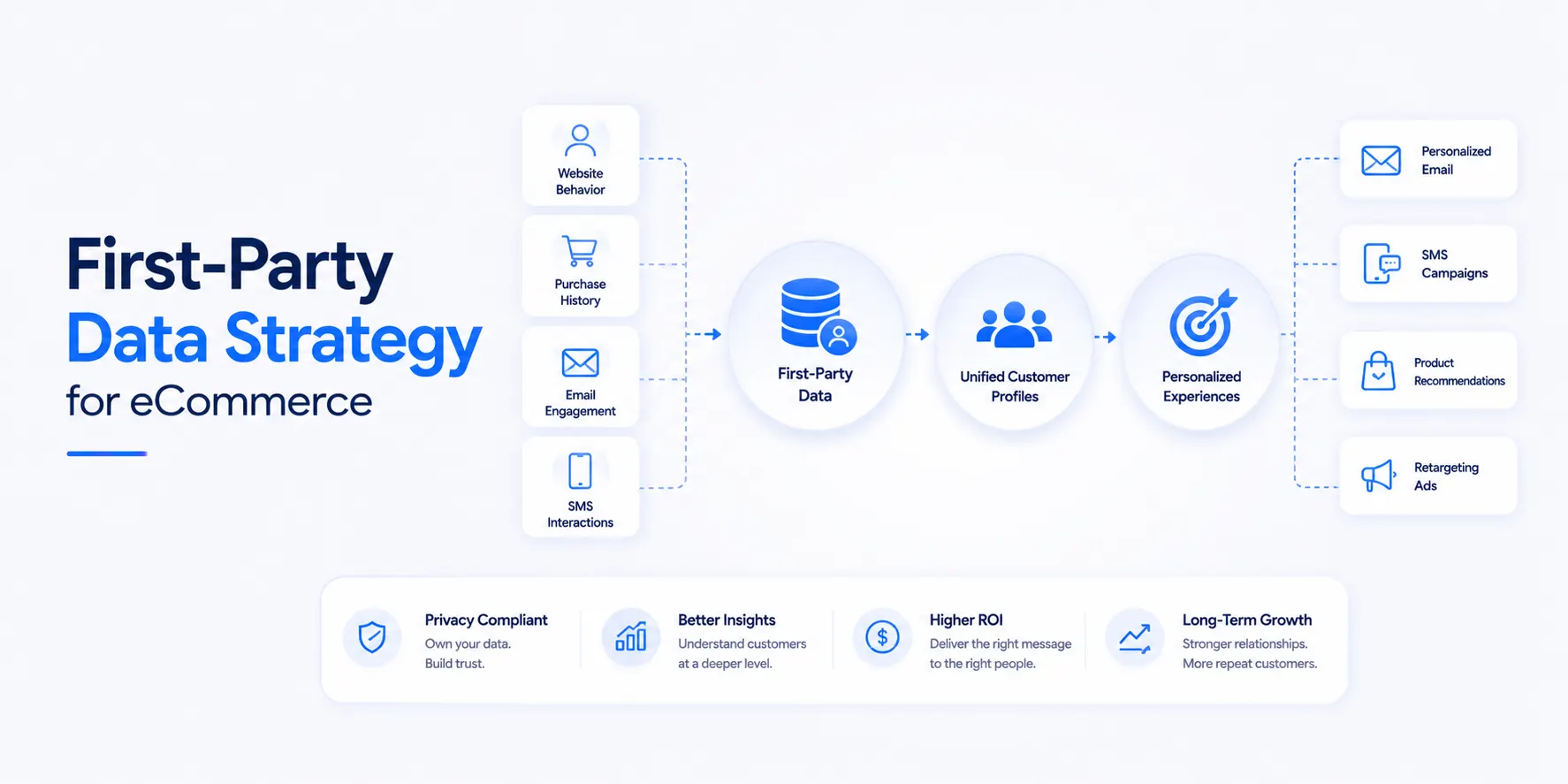
First-party data refers to information that businesses collect directly from customers through owned channels with appropriate consent and transparency.
In an eCommerce context, this includes:
- Clickstream data: pages viewed, product clicks, time on site, cart additions
- Transactional data: Purchase history, order value, return history, frequency
- Account data: Name, email, shipping address, and saved preferences.
- Engagement data: Email opens, SMS replies, loyalty program usage
- Support data: Chat transcripts, reviews, post-purchase survey responses
It is the ownership that is the hallmark. You collected it. You store it. You control it. Because organizations own first-party data, browser policy changes are less likely to disrupt their availability and usability.
Third-party data is the equivalent of leasing a customer record from another list. First-party data is the creation of a database of your own contacts, organized by meaningful relationships.
First-Party vs. Zero-Party vs. Third-Party Data
Knowing the difference between the various types of data is essential to developing a smart first-party data strategy.
|
Data Type |
Source | Collection Method | Accuracy |
Privacy Risk |
| Zero-Party Data | Customer willingly shares | Quizzes, preference centers, surveys | Very High | Very Low |
| First-Party Data | Your own properties | Web analytics, website purchases, CRM | High | Low |
| Second-Party Data | Partner’s first-party data | Data-sharing agreements | Medium | Medium |
| Third-Party Data | Aggregators and data brokers | Cookies, data marketplaces | Low | High |
Zero-Party Data vs. First-Party Data: What’s the Real Difference?
Zero-party data is information you receive willingly and intentionally from the customer, such as a customer telling you their skin type in a beauty quiz or choosing the product categories they prefer during onboarding.
First-party data, on the other hand, is observed and it’s based on actions someone takes on your website or your communications. Both are priceless, and the richest eCommerce brands use both to create comprehensive and accurate profiles of their customers.
The takeaway for 2026 is that if you have your zero-party and first-party data infrastructure properly set up, then you don’t need to rely on third-party data.
Why First-Party Data Is More Critical Than Ever in 2026?
The removal of third-party cookies from Chrome, after Firefox and Safari, has been the most seismic change in digital marketing in 10 years. Throw in Apple’s App Tracking Transparency (ATT) approach, the growing enforcement of GDPR and CCPA, and the data landscape has been forever transformed.
Here’s what that means in practice for first vs. third-party data:
- Attribution gaps: If your audience is on Meta or Google, then you can expect 30-60% of the signals you relied on in pre-2021 days to be lost.
- Audience Degradation: Lookalike audiences built from thin-pixel data aren’t performing as well year over year.
- Rising CPMs: Less accurate targeting means less efficient spend, driving costs up across channels.
Brands that have taken the initiative to invest in first-party data are now experiencing tangible benefits, including reduced CAC, increased ROAS, and improved revenue forecasting accuracy. This is not about future-proofing, it’s about giving yourself a competitive edge today.
Best First-Party Data Collection Tactics for eCommerce
The best first-party data collection strategies are not a one-size-fits-all. The data collection process feels more like a value exchange than a form of interrogation, as it’s woven into the natural flow of the customer experience.
On-Site Collection
- Progressive profiling: No all-in-one forms. Request an email, then a telephone call, then preferences for multiple points of contact over time.
- Product quizzes and recommendation tools: “Find your perfect fit” quizzes generate high-intent zero-party data while improving conversion.
- Loyalty program enrollment: Promises of access to the gate, discounts, or reward points in exchange for signing up. People are happy to give out data if they feel it serves a purpose.
- Post-purchase surveys: A simple “How did you hear about us?” (HDYHAU) survey post-checkout gives you attribution data that no pixel can capture.
Email & SMS Opt-Ins
- Clearly communicate the value customers will receive, such as discounts, exclusive content, or early access to promotions. Don’t use the same language for “subscribe to our newsletter”.
- Don’t add people to an opt-in list unless they are opting in. Understand why a person signed up: a product quiz vs. a checkout discount. This context is important for personalization later.
Behavioral Tracking (On Your Own Domain)
- Use server-side tracking (as covered in Section 7) to track on-site behavior even if the browser-side tracking scripts are disabled.
- Monitor micro-interactions: how far users scroll, video views, and wishlist additions, and these signal intent before a cart event does.
In-Store and Offline Data
For brick-and-mortar stores or pop-ups, link them to your digital CRM. If a customer purchases in-store and then conducts online research, they’re telling you something about their journey.
How to Activate First-Party Data Across Ad Platforms
Gathering first-party data is just part of the picture. The other half is turning it back on, sending it back to your ad platforms to tighten targeting, better measure, and waste less money.
Meta: Conversions API (CAPI)
The CAPI Conversion API ecommerce integration allows you to share conversions without using the browser. This means:
- Server-side tracking helps recover conversion events that browser restrictions and privacy changes may otherwise limit.
- Your Event Match Quality (EMQ) score increases, directly boosting ad delivery and ad optimization.
- You get more accurate purchase attribution without depending on the Meta Pixel alone
Best practice: Run both CAPI and Pixel concurrently (with deduplication enabled) during the transition period, and assess which data source is cleaner.
Google: Enhanced Conversions
Enhanced Conversions, by Google, functions in much the same way, such as hashing first-party information (such as email or phone) and matching it to signed-in Google users to recover lost conversion signals.
Custom Audiences and Lookalikes
Upload your customer email lists to Facebook, Google, and TikTok to create Custom Audiences using real purchase behavior rather than modeled cookie data. From that point, create Lookalikes for your highest-value customer segments (e.g., the LTX top 10%).
This is where first-party data pays off: Lookalikes built on actual purchase data always outperform those built on pixel signals alone, particularly in a cookieless world.
The Role of a Customer Data Platform (CDP) in Your Stack
All of this is scalable because it is implemented through a customer data platform (CDP) ecommerce deployment. A CDP brings together data from all of your touchpoints into one customer profile, everything from your website to your email system, CRM, ads, loyalty program, and point of sale.
If you don’t have a CDP, you end up with data silos: your email tool has one piece of data about a customer, your ad platform another, and your support desk yet another. A CDP brings those dots together.
Key capabilities to look for in an eCommerce CDP:
- Real-time identity resolution: Stitch anonymous sessions to known customers when they log in or convert
- Audience segmentation: Create dynamic segments that are automatically updated when customer behavior changes
- Activation connectors: Push segments directly to Meta, Google, Klaviyo, and other platforms
- Data governance tools: Control data consent, retention, and compliance in one place.
Some of the most popular tools in the space are Segment, Bloomreach, and Simon Data, but the right choice depends on the size of your dataset, your team, and your existing tech stack.
Building a Cookieless Tracking Infrastructure
Cookieless tracking ecommerce is not tracking less, but tracking smarter without relying on third-party browser cookies.
Server-Side Tracking
Server-side tracking moves analytics and conversion measurement from the browser to a server environment, improving data reliability and control. The reduced flow is as follows:
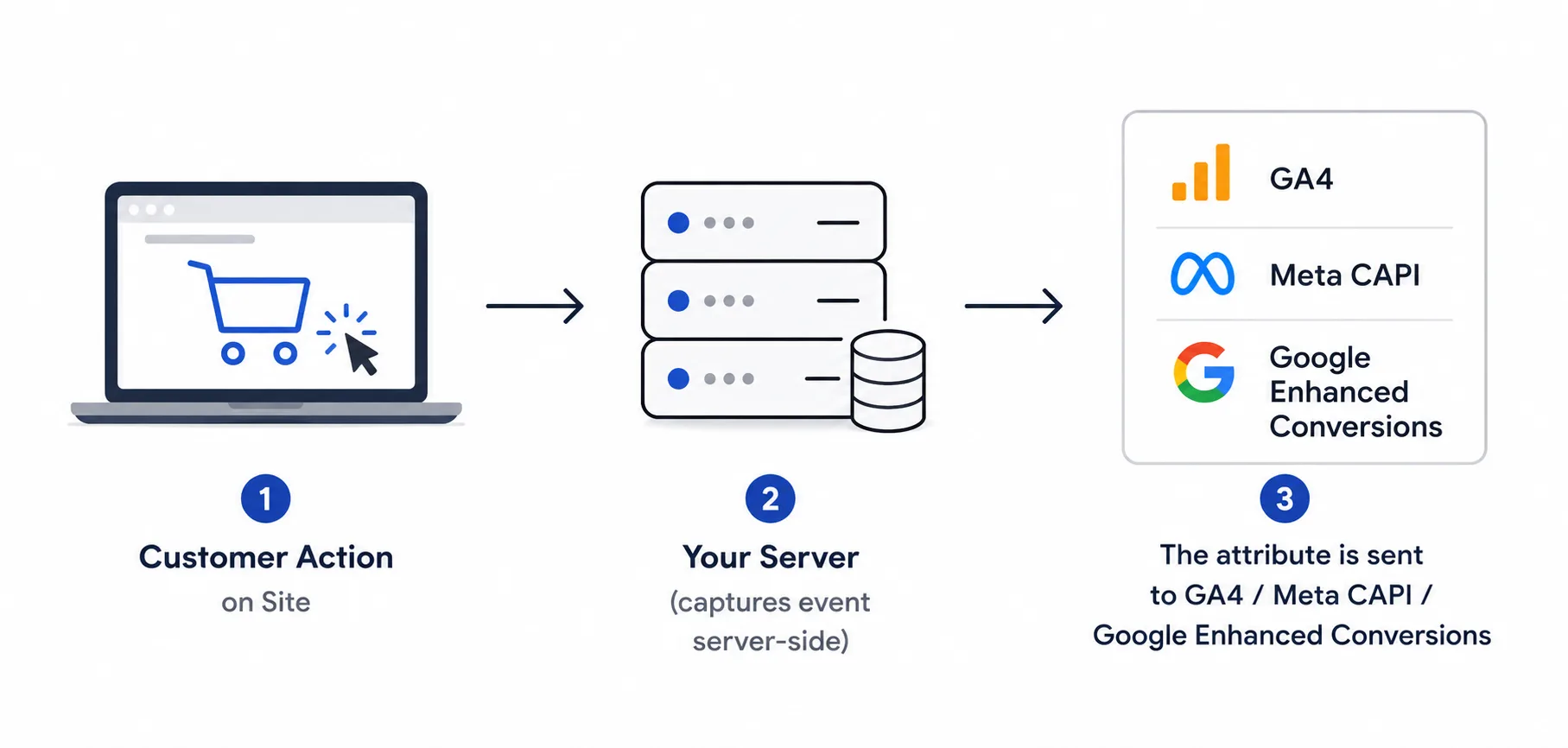
This way, you can improve the accuracy of your data and have more control over what data is shared with third parties.
First-Party Cookies (Not the Same as Third-Party)
If you install your tracking cookies in a “first-party” context (your own domain), that will seriously reduce the likelihood that they are blocked by browsers such as Safari or Brave. There are tools such as Elevar or Stape.io that specialize in setting it up for Shopify and WooCommerce stores.
Probabilistic and Modeled Data
None of the systems will achieve 100% conversion rate. The gaps are being filled for platforms such as GA4 and Meta using modeled attribution. However, it can only model accurately when robust first-party signals serve as anchors. That is why your owned data collection will remain the basis and not just a ‘nice to have’.
How ProactiveAI Fits Into Your First-Party Data Strategy?
Here’s where strategy becomes action. ProactiveAI is an eCommerce analytics platform built to empower DTC and online brands to extract the maximum value from their first-party data while eliminating the need for a dedicated data science team.
It integrates store performance, customer behavior, and marketing channel data into a single dashboard, giving you a comprehensive view of your business without switching between tools.
Teams don’t have to create complex reports and instead can ask simple questions and get immediate insights via conversational AI. This speeds up data analysis and facilitates it throughout the enterprise.
ProactiveAI also leverages predictive analytics to forecast revenue, demand, and customer trends, enabling businesses to make informed decisions about their inventory, marketing investments, and promotions.
Self-service analytics allows each team to discover what matters most to them in the data, and high-value customer audiences can be identified and activated through advanced Segmentation. This translates to quicker decisions, higher performance, and a competitive edge.
Best Practices to Future-Proof Your eCommerce Data Privacy Strategy
An ecommerce data privacy strategy isn’t limited to compliance, and it’s about creating and sustaining customer trust, which grows with time.
1. Be transparent and consensual
Employ clear consent banners, simple language in privacy policies, and explicit opt-in language for all points of data collection. It’s much more likely that customers will provide accurate information when they know what they’re signing up for.
2. Create a preference center
Provide customers with control over the information you have and how you use it. This helps minimize customer attrition among users concerned about their privacy and fosters trust and engagement that can lead to long-term customer value.
3. Create a data governance plan
Understand the locations, lifetimes, and access to all customer data. The enforcement of the GDPR and the CCPA continues to become more stringent, and so are their penalties for non-compliance.
4. Invest in enrichment and not only in collection activities
Raw data does not equal insight. Over time, expand your first-party profiles with behavioral signals, purchase frequency metrics, and predictive LTV scores to make your data more actionable over time.
5. View data as a product
Ownership, quality control, and periodic pipeline audits for accuracy and completeness. With AI systems and ad platforms, garbage in, garbage out, particularly when it comes to their data.
6. Diversify your channels
Email, SMS, and loyalty programs are all first-party channels. Having a diversified owned-media mix protects from one platform change wreaking havoc on your customer relationships.
Conclusion
What all of these brands have in common in their eCommerce success is that they are in control of their customers, rather than just their products. It’s ownership that is worthy of its name and can be monetized through a mature first-party data marketing strategy that covers data collection, data unification, data activation, and data analysis.
First-party data isn’t a project for your data team. It’s a business approach that involves acquisition, retention, personalization, and measurement. Each customer contact is a learning moment to enhance the next interaction.
Organizations do not need to build these capabilities entirely in-house. Tools like ProactiveAI are specifically designed to help eCommerce brands leverage the intelligence in their first-party data and make revenue decisions you can be confident in.
Frequently Asked Questions
What is first-party data in eCommerce?
First-party data in eCommerce refers to information you gather from your own customers via your website, mobile app, email, or loyalty programs, with their permission. It contains purchase history, browsing activity, and account preferences, and that’s all yours, under your control.
How is first-party data different from zero-party and third-party data?
First-party data is data collected from customer behavior, and zero-party data is data collected proactively by customers, such as their answers to a quiz. Third-party data is unreliable, comes from outside intermediaries, and is becoming more limited due to browser policies and privacy standards in 2026.
Why is first-party data more important in 2026 than ever before?
Third-party cookies are no more, privacy changes have made mobile attribution much more difficult, and regulators such as the GDPR are aggressively enforcing data privacy laws. Brands with weak first-party data are seeing rising CPMs, less accurate attribution, and shrinking audiences on paid channels.
What are the best ways for eCommerce brands to collect first-party data?
Top tactics include loyalty program enrollment, product recommendation quizzes, post-purchase surveys, email and SMS opt-ins with clear value offers, and server-side behavioral tracking on your own domain, all anchored in transparent customer consent and genuine value exchange.
How do you activate first-party data in ad platforms like Meta and Google?
Upload hashes of customer lists as Custom Audiences, use Meta’s Conversions API (CAPI) for server-side signal sharing, set up Google Enhanced Conversions, and create Lookalike Audiences based on your highest LTV lists to better target your customers without relying on cookies from third parties.
You might also like
Handpicked articles for your reading list.

Get the latest insights on Conversational AI
Stay ahead of the curve with weekly updates on data analytics, AI trends, and eCommerce growth strategies delivered straight to your inbox.
Join 5,000+ industry leaders. Zero spam, just pure insights.