
 SparxIT
 SPXCommerce
 What's Your A


eCommerce
Marketing
First-Click Attribution: What It Is, Pros, Cons & When to Use It
-
Varun Kumar
- Jun 08, 2026
- 7 mins read
You’re investing a large portion of your budget in paid search, social media, email, and display, and you need to know what really got people into your business’s buying cycle, but you have no data to act on. You know who your customers are, but what channel got them interested in the product, service, or offering in the first place? It’s one of the biggest issues plaguing first-click attribution marketing, and it catches brands at every level.
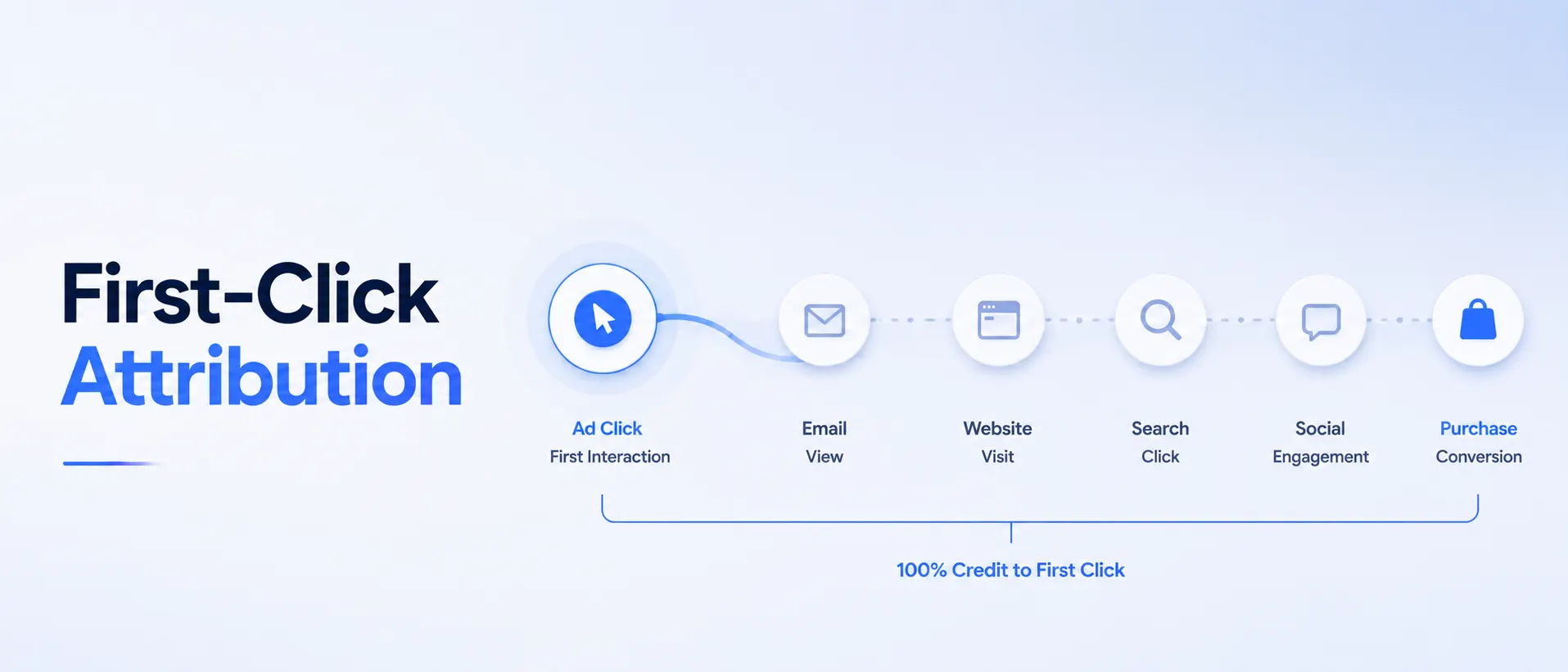
It’s not about throwing money at all channels and hoping for the best. It’s about taking an attribution approach to respond to a specific strategic question: Where do my best customers come from? The goal of the first click attribution model is just that. It puts the spotlight on the first interaction in which the channel or ad introduces a stranger to your brand and assigns 100% of the credit for the conversion to that channel or ad.
In the context of modern attribution, AI plays a pivotal role in linking the dots across touchpoints in a customer’s journey, helping businesses determine which channels drive their most valuable customers.
Under the right circumstances, first-click attribution can be an incredibly effective tool for boosting brand awareness, expanding top-of-funnel initiatives, and improving channel investment decisions.
In this guide, you’ll learn in-depth what first click attribution is, why it differs from other models, its pros and cons in practice, and when and when not to use it.
What Is First-Click Attribution?
First-click attribution (also known as first-touch attribution) is one of the marketing attribution models that gives full credit for the conversion to the first marketing touchpoint a customer interacted with before converting. After they’ve followed the same path on ads, opened the emails they received, and then done organic searches, the first interaction is all that matters.
Imagine tracing a river back to its source! It’s possible to travel through mountains, valleys, and cities until you finally arrive at the ocean, but only the spring where the water first flows matters for the first-click attribution.
If your product is first seen by a customer in a Google Search ad, then in a Facebook retargeting ad, and finally converted via email, the value goes to the Google Search ad.
How Does the First-Click Attribution Model Work?
The mechanics are kept as simple as possible. You have all of the touchpoints tracked throughout a customer’s journey in your analytics or attribution platform. If the system records a conversion, it searches the conversion history backward to find the earliest recorded interaction. All touchpoints after that touchpoint get zero credit clicks, revenue, or ROAS.
This is most commonly done through UTM parameters, cookies, or a pixel-based tracking system. If a user is redirected to your site for the first time via a paid ad, they are marked with that source, and the source is stored. If the same user returns later through a different channel, the same touchpoint is attributed to the original source.
First-Click Attribution Example
Let’s make this concrete. Let’s say it was a SaaS company running campaigns across several channels. Suppose it was a SaaS organization and they were running campaigns across multiple channels. This is the journey that a prospect takes prior to buying a $299 annual subscription:
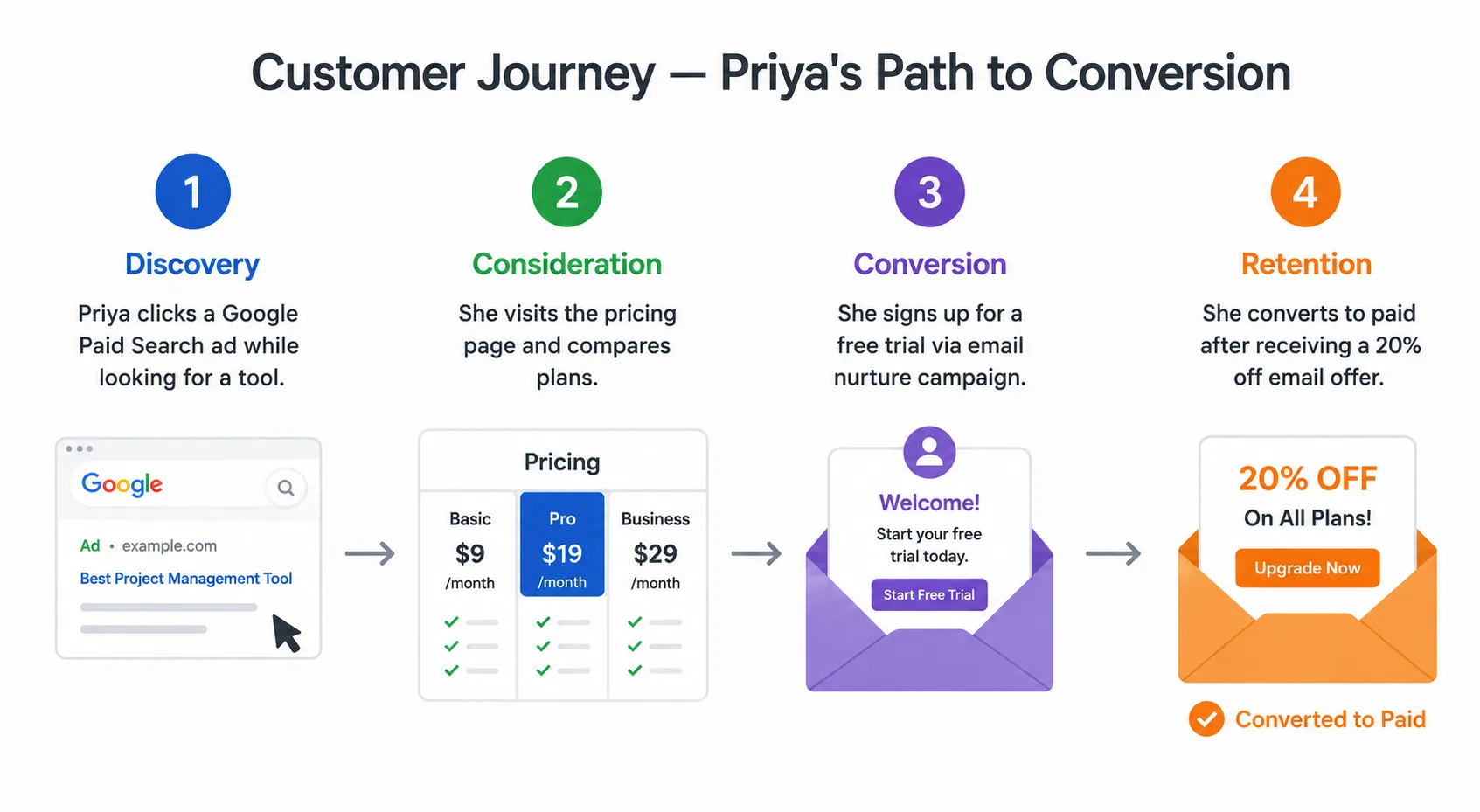
This is a great example of how powerful yet restrictive first-touch attribution can be. The Google ad is rightly known as the discovery engine, and without it, Priya would never have fallen into the funnel. The email that ultimately did the deal, however, is not even mentioned.
Detailed Comparison of First-Click vs Last-Click Attribution
One of the most popular topics in the performance marketing world is the first-click vs. last-click attribution model. They are both single-touch models, but they’re at opposite ends of the customer experience.
|
Attribute |
First Click Attribution |
Last Click Attribution |
| Credit Given To | First touchpoint | The final place where a user interacted with the website before converting |
| Primary Question Answered | “What was the catalyst that got them going?” | “What was the clinching factor that got them to close?” |
| Best For | Brand awareness, top-of-funnel | Direct response, bottom-of-funnel |
| Favored Channels | On-page optimization, Social Discovery, Paid Search, and Display | Email, Retargeting, Branded Search |
| Middle Funnel Credit | None (ignored) | None (ignored) |
| Complexity | Simple | Simple |
| Risk | Invests more in awareness than is required | Increases capital investment in closing channels |
No single model is “the best. This is a decision that is dependent on the question you are attempting to answer. Brands in a high-awareness stage are better suited to first-click, while brands focused on conversion efficiency are better suited to last-click.
Advantages and Disadvantages of First-Click Attribution
As with all attribution models, first click attribution has its legitimate advantages and significant disadvantages. As always, here’s a candid evaluation:
|
Pros |
Cons |
| Simple to implement, as it does not require complex weighting algorithms or machine learning models. | Fails to recognize middle- and bottom-of-funnel touchpoints, even when they significantly influence conversions. |
| Provides clear top-of-funnel insights, making it easy to identify where audiences originate. | Can lead to budget misallocation by overinvesting in awareness channels while underinvesting in retention and nurturing efforts. |
| Ideal for awareness campaigns where brand discovery is the primary KPI. | Creates challenges for B2B companies with 6–18 month sales cycles because valuable context from the middle of the journey is lost. |
| Easy for stakeholders to understand because it avoids technical complexity. | If the final purchase trigger is not captured, channels like email or retargeting ads receive no attribution credit. |
| Gives visibility to channels that are often undervalued in last-click models, such as display advertising or YouTube campaigns. | If first-touch tracking fails, the resulting data gaps can compound errors and cause the attribution model to break down entirely. |
When to Use First Click Attribution?
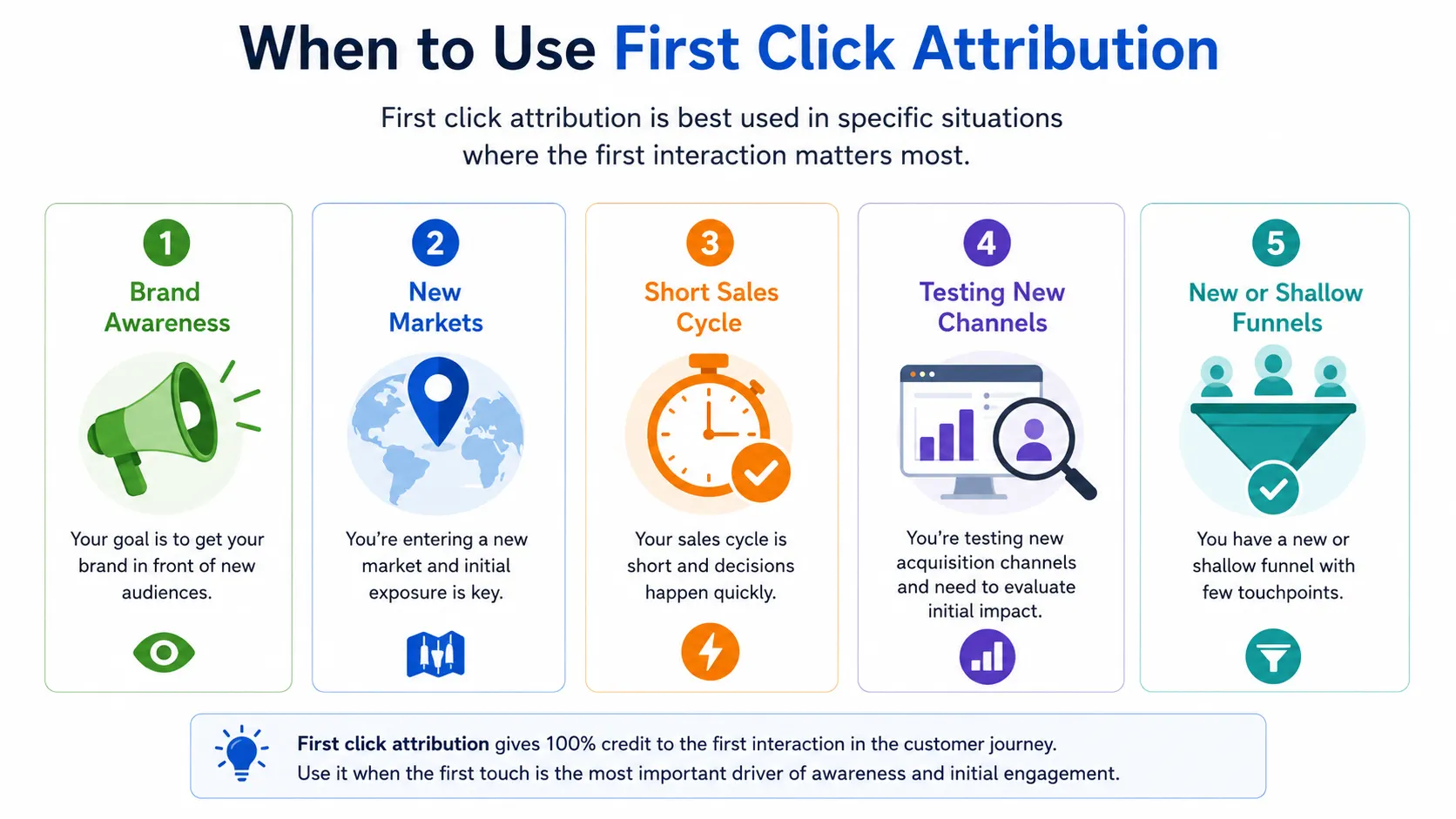
“First click attribution” is not a one-size-fits-all solution. It’s very good at certain strategic situations and poor at others. Feel free to use it when:
- You’re optimizing for brand awareness: Your primary goal is to get your brand in front of new audiences, not just convert existing demand.
- You enter a new market: Knowing where to gain the most initial exposure is important.
- Your sales cycle is short: If it takes no longer than a few minutes to consider your product, the first impression might be the last.
- You’re testing new acquisition channels: First-click helps you evaluate which channels are generating genuine new audience vs recycled converters.
- You have a new or shallow funnel: If you’re a startup in the early stages with limited touchpoints per funnel, you might be able to go with a single-touch model, such as first click.
Number of Other Attribution Models to Know
The first-click attribution concept isn’t an isolated one. Knowing its place in the big picture allows you to make more effective modeling choices:
|
Model |
How Credit Is Distributed |
Best Use Case |
| First Click Attribution | 100% of the credit is assigned to the first touchpoint. | Best for awareness campaigns and acquisition optimization. |
| Last Click Attribution | 100% of the credit is assigned to the final touchpoint before conversion. | Best for direct-response marketing focused on driving immediate actions, such as purchases or newsletter sign-ups. |
| Linear Attribution | Credit is distributed equally across all touchpoints in the customer journey. | Best for obtaining a balanced, full-funnel view of marketing performance. |
| Time Decay Attribution | More credit is given to touchpoints that occur closer to the conversion event. | Best for campaigns with shorter sales cycles, limited-time promotions, or lead generation efforts. |
| Position-Based (U-Shaped) Attribution | Typically assigns 40% credit to the first touchpoint, 40% to the last touchpoint, and 20% to middle interactions. | Best for brands focused on both customer discovery and conversion. |
| Data-Driven Attribution | Credit is distributed algorithmically based on each touchpoint’s actual impact on conversions. | Best for organizations with large-scale, mature marketing operations and sufficient historical data. |
The most advanced marketing units do not pick just 1 model, as they employ several models at once to help them triangulate the truth. This is a core capability of ProactiveAI’s attribution engine that allows you to switch between models and reveal the full narrative of each customer journey.
How ProactiveAI Elevates Your Attribution Strategy?
Understanding the first-click attribution conceptually is one thing, and acting on it accurately and at scale is another. This is where ProactiveAI, an intelligence-driven marketing analytics platform, becomes your strategic advantage.
We bring you together cross-channel data, advanced attribution modeling, and AI-powered insights into a unified dashboard, so you can move from confusion to clarity in minutes, not weeks.
Our platform also comes with an ecommerce analytics dashboard, allowing marketers to view initial touch performance, conversion paths, and campaign effectiveness on a single platform.
Growth marketers seeking to demonstrate the effectiveness of a new awareness initiative, CMOs defending top-of-funnel budget allocations, and analysts building a complete attribution framework can all benefit from using our platform. With our platform, you gain the data infrastructure needed to make every attribution model actionable, including first-click attribution.
Self-service analytics is easier to use for growing teams, enabling them to explore attribution data, compare campaign performance, and view the data without relying on technical teams.
Conclusion
One of the best yet most misunderstood tools in today’s marketer’s arsenal is first-click attribution. It answers the question, which no other one-touch model can: which channel is bringing my best customers into my world?
It is not going to explain the full story of every conversion to you. There is no one-size-fits-all solution for attributions.
However, when implemented as part of a multi-layered analytics strategy, first-touch, last-touch, and multi-touch approaches go hand in hand and, in that context, are irreplaceable tools for scaling up what works and eliminating what does not.
Not all the brands that won in 2026 have the deepest pockets. They’re the ones who have the best visualization of their customers’ journeys.
Begin with first-click attribution to learn what is driving your traffic, then add more in-depth attribution, such as richer models to learn about the entire journey, and use a platform like ProactiveAI to intelligently, accurately, and in real time combine it all.
Frequently Asked Questions
What is meant by first-click attribution?
First-click attribution is a marketing measurement model that assigns 100% credit for a conversion to the customer’s very first interaction with a brand, which is the channel that initially brings in new customers.
How does first-click attribution differ from last-click?
First click attribution gives all credit to the first click that leads to a conversion; last click attribution gives all credit to the last click that leads to a conversion. It’s about celebrating the start and/or end of the trip.
When should you use first-click attribution?
First-click attribution is most effective for businesses trying to assess the impact of their campaigns, channels, and content on driving brand awareness and capturing potential customers in the initial stages of their customer journey.
What are the disadvantages of first-click attribution?
First click attribution’s biggest drawback is that it doesn’t account for subsequent customer interactions, which can be important for conversions, making it difficult to see the whole picture of nurturing campaigns and multi-channel marketing.
You might also like
Handpicked articles for your reading list.

Get the latest insights on Conversational AI
Stay ahead of the curve with weekly updates on data analytics, AI trends, and eCommerce growth strategies delivered straight to your inbox.
Join 5,000+ industry leaders. Zero spam, just pure insights.