
 SparxIT
 SPXCommerce
 What's Your A

eCommerce
eCommerce
eCommerce Customer Retention: Why It Matters More Than Acquisition and How to Improve It
-
Varun Kumar
- Jul 06, 2026
- 9 mins read
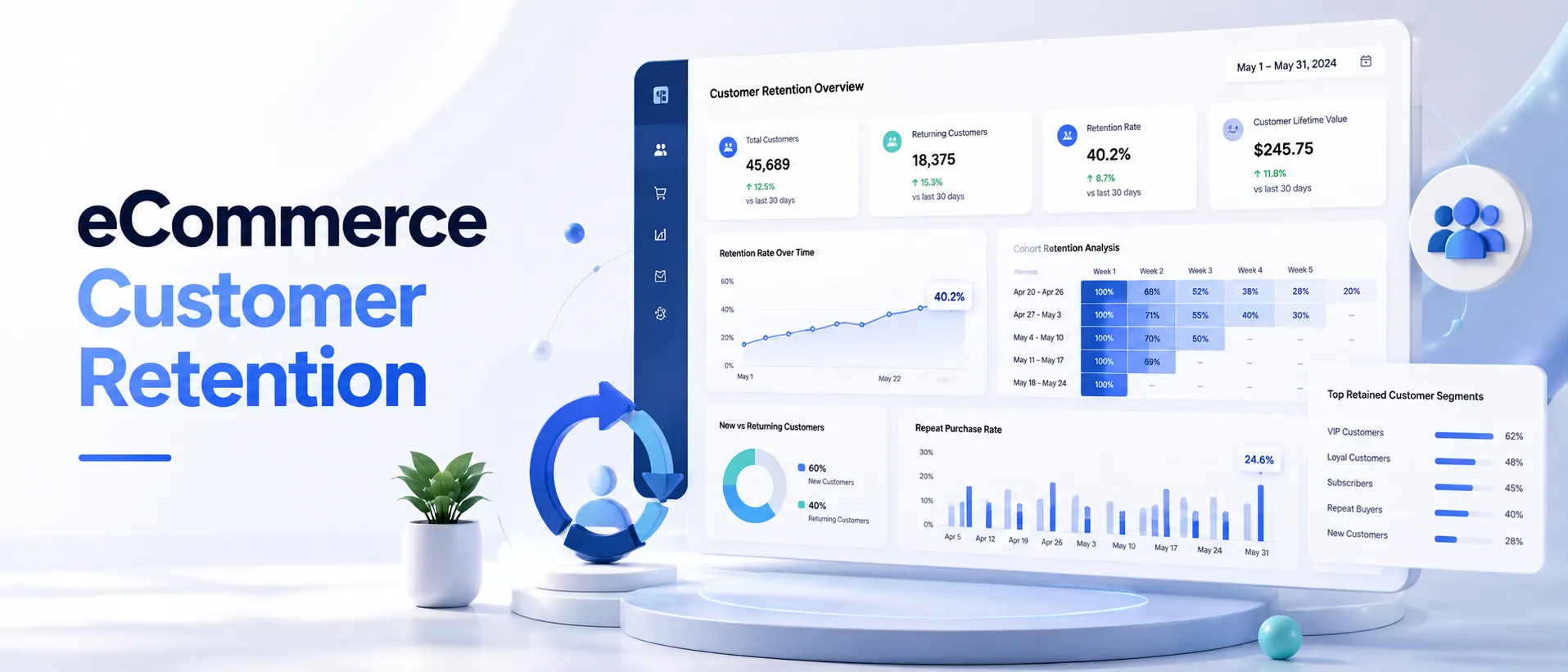
Unfortunately, most eCommerce brands eventually discover that spending thousands on ads, influencer marketing, paid search, and more doesn’t always translate to increased revenue. Why? Because many brands continue investing in acquisition without addressing customer attrition. New customers make a single purchase and never return. The treadmill keeps going.
The cost of acquiring customers has increased by more than 222% in the last 10 years. The average cost of acquiring a new customer today is $29, a price that is almost impossible to recoup based on a single sale. But your existing customers are largely unengaged. They know your brand, trust your products, and have already purchased from you.
This is where ecommerce customer retention can be your biggest growth catalyst. Retained customers spend 67% more than new customers, need little persuading, and are much more likely to refer. A mere 5% improvement in retention can lift profits by 25% to 95%, according to Harvard Business Review.
It’s not just about ‘working harder’ to retain; it’s about ‘working smarter’. By leveraging the right strategies, tools, and data to address customer churn effectively, you can boost customer lifetime value (CLV), foster customer loyalty, and retain customers for the long haul.
What is eCommerce Customer Retention?
eCommerce customer retention is the effort by ecommerce businesses to retain their current customers over the long term, keeping them satisfied and engaged with the website. It represents the opposite of customer churn, which measures the percentage of customers who stop purchasing from a brand.
Retention is not a single tactic but a comprehensive business strategy. It’s a system that combines post-purchase communication, product experience, pricing strategy, loyalty incentives, and customer service to create a sense of value for the consumer and encourage them to return.
Ultimately, your Customer Retention Rate (CRR) is the metric that represents retention.
CRR = (Customers at the end of the period – New Customers Acquired / Customers at the beginning of the period) x 100
So if you had 1000 customers at the beginning of the quarter, gained 200 by the end, and ended with 1050, your retention rate is 85%.
Additional retention metrics include:
- The percentage of customers that are lost in a timeframe (Customer Churn Rate)
- Repeat Purchase Rate is the percentage of customers who make repeat purchases.
- Customer Lifetime Value (CLV) lifetime value of a customer to your brand (total revenue generated by a customer over their lifetime with your brand)
- Purchase Frequency is the number of purchases in a given period of time
When read together, these numbers provide a complete picture of your retention health and what you should prioritize.
Acquisition vs retention: The economics that matter
The economic comparison between customer acquisition and retention clearly demonstrates the long-term value of retention.
| Metric | Customer Acquisition | Customer Retention |
| Average Cost | Approximately $29 to acquire one new customer | Around 5–7× cheaper than acquiring a new customer |
| Conversion Likelihood | 5–20% (cold prospects) | 60–70% (existing customers) |
| Revenue per Order | Baseline | Up to 67% higher than new customers |
| Referral Behavior | Rare | Loyal customers are more likely to refer friends and family |
| Profit Impact | High upfront acquisition costs | Compounding long-term profits through repeat purchases and higher customer lifetime value |
The math is clear. However, 80% of the marketing budget is spent on acquisition for most eCommerce brands. While this is not all bad, you do need to acquire new customers to grow, and failing to retain them means you are always starting over.
Customer retention requires ongoing investment, much like managing a long-term business asset. New customer acquisition introduces growth opportunities, but retention determines their long-term value. Retention is the process of watering, fertilizing, and caring for those seeds so that they produce something of value. It’s a must, or even the most expensive seeds will wither.
Brands that get both right (acquisition at lower cost and retention at a steady pace) will experience sustainable compound growth, rather than the peaks and valleys of acquisition-only strategies.
What Is a Good eCommerce Customer Retention Rate?
Retention metrics deliver value only when benchmarked against industry standards. Let’s take a look at the ecommerce retention rate benchmarks by business model:
|
Business Type |
Average Retention Rate |
| General eCommerce | 30–40% |
| Subscription / DTC Brands | 40–60% |
| Fashion & Apparel | 25–35% |
| Beauty & Personal Care | 35–45% |
| Electronics | 20–30% |
| Health & Wellness | 40–50% |
A score of less than 25% is a warning sign. You’re probably losing more customers than you’re gaining, and your CLV is taking a hit.
Conversely, a reliable score above 45% in a competitive category often indicates strong product-market fit, a great customer experience, and effective post-purchase engagement.
The objective is continuous improvement through sustained quarter-over-quarter retention growth, using deliberate strategies, and learning why customers churn and what to do to fix it at the root.
10 Proven Customer Retention Strategies for eCommerce
eCommerce customer retention is more cost-effective than constantly acquiring new ones. The following proven strategies can help increase repeat purchases, strengthen customer loyalty, and drive long-term growth for your eCommerce business.
1. Nail the Post-Purchase Experience
The first 48 hours after purchase are critical to long-term retention. This is where buyer’s remorse is at its highest, and where a timely, thoughtful touchpoint can turn a one-time buyer into a loyal customer.
What a great post-purchase experience is:
- Rapid order confirmation with transparent delivery dates.
- Personalized ‘thank you’ note, not a standard receipt.
- Predictive sales notifications of upcoming shipments are sent by SMS or email.
- Unboxing experience that is personal to your brand (packaging, handwritten notes, small freebies)
- Send follow-up email 7-10 days after shipment, requesting feedback/review
This isn’t about being a show-stealer, and it’s about easing their fears and making them feel delighted in a way they’ll never forget.
2. Create a Loyalty Program that Delivers Rewards
A well-designed loyalty program extends beyond points and serves as a strategic retention mechanism. The best programs engage emotion, rather than just incentivize.
Loyalty program design that is effective:
- Tiered programs (Bronze, Silver, Gold) develop status motivation and aspiration
- Rewards that are linked to the experience, such as early access to products, exclusive events, VIP support, etc.
- Milestone bonuses mark purchase anniversaries, birthdays, or “100th order” events.
- Reward customers for bringing in their friends to your system.
The trick is to make rewards seem realistic and desirable. If it takes customers $5,000 to get any value out of it, they won’t bother. In the first 2–3 purchases, have the first reward close at hand.
3. Leverage Email Marketing for retention (not promotion)
Many brands limit retention email marketing to promotional broadcasts rather than relationship-building initiatives. The brands winning at retention are using email as a relationship tool.
Retention-focused email flows to build:
- Welcome series: 3-5 emails that introduce your brand story, values, and bestsellers
- Post-purchase sequence: Tips, care instructions, and cross-sell recommendations
- Re-engagement flow: Sends an email to the customer after 60-90 days if they haven’t opened any emails or made a purchase.
- Loyalty milestone emails: Reward when they hit points, tier, low customer activity, etc.
- Additional educational information: valuable beyond the point of sale, such as how-to guides, tutorials, and use-case content.
Divide your list into categories based on the types of people, the level of interaction they’ve had, and their buying history. If a customer made a purchase three times, they will not receive the same email as if they made a purchase once 8 months ago.
4. Personalize at Scale
Generic customer experiences rarely foster long-term loyalty. Customers are aware of the personalized experiences and feel that they were intentional. Today, enterprise brands no longer enjoy the luxury of personalization at scale, thanks to conversational AI analytics.
Customized touchpoints that help retain customers:
- Recommendations of the homepage and products based on the purchase/browse history.
- Email content that adapts based on customer segment.
- Individual price sensitivity signals are personalized discount offers.
- Customized SMS messages, based on the customer’s previous purchases
- When you make a suggestion that makes sense as a cross-sell, it does.
The aim is to make every customer feel that your store was created for them, not just one of millions who experienced the same.
5. Launch Win-Back Campaigns for Churned Customers
Not all lost customers are gone forever. A targeted win-back campaign ecommerce strategy can re-engage a substantial amount of lost buyers at a much lower cost than acquiring new buyers.
A framework that is efficient in implementing win-back campaigns is:
- Trigger: Customer hasn’t purchased in 90–180 days (adjust based on your average purchase cycle)
- Message 1 (Day 90): “We miss you.” Remind them of what they loved, no discount yet
- Message 2 (Day 105): Value-add content: what’s new, what’s changed, what they’re missing
- Message 3 (Day 120): Incentive offer is a time-limited discount or bonus gift with purchase
- Message 4 (Day 135): Last chance, urgency-driven final attempt before suppression
Be truthful in your communication. Brands that recognize the relationship with their customers are valued by them, rather than those that contact them for sales purposes.
- Provide Subscriptions or Replenishment Notifications
Subscriptions are among the highest-leverage retention tactics for consumables like supplements, pet foods, skin care products, and coffee. They make it transactional, replace it with a recurring option, and allow customers to never run out.
If you don’t have a subscription model, there’s a nearly as effective way: reminders when it’s time to replenish. If you can add a line to your last order that suggests “Based on your last order, you might be running low on time to restock?” you’ll get repeat business without much hassle.
7. Make Proactive Customer Support an investment
Reactive support addresses issues only after customers encounter problems. By proactively supporting them, you can prevent them and, of course, enhance your customers’ perception of your brand even if you do get them.
Preventative support strategies that increase retention:
- Please inform customers of shipping delays before they ask questions.
- Follow up orders with problems (returned, damaged) with check-in
- Provide live chat service on product pages for pre-purchase questions.
- Send care/usage tips automatically after purchase to minimize ‘it did not work’ returns.
Brands with the highest retention rates treat customer service as a revenue function rather than a cost center.
8. Leverage User-Generated Content and Reviews
Social proof serves both acquisition and retention objectives. Their presence in your community is reinforced as they see their reviews posted, their photos displayed, and their stories shared.
Encourage reviews post-purchase. In your emails and website, include photos of your customers! Create a Facebook community, a Discord server, or a hashtag that customers can gather around your brand.
Strong customer communities increase switching costs and strengthen long-term loyalty.
9. Reduce Friction at Every Touchpoint
Friction is a silent killer of retention. The returns process, checkout, and account setup can all undermine a customer’s resolve not to return.
Friction audit checklist:
- Can you create an account when you check out?
- Do returning customers require 2 clicks or fewer?
- Does the returns process allow for a self-service and hassle-free experience?
- Is your mobile user experience as fast and user-friendly as your desktop user experience?
- Are the size guide, product information, and FAQ readily accessible prior to purchase?
Over time, these minor irritations add up to major churn numbers. Review your customer journey every 3 months.
10. Use AI Analytics to Identify Churn Signals Early
Even the most advanced retention strategy in the world will not work if executed too late. You need to catch at-risk customers as they leave your eCommerce site, not at the very end.
This is where data-driven intelligence creates a measurable competitive advantage. When you’ve got purchase-frequency drops, email disengagement, support-ticket sentiment, and browse-without-buy metrics, you’ll have a heads-up that a customer is slipping away.
These are all things you can track with an ecommerce analytics dashboard like ProactiveAI, receive automated alerts, and implement customer retention actions at the optimal time before they leave.
How Does ProactiveAI Help You Retain More Customers?
Customer retention extends beyond best practices and requires identifying at-risk customers before they churn. ProactiveAI enables eCommerce brands to proactively detect and act on risks with confidence.
With its Conversational AI Analytics, teams can ask questions about their business in natural language and get real-time insights without requiring SQL or analyst help.
The pre-built eCommerce dashboards offer real-time insights into key customer retention metrics, including customer lifetime value, repeat purchase rate, churn, and purchase frequency.
The Forecasting Engine predicts revenue trends, uncovers demand patterns, and identifies churn risks before they impact growth using machine learning.
Self-Service Analytics enables marketing and customer experience teams to explore data independently, create custom segments, and analyze customer behavior more quickly, making better decisions and boosting retention, leading to sustainable revenue growth.
Conclusion
Shifting focus from acquisition to retention transforms both growth strategy and long-term profitability. If you realize that your best customers are the ones you already have, then every dollar spent on marketing is more powerful, every improvement to your product is more powerful, and every new customer starts the relationship with compounding power.
Begin at the start: measure your retention rate, compare it to your category, and see where your customers are dropping off. Next, add strategies that are a perfect match for your brand, such as a loyalty program, an improved post-purchase email sequence, or an AI-powered win-back campaign.
When organizations are ready to replace guesswork with actionable retention insights, ProactiveAI provides the capabilities required to drive data-informed decisions.
Once you’ve won a customer, they deserve more than a single transaction. Provide an incentive for them to remain.
Frequently Asked Questions
What is the customer retention rate in eCommerce, and how is it calculated?
Customer retention rate is the percentage of current customers who remain customers within a specific timeframe. It can be computed as: (Customers at Period End – New Customers) / Customers at Start x 100. The higher the rate, the more loyal they will be and the more reliable the revenue will be.
What is a good customer retention rate for an online store?
The average retention rate for most eCommerce stores is 30-40%. Subscription-based models have a 40-60%. Less than 25% is a caution signal for churn and needs to be addressed. Your goal needs to show positive quarter-over-quarter growth relative to your category benchmarks.
Why is retaining customers cheaper than acquiring new ones?
The cost of acquiring a new customer is 5–7 times that of retaining an existing one. Existing customers already know, like, and trust your brand, are 60-70% more likely to convert than customers just acquired with paid media, spend more per order, and refer others, all without the paid media investment required for acquisition.
What are the most effective retention tactics for DTC brands?
Personalized post-purchase communication via e-mail campaigns, tiered loyalty schemes, proactive customer support, win-back campaigns for customers who have not bought in a while, and subscription and replenishment offers are among the top DTC retention strategies. AI analytics for early detection of at-risk customers gives a competitive edge.
How do loyalty programs impact customer retention in eCommerce?
Loyalty programs: emotional investment and regular buying behavior that help to keep customers. The multi-level systems incentivize customers to spend more to achieve a higher level. Program design can boost repeat purchases by 20-30% and, over time, make a notable difference in customer lifetime value.
You might also like
Handpicked articles for your reading list.

Get the latest insights on Conversational AI
Stay ahead of the curve with weekly updates on data analytics, AI trends, and eCommerce growth strategies delivered straight to your inbox.
Join 5,000+ industry leaders. Zero spam, just pure insights.