
 SparxIT
 SPXCommerce
 What's Your A


eCommerce
eCommerce
eCommerce Inventory Analytics: How Data Can Prevent Stockouts and Overstock
-
Vikash Sharma
- Jul 02, 2026
- 11 mins read
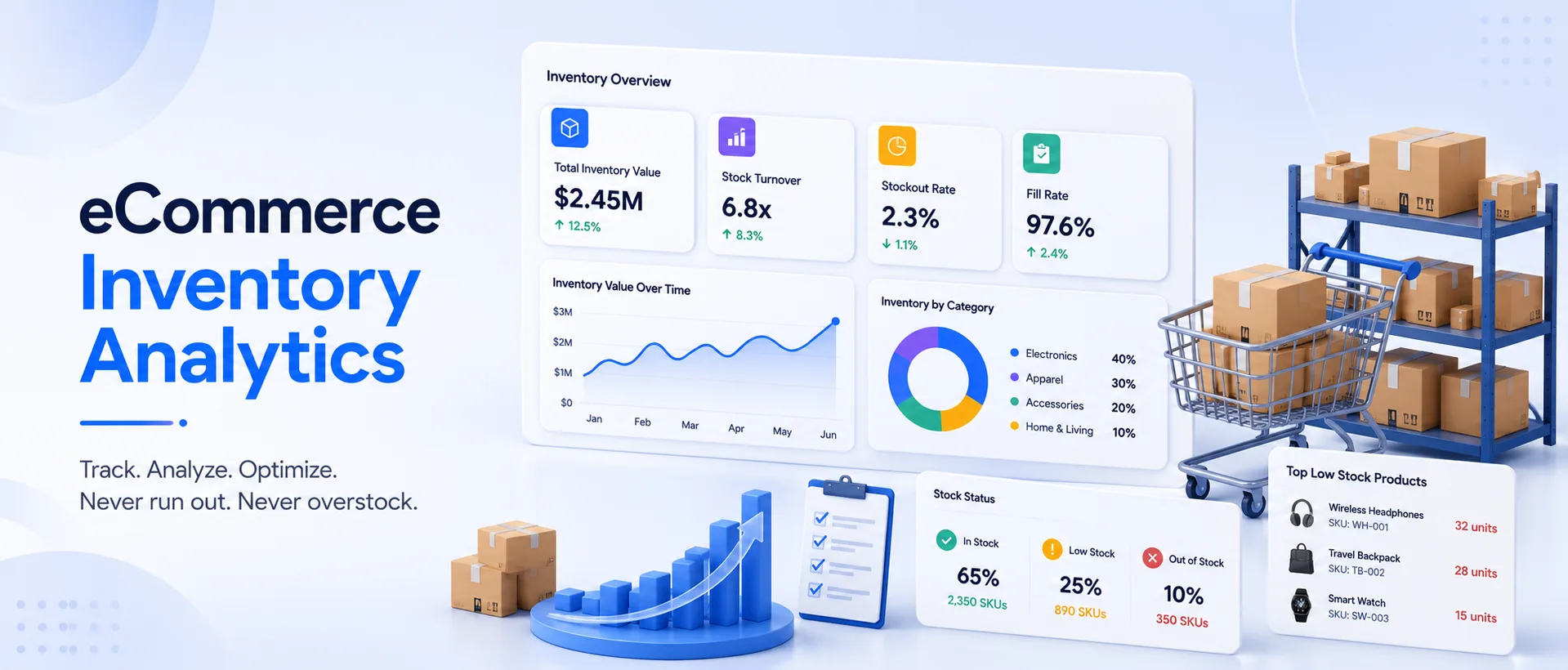
You’ve been there. Your best-selling SKU sells out in hours when your flash sale goes live, while your customers see their carts emptied and get mad. Within hours of launching your flash sale, your best-selling SKU sells out, leaving customers frustrated when products become unavailable during checkout. Or it’s the opposite: you ordered more than you sold for a short season, your margins are suffering from thousands of dollars in unsold dead stock, and your warehouse is being filled to capacity.
These are not simply operational problems to deal with. It is estimated that $1 trillion in lost global sales is experienced by eCommerce businesses due to stockouts every year, and that overstocking ties up working capital that could be utilized for business expansion. Just in case you’re wondering, most of these issues are no accident. They are due to poor data and, more often than not, the lack of proper data at the right time.
That’s where eCommerce inventory analytics can make a difference. Modern analytics platforms turn raw data into actionable information, which enables online retailers to forecast demand, manage inventory, and make sound decisions before a crisis strikes. The result? Better margins, more satisfied customers, and a supply chain that cooperates, not competes!
In this guide, we’ll break down everything you need to know, from core concepts and key metrics to AI-powered tools, best practices, and how platforms are redefining what’s possible for data-driven inventory management.
What is eCommerce Inventory Analytics?
Inventory analytics for eCommerce involves gathering, analyzing, and interpreting data on your product inventory across all of your warehouses, sales channels, and customer interactions. Businesses use this information to make smarter decisions about what to purchase, when to replenish inventory, and how much stock to order.
Imagine you have a control tower for your supply chain. Instead of reacting to empty shelves or excess inventory, businesses can rely on real-time, data-driven insights into demand trends, stock velocity, supplier lead times, and customer behavior. The end result is always the same: getting the right product, in the right amount, at the right location, at the right time.
Inventory management analytics is essentially the integration of three fields:
- Descriptive analytics: What did the stock levels look like in the previous time period?
- Diagnostic analytics: What was the reason for a product’s success or failure?
- Predictive analytics: What does demand look like for the next 30, 60, or 90 days?
When businesses combine all three analytics models, they create a continuous improvement cycle for inventory planning and replenishment.
What is the Real Cost of Stockouts and Overstock?
First, it’s important to have a discussion on the “why” rather than the “how.
Why are stockouts an Invisible Revenue Killer?
A stockout doesn’t just mean one lost sale. It’s a customer who never comes back. Studies consistently show that 37% of customers who experience a stockout will purchase from a competitor. A single stockout also negatively impacts product ranking, and this will cost you on marketplaces like Amazon and others long after the shelves are stocked.
The harm adds up for multichannel retailers. When your inventory doesn’t update automatically across Shopify, Amazon, and your wholesale channel, you risk overselling a product you don’t actually have, along with the chargebacks, returns, and customer service expenses that come with it.
Why is Overstock the Silent Margin Drain?
Looking at the other side of the coin, as the saying goes, excess inventory means capital locked up. You’re paying storage fees (which are especially bad if you’re using Amazon FBA or a 3PL), risking product obsolescence, and ultimately resorting to sales to ruin your margins.
Think of overstocking as pouring water into a bucket that has a hole in it! You continue to fill it to meet demand, but the steady losses of carrying costs, spoilage, and markdowns quietly erode profitability.
Inventory analytics is what patches the bucket and replaces guesswork with precision.
Key Metrics Every eCommerce Brand Must Track
The first step in great inventory analytics is having the right KPIs. The key metrics to watch:
Inventory Turnover (eCommerce)
Formula: Cost of Goods Sold ÷ Average Inventory Value
The inventory turnover in eCommerce is the number of times you sell off your full inventory over a period of time. The higher the ratio, the stronger the demand and the more efficient the buying. The industry averages are quite diverse, ranging from fashion, which may aim for 4-6 inventory turns, to electronics, which may aim for 8-12x inventory turns.
Example: If your COGS for 12 months is $500,000 and your average inventory value is $100,000, your inventory turnover is 5x, which means you sold your entire inventory 5 times over 12 months.
Sell-Through Rate
Formula: Units Sold / Units Received x 100
The sell-through rate in eCommerce is the percentage of the stock you received that has been sold over a period. One of the most actionable indicators to identify a product that is not moving quickly enough. If the sell-through rate drops below 80%, there may be a problem with demand or pricing at the SKU level that should be investigated.
Days Inventory Outstanding (DIO)
Formula: (Average Inventory ÷ COGS) × Number of Days
Days Inventory Outstanding (DIO) measures the average time an item remains in inventory before sale. Faster inventory turn and improved cash flow with lower DIO. In most cases, a DIO of 60 to 90 days is a negative sign for eCommerce brands to act on.
Stockout Rate
The proportion of time a product is not available for sale to a customer when he or she tries to buy it. A 5% stockout anywhere in your catalog can be a lot of lost revenue.
Reorder Point (ROP)
The quantity of an item that should be ordered to prevent running out of stock, including the average daily sales volume and supplier lead time. This isn’t possible to calculate statically without taking into account demand variability, and is where analytics becomes incredibly valuable to static thresholds.
Carrying Cost Percentage
Total cost of inventory holding (storage/insurance/obsolescence/opportunity cost) / total inventory value. That is typically 20-30% annually, or $0.20-$0.30 per dollar of overstocked inventory for most retailers.
What are the Core Components of an Inventory Analytics Stack?
A comprehensive inventory management analytics system consists of multiple layers:
1. Data Ingestion Layer
Pulls real-time data from sales channels (Shopify, WooCommerce, Amazon & TikTok Shop), ERP, WMS, and supplier systems. The key requirements are speed and accuracy because stale data leads to inaccurate forecasting and poor inventory decisions.
2. Data Processing and Normalization
Raw transaction data is messy. This layer normalizes SKU identifiers, unifies SKU names across channels, and provides a unified view of inventory data.
3. Analytics and Modeling Engine
This is where the intelligence lives. Statistical models, machine learning algorithms, and business rules combine to generate demand forecasts, reorder recommendations, and anomaly alerts.
4. Visualization and Reporting Layer
The key to a successful eCommerce analytics dashboard is its ability to break down complex data into visual KPIs, drill-down reports, and actionable alerts, empowering operations teams and executives to take immediate action without requiring a data science degree.
5. Action Layer
The optimal analytics platforms complete the cycle by automatically taking action on the insights they have found, such as drafting a purchase order, alerting suppliers, or pausing a listing.
How AI and Predictive Analytics Prevent Inventory Problems
With traditional inventory management, reorder points were fixed, and purchasing decisions were based on experience. AI-driven analytics is the intelligence that replaces instinct.
1. Demand Forecasting at Scale
Today’s eCommerce demand planning solutions leverage AI to analyze a wide range of variables simultaneously, including past sales velocity, promotions, seasonal data, external factors such as weather and social media buzz, and even competitor pricing. The answer is a probabilistic demand forecast at the SKU level, not just “we will sell approximately 200 units” but “there is a 90% chance that we will sell between 180 and 230 units in the next 30 days.
2. Anomaly Detection
AI models constantly analyze stock metrics and alert to abnormalities in stock trends. When a particular SKU becomes out of stock for some reason, say, for a product going viral on social media, the alert comes before you are completely out of stock, giving your team the time to rush to reorder.
3. Seasonal and Promotional Intelligence
A key application in overstock analytics is Post-promotion analysis. AI can assess the results of an inventory promotion, learn from it, and incorporate the learning into future inventory models. With each campaign, your system becomes smarter over time.
4. SKU Rationalization
With the power of AI, SKU performance analytics enables brands to determine which products are boosting profitability and which are eroding it. High carrying costs, low sell-through, and low-margin-contribution products become candidates for discontinuation or consolidation, thereby releasing capital for better-performing products.
Demand Planning and Inventory Forecasting in Practice?
So let’s get to a scenario that “feels real.
Let’s say it is a small-to-medium fashion company on Shopify with 800 active SKUs and 5 product categories. They are coming into Q4 with more coat inventory than required, as last November was warmer than anticipated, and with a lot of understock in accessories, which ramped up during a social media craze.
An effective inventory forecasting Shopify service should:
- Retrieve 24 months of sales data on both the SKU and category levels.
- Add external signals: Google trend of product keywords, Meta ad spend timelines, and historical markdown timing
- Generate SKU-level forecasts with confidence intervals for a 12-week planning horizon.
- Suggest purchase quantities based on forecast demand, inventory, outstanding POs, supplier lead times, etc.
- Provide the buyer team with a sell-through alert when a particular SKU is below target for that season, and recommend that SKUs be marked down for the end of the season
The result is a dramatic decrease in end-of-season markdowns and mid-season stockouts, two of the biggest fashion retail margin leaks.
This workflow can be used for consumer electronics, beauty, home goods, and any other product category that experiences seasonality or trends.
Inventory Analytics for Shopify and Multichannel Sellers
Shopify’s built-in analytics is a good place to start, as you’ll be able to view sales trends, low-stock alerts, and basic product performance. However, native reports are quickly surpassed by brands with high inventory complexity.
The real challenge for multichannel sellers is unified inventory visibility. If your stock is held on Shopify, Amazon FBA, at a 3PL warehouse, and in a brick-and-mortar store, it is essential to have a dedicated analytics layer that pulls data from each of these sources in real time to know what stock is available at any given time.
In addition to knowing how many items are in stock, warehouse analytics can help you see where they’re stored, how efficiently they’re stored, and whether your fulfillment center is creating pick-and-pack inefficiencies due to its layout. High-volume sellers can save 10-15% on their fulfillment costs by optimizing warehouse operations using analytics without altering purchase volumes.
The most advanced multichannel sellers also rely on Stockout analysis in eCommerce to understand the downstream effects of an unfulfilled stockout, what they bought instead, and whether those items were recovered in later campaigns. This makes a reactive metric a strategic input for customer retention planning.
What are the Top Tools for eCommerce Inventory Analytics?
As inventory operations become more complex, businesses increasingly rely on advanced analytics platforms to improve forecasting accuracy and inventory efficiency. Let’s take a look at a landscape overview:
| Tool | Best For | Key Capability |
| ProactiveAI | AI-powered analytics for eCommerce teams | Conversational AI analytics, pre-built eCommerce dashboards, and ML forecasting engine |
| Brightpearl | Mid-market multichannel retailers | Unified inventory and order management |
| Cin7 | Manufacturers and wholesalers | Deep production planning |
| Inventory Planner | Shopify and WooCommerce brands | Replenishment automation |
| Linnworks | High-volume multichannel sellers | Order routing and WMS integration |
| Looker / Tableau | Enterprise BI teams | Custom analytics infrastructure |
The ideal tool for most eCommerce brands is one that offers meaningful, easy-to-use analysis, so you don’t have to wait for your data analyst to create a report before you can make data-driven decisions.
Best Practices for Inventory Management Analytics
Using analytics is just one element of the equation. So what makes brands successful at transforming businesses into ones that deliver results, compared to those with an expensive dashboard nobody uses?
1. First, build a single source of truth
You can’t get smart with inventory data without clean, unified data. Check your data sources, remove duplicate SKUs, and validate that your ERP, WMS, and channels are syncing.
2. Divide inventory into classes according to the ABC analysis
Not every SKU is worth the same level of analysis. The top 20% of SKUs, accounting for ~80% of revenue, should be monitored daily and have narrow reorder margins. “C” Items are items that can be reviewed monthly. This will avoid analysis paralysis and ensure your team stays focused on what matters.
3. Go over forecasts periodically, especially during the purchase season
Demand signals are dynamic in eCommerce. Establish a weekly cycle to assess forecast accuracy and adjust the models based on the most recent “sell-through” data.
4. Assess forecast accuracy at the SKU level, not overall
While an aggregate MAPE (Mean Absolute Percentage Error) of 15% is considered good, there may be a group of SKUs with forecast errors of 50% or more. Get to the core of what is not working with your models.
5. Link inventory information with marketing
A best practice that isn’t widely used enough: provide your performance marketing team with sell-through rate data. You should never be spending more on ads for a product if you know it’s not selling out until the end of the season, and that just means they’ll be there at a discount later.
6. Democratize data with Self-Service Analytics
The ideal scenario is when the people who are directly responsible for the products, buyers, category managers, and operations leads can explore product information themselves without creating tickets that are sent to the BI team. ProactiveAI’s self-service analytics platform is built just for that, so non-technical users can ask questions about inventory data using natural language and create their own views without touching a single line of SQL.
Conclusion
Predictable demand is seldom the root cause of eCommerce inventory issues such as stockout or overstock. This is where inventory analytics comes in. It converts raw sales and inventory data into actionable insights that help businesses make more informed buying and restocking decisions. It helps brands monitor essential metrics, gain insights into demand trends, and ensure their products are optimized in all channels.
AI tools enable businesses to predict market trends, identify irregularities, and minimize missed sales and overstocking. This results in better cash flow management, reduced storage costs, and a higher profit margin.
In an increasingly competitive eCommerce landscape and a multichannel environment, it’s no longer sufficient to rely on manual planning or static rules. Inventory Analytics is the intelligence to remain agile and efficient. In conclusion, brands with a data-driven approach to inventory management enjoy a significant competitive edge in delivering the right products at the right time and maximizing profitability.
Frequently Asked Questions
What is eCommerce inventory analytics?
eCommerce inventory analytics involves gathering and analyzing data on your inventory, sales velocity, and supply chain to make informed buying choices. It helps brands avoid stockouts, minimize overstock, streamline cash flow, and enhance overall inventory efficiency by relying on data rather than intuition.
How do you calculate the inventory turnover rate for an online store?
Divide your Cost of Goods Sold (COGS) by your average inventory value for the period. For instance, $600,000 in COGS divided by an average inventory of $100,000 equals 6x. Generally, higher turnover is a positive sign of strong demand and tighter inventory management, although optimal benchmarks can vary by category.
What is the sell-through rate, and how do you use it in inventory planning?
The percentage of inventory received that is sold within a specified period, as determined by dividing the number of units sold by the number of units received and multiplying the result by 100 is the sell-through rate, which is expressed as: (Units Sold / Units Received) x 100% Utilize it to find the slow moving SKUs, before they become dead stock, to make the right decisions about markdowns, and to determine which products sold and which didn’t to guide future SKU purchases.
How does AI analytics help prevent stockouts and overstocking?
AI can predict SKU-level demand more accurately than a spreadsheet by analyzing sales trends, seasonality, promotions, and external factors. It identifies demand surges early, suggests appropriate reorder levels, and continually refines its demand models using actual sell-through data, thereby minimizing both the number and magnitude of inventory mismatches.
What inventory KPIs should every eCommerce brand track?
It’s crucial for every eCommerce brand to keep track of inventory turnover rate, sell-through rate, days inventory outstanding (DIO), stockout rate, reorder point accuracy, and carrying cost percentage. These KPIs provide a comprehensive view of inventory health, encompassing metrics such as turnover and holding costs, and empowering companies to make informed decisions throughout the supply chain.
You might also like
Handpicked articles for your reading list.


Get the latest insights on Conversational AI
Stay ahead of the curve with weekly updates on data analytics, AI trends, and eCommerce growth strategies delivered straight to your inbox.
Join 5,000+ industry leaders. Zero spam, just pure insights.