
 SparxIT
 SPXCommerce
 What's Your A




eCommerce
AI & Analytics
AI eCommerce Analytics: How Generative AI Is Changing How Brands Use Their Data
-
Varun Kumar
- Jul 10, 2026
- 7 mins read
You have mountains of data to analyze, such as orders, sessions, ad spend, inventory, churn indicators, etc., and yet making a quick and confident decision is still a guessing game. Many traditional BI tools require hours or even days to generate actionable reports. Your analyst is so overwhelmed with dashboard requests. By the time your insight is in your inbox, it’s too late to take action.
In 2026, most ecommerce brands will have access to abundant data. The real challenge is transforming that data into timely, actionable insights.
Generative AI is changing how brands engage with their data without replacing analysts or adding unnecessary complexity to existing workflows. Instead, AI ecommerce analytics empowers your team to ask natural-language questions, discover patterns before they become issues, and produce narrative reports in seconds, not days.
The result? Brands that act first will gain a real competitive edge, and their actions will result in faster decision-making and leaner operations.
What is AI eCommerce Analytics?
AI ecommerce analytics uses machine learning, natural language processing, and generative AI to transform ecommerce data into actionable insights that improve business performance.
As opposed to traditional analytics, which relies on human effort for knowledge of what to ask and how to ask it, AI-based systems can:
- Interpret questions presented in simple, everyday speech
- Identify surface anomalies and trends proactively (without being prompted)
- Create written narratives and summaries in conjunction with charts
- Analyze and apply patterns from past events to make predictions about future events
Rather than functioning as a static dashboard, AI analytics acts as an intelligent decision-support system that continuously analyzes business data and delivers actionable insights.
What are the Key Capabilities Reshaping the AI-Powered eCommerce Analytics?
AI analytics for ecommerce consists of multiple capabilities that work together to improve decision-making. Knowing these layers can help you separate out vendor noise so you can look beneath what’s being said to determine what’s under the hood.
1. Natural Language Querying
The first change is in how teams engage with data. By eliminating the need for SQL, natural language analytics for ecommerce is a game-changer. Business users can retrieve insights by asking questions in natural language without relying on analysts or submitting reporting requests.
The ROI from conversational AI analytics platforms comes in real time. Teams that have to wait days for reports can self-serve in real time.
2. Automated Insight Generation
AI systems don’t wait for someone to see a trend; they push it to you. AI-powered reporting automatically detects anomalies such as declining ROAS, inventory delays, or spikes in cart abandonment and provides contextual insights for faster action.
3. Predictive and Forecasting Layers
The real strategy is here. AI data analysis for ecommerce goes beyond explaining historical performance by predicting future outcomes. AI sales forecasting can forecast demand by SKU, helping brands plan replenishment cycles and target ad spend towards forecasted revenue curves rather than last month’s.
4. AI Data Storytelling
Action is often not the result of raw numbers. Generative AI steps in to make that possible by turning data outputs into storytelling-friendly summaries, whether it’s a written performance recap, an executive briefing, or an explanation of an anomaly that anyone can read without interacting with a chart. This is data storytelling for AI at scale, and it’s quickly becoming the norm for brands that need to tell their story through marketing, ops, and finance lenses.
5. Agentic Analytics
The new frontier is agentic ecommerce analytics: AI proactively initiates data analysis, identifies anomalies, and recommends next steps based on predefined objectives. Agents track KPIs, execute diagnostic queries when thresholds are exceeded, and provide results and suggested next steps. It’s the difference between reactive reporting and a proactive intelligence layer.
Which is better, Generative AI vs. Traditional BI?
Traditional BI provides you with information about what has happened through predefined dashboards, reports, and KPIs. With Generative AI, you’ll also gain insight into why things happened, answers to your questions in plain language, automatic recognition of patterns, and suggestions for the next best actions. Rather than sifting through data, teams receive more timely and actionable insights that help them make better decisions.
| Dimension | Traditional BI Tools | AI-Powered Analytics |
| Access model | Analyst-dependent | Any member of the team can self-serve |
| Query method | SQL / drag-and-drop builders | Natural language, conversational |
| Insight generation | Manual, scheduled reports | Automated, real-time, proactive |
| Forecasting | Rule-based (static) models | ML-driven, continuously updated |
| Time to insight | Hours to days | Seconds to minutes |
| Narrative output | Charts and tables | Charts + written summaries |
| Learning over time | Static | Adaptive, pattern-learning |
The shift from traditional BI to generative AI represents a fundamental change in how businesses use data. The shift from traditional BI to generative AI business intelligence shifts the operating model from data being a bottleneck to a driver of data velocity within your brand.
Core Use Cases for DTC and eCommerce Brands
With Generative AI, DTC and ecommerce brands can automate analysis, gain actionable insights, optimize their inventory and marketing, minimize returns, and make quick, data-driven decisions.
1. Sales Performance Monitoring
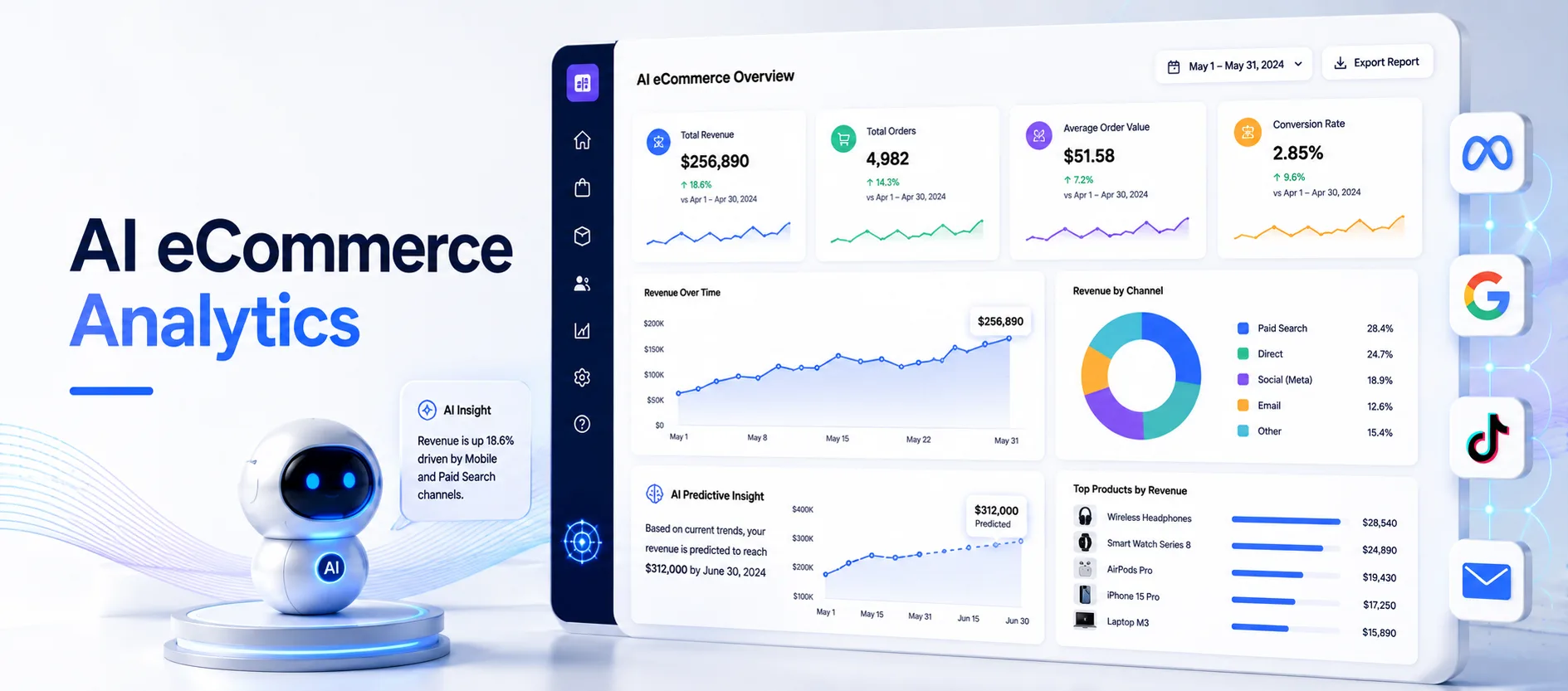
An AI-powered ecommerce analytics dashboard allows sales teams to track revenue, AOV, and conversion rates in real time across channels, regions, devices, and campaigns, eliminating the need to wade through deep filter menus. On day one, ProactiveAI’s Pre-built eCommerce Dashboards are available for use specifically for eCommerce KPIs.
2. Demand and Inventory Forecasting
Brands with many SKUs find that using ML models for inventory forecasting is a game-changer. The AI eliminates the need for spreadsheet-based estimates by analyzing historical velocity, seasonal trends, and supplier lead times to generate accurate reorder signals. Overstock and stockout costs, which are not realized until they turn up on the P&L, become predictable and preventable.
3. Customer Segmentation and Retention
AI can segment customers into groups based on customer behavior patterns, such as purchase frequency, product affinity, or churn risk, and provide automatic insights that marketing teams can act on. Instead of segmenting manually in a CDP, the AI identifies who is at risk, why, and provides sufficient context to act quickly.
4. Marketing Attribution
Multi-touch attribution across paid, organic, email, and affiliate marketing has always been challenging to analyze. AI can take the grunt work out of the equation, modeling contributions at each touchpoint and assisting teams in making intelligent budget decisions about how to allocate spend for the greatest return.
5. Executive Reporting
The CEO does not desire to take a report. They would like to know “how we did this month compared to our plan, and what’s causing the difference? GPT analytics for ecommerce capabilities means that an answer is generated automatically in prose, with context, ready to share.
How to Evaluate AI Analytics Tools Before You Buy
Don’t just take the demo for granted when assessing ecommerce dashboard solutions. These are the questions that really distinguish the good from the great when it comes to tools:
1. What data sources does it natively connect to?
Data, like a tool, is only as valuable as what it can do. Use platforms that have native integrations to your eCommerce stack: Shopify, WooCommerce, Amazon Seller Central, Meta Ads, Google Analytics, ERP, or 3PL.
2. How does it handle data freshness?
When it comes to real-time decisions, it’s crucial that the data is up to date. Inquire with vendors about the frequency of synced data and whether the AI runs on real-time data or on batch-exported data.
3. Can non-technical users actually use it?
Ask your marketing or ops team to do a live trial with them, not your data engineer. If they have to look up a question in a manual, the natural language is insufficient.
4. Can the forecasting engine explain?
Black-box predictions have a diffusing effect on trust. Seek out platforms that explain how they created a forecast and what confidence and variables were used.
5. How does it deal with data governance and security?
For enterprise or multi-brand configurations, learn how the platform handles user access and permissions, data access controls, compliance requirements, and more, particularly for brands.
6. What does onboarding actually look like?
There are tools available that are “instant setup” but take weeks of data mapping. Get a realistic picture of the timeframe and what your team needs to deliver to reach the first insight.
Best Practices for Adopting AI eCommerce Analytics
Successful deployment of AI analytics is more than a technical challenge. Look at the difference between brands that get quick ROI and those that deploy and drop:
1. Begin with a single, high-value use case
Don’t attempt to solve all problems. Choose the question your team has the most and show how AI can provide a more effective and timely answer than your current process, such as “What caused last week’s revenue miss?
2. Connect information that is clean first
AI enhances both good and bad data quality. Do an audit of your data sources before joining them to an AI layer, or you’ll get confident-sounding, wrong answers!
3. Train your team on how to ask questions
Natural language querying is powerful, but requires some prompt hygiene. Discuss with your team the importance of using specific, scoped questions for the most precise outputs.
4. Use AI-generated narratives as a starting point, not a final product
Use AI for assistance with high-stakes reports, but always have a human check the AI-generated summary before it is disseminated. Your AI provides you with an initial draft, which your analyst then judges.
5. Set KPIs for the analytics tool itself
Track time to insight pre- and post-deployment. Monitor the number of ad hoc analyst requests that were met with self-service instead. These metrics make the investment worthwhile and encourage adoption.
Conclusion
ECommerce brands used to have the data advantage because of their large analytics teams, but not anymore. It’s part of the brand that gets from question to decision quicker than anyone else.
AI ecommerce analytics using generative AI, natural language interface, and autonomous insight generation bridges that gap to near zero. The brands investing in this transformation today are creating a compounding competitive edge: more people making better decisions, faster and with fresher data, throughout their organization.
When looking into where to begin, you should consider ProactiveAI. It’s designed for eCommerce teams seeking an analytics platform that understands their business, no matter how you say it. Whether you’re making conversational queries, predicting future insights, or creating self-service analytics dashboards, it’s the kind of layer of intelligence that doesn’t make your data team redundant, and it makes them more powerful.
Frequently Asked Questions
How is AI changing eCommerce analytics in 2026?
The way AI will transform eCommerce analytics from reactive, analyst-reliant to proactive, real-time intelligence. Brands can ask questions in plain English, receive automated insights and summaries, run predictive models, and make faster decisions without technical expertise.
What is the difference between traditional BI tools and AI-powered analytics?
Traditional BI tools involve the end user in specifying what they want to query and how to format the query (usually in SQL or via drag-and-drop tool builders). With AI-driven analytics platforms that can comprehend natural language queries, proactively identify insights, track written summaries, and ingest new data, anyone can analyze and do it much quicker.
Can an AI analytics tool replace a data analyst for eCommerce teams?
Not completely, but it will fundamentally change how analysts perform what they do. With AI taking over routine reporting, query generation, and anomaly detection, analysts can dedicate more time to interpreting the trends and creating cross-functional narratives. The goal of a team using AI tools is not to replace the analyst but to make their job more efficient.
What are the most useful AI analytics features for DTC brands right now?
The most impactful features are the capabilities to use natural language queries to ask and answer ad hoc questions, sales and inventory forecasting (automated), real-time anomaly detection of revenue and marketing KPIs, AI-generated executive summaries, and pre-built eCommerce dashboards with no setup time, all of which help to reduce decision latency across sales, marketing and operations teams.
How do you evaluate AI analytics tools before buying one?
Your native data source integrations within your eCommerce stack, real-time vs batched data syncing, usability for non-tech team members, explainability of your forecasting models, and realistic data onboarding timelines are all five factors to consider. Get a trial with real end users, not just your data team, to see if the natural language layer is effective in practice.
You might also like
Handpicked articles for your reading list.

Get the latest insights on Conversational AI
Stay ahead of the curve with weekly updates on data analytics, AI trends, and eCommerce growth strategies delivered straight to your inbox.
Join 5,000+ industry leaders. Zero spam, just pure insights.