
 SparxIT
 SPXCommerce
 What's Your A


eCommerce
Marketing
Cart Abandonment Rate: Benchmarks & Recovery Strategies for 2026
-
Varun Kumar
- Jun 01, 2026
- 8 mins read
A customer visits your online store, adds three items to their cart, reaches checkout, and then leaves. Every abandoned cart represents a missed purchase opportunity. This is not a once-in-a-lifetime occurrence! That’s 7 of 10 consumers in your store, in the moment, every day.
One of the most damaging ecommerce metrics is the cart abandonment rate. It represents both lost revenue and lost purchase intent from customers who were close to converting. For most online retailers, it’s billions of dollars of lost revenue annually.
The good news? Abandoned carts do not equal death. When you have an appropriate benchmark to set expectations, you understand why customers are leaving, and you have a plan for how you’re going to recover a significant amount of that lost revenue, you can do it consistently and on a regular basis.
In this guide, we break down the 2026 benchmarks, industry-specific data, the top causes of abandonment, and proven recovery strategies, all built for the modern e-commerce operator who wants results, not theory.
What Is Cart Abandonment Rate?
The cart abandonment rate is the percentage of shoppers who add items to their cart but leave before completing their purchase. It’s a clear sign of friction, hesitation, and lost intent in your conversion funnel.
The cart abandonment rate formula is:
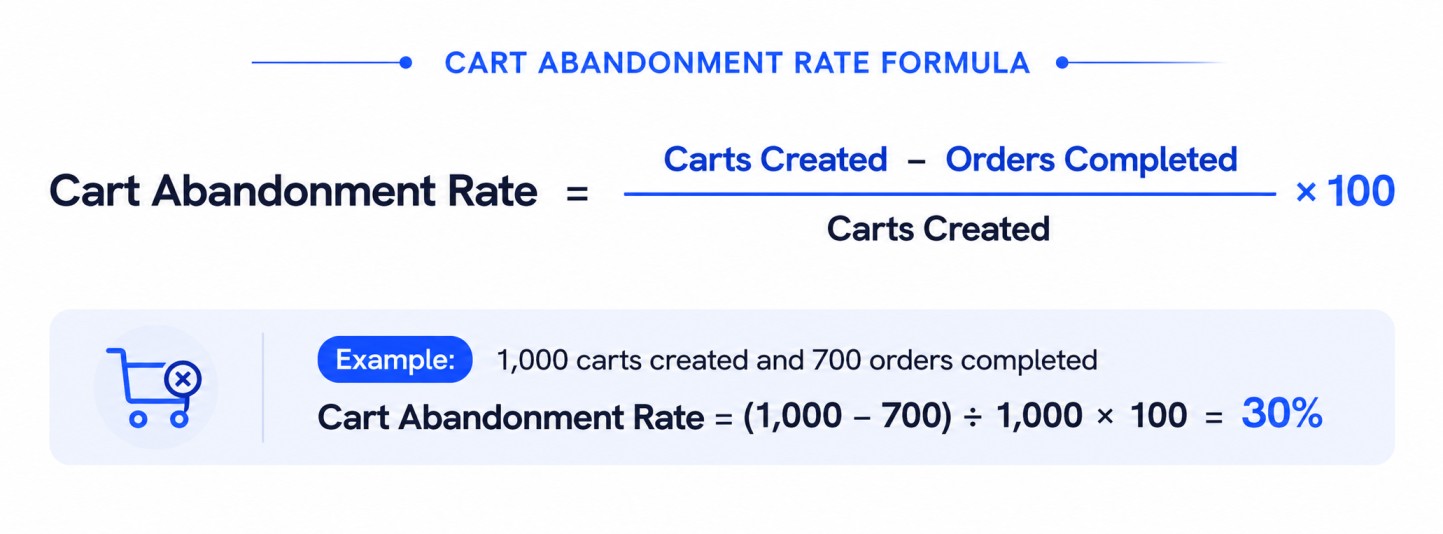
Think of your conversion funnel as a system where potential revenue is lost before checkout completion. Water is constantly being poured into your marketing funnel, but a leak near the bottom lets it out before it reaches the “full” mark. The cart abandonment rate helps quantify that lost revenue opportunity. The solutions in this guide can help you patch it.
2026 Benchmarks for Cart Abandonment by Industry
Before improving performance, you need to understand how your abandonment rate compares with industry benchmarks. The average e-commerce cart abandonment rate across all industries in 2026 is roughly 70-72%, a consistent figure for years, making it a structural problem.
Cart Abandonment Benchmark by Industry (2026)
Cart abandonment varies widely across industries due to differences in purchase intent, decision complexity, and price sensitivity. These benchmarks help you understand what “normal” looks like for your category so you can identify gaps and set realistic optimization targets.
|
Industry |
Avg. Abandonment Rate |
Performance Signal |
| Travel & Hospitality | 85–90% | Strong research orientation, long decision-making timeframes |
| Fashion & Apparel | 76–80% | Significant uncertainty about size/fit causes users to exit |
| Electronics | 74–78% | High price-comparison behavior |
| Health & Beauty | 68–72% | Repeat buyers contribute to stronger retention |
| Grocery & Food | 65–70% | Frequent repeat purchases help keep abandonment rates lower |
| Home & Furniture | 78–83% | High-ticket products require longer decision-making time |
| Sports & Outdoors | 70–74% | Seasonal surges inflate abandonment rates |
| Baby & Kids | 58–63% | Lower abandonment with higher-intent buyers |
These numbers are what you should use as your cart abandonment benchmark. If your rate is much higher than average, then you have a serious issue to correct. If you are below or close to the benchmark, you have an opportunity to optimize, not just to survive.
Reasons Why Shoppers Abandon the Cart?
Data from large-scale qualitative research consistently surfaces the same root causes. Understanding these is the foundation of any effective abandoned cart strategy.
1. Unexpected Extra Costs/Shipping, Taxes, Fees
Among those who abandoned, ~48% said this was the top reason. If a product is $40 and appears at the check-out counter as $62, many shoppers abandon their purchase.
2. Forced Account Creation
Some 26% of shoppers drop off when asked to register. Guest checkout is no longer a convenience; it is an expectation.
3. Complicated or Long Checkout Process
Over 17% report that friction at checkout (too many form fields, confusing steps, or no progress indicators) is a problem.
4. Payment Security Concerns
Trust signals are very important. Without SSL icons, payment images, or clear return policies, visitors tend to drop off at the payment stage.
5. Just Browsing / Research Mode
Cart additions account for a large proportion of intentional “save for later” operations. True abandoners require re-engagement approaches that differ from those for these users.
6. Slow Site Speed or Technical Errors
With each second that your website takes to load, you can expect to see a 7% drop in conversions. The tolerance is even lower at checkout. Site performance is a critical conversion factor.
Checkout Abandonment Rate vs. Cart Abandonment Rate
The two terms are frequently used interchangeably, but they measure two different points in the funnel, and fixing one doesn’t necessarily fix the other.
|
Metric |
What It Measures | Industry Average (2026) |
Primary Fix |
| Cart Abandonment Rate | Customers who add items to their cart but do not start the checkout process | ~70% | Improve product page trust, pricing transparency, and retargeting |
| Checkout Abandonment Rate | Shoppers who start checkout but do not complete payment | ~40–50% | Optimize checkout flow, payment methods, and form design |
These metrics represent two distinct stages where customers leave the purchase journey. Cart abandonment is when people take their first detour before reaching the highway. Checkout abandonment occurs when people get on the highway but leave before they reach their destination. To improve conversion rates, businesses need visibility into drop-off points across the entire purchase journey.
Top Cart Abandonment Recovery Strategies for 2026
Understanding why shoppers abandon their carts is the first step toward improving recovery rates. The other half involves the systematic building of recovery infrastructure. Let’s take a look at the strategies that always have an impact.
1. Simplify Your Checkout Flow
The typical ecommerce checkout process requires 23+ form fields. This can be cut down to 12–14 without loss of essential data, research indicates. Cognitive friction decreases with each field you remove. Use progress bars, autofill, and address lookup APIs. Do not hide guest checkout as an option, and make it a default.
2. Introduce Transparent Pricing Early
Show shipping costs, estimated taxes, and any applicable fees for the product on the product page or in the shopping cart page prior to checkout. Take advantage of a live shipping calculator. Prominent free shipping over $X thresholds on the cart page can actually help boost both AOV and decrease abandonment rates at the same time.
3. Deploy Exit-Intent Technology
With a good design, exit-intent popups can bring back 5-15% of visitors who abandoned. The important thing is that it is relevant: send different messages based on the cart value, product category, or customer segment.
The first time someone visits the store with $150 in their cart, they are in a different mental state than the person who returns with $30. By proactively addressing shipping, sizing, and return-policy queries as they arise, modern conversational AI can help alleviate hesitation at checkout and boost conversions.
4. Use Live Chat and AI Assistants at Check Out
Many times, people are uncertain about a purchase at checkout because they have unanswered questions about returns, product fit, delivery timelines, etc. A proactive chat that appears after 45 seconds of inactivity on the checkout page can prevent abandonment. These conversations can be held with AI-powered assistants, without incurring staffing costs.
5. Create Multi-Channel Recovery Sequence
On average, only 6.1% of abandoned carts are recovered via email. When brands combine email and SMS recovery campaigns, recovery rates can increase to 8.4%–24.3%. Complete recovery ecosystem with retargeting ads and push notifications. Brands that are doing well at cart abandonment recovery aren’t just relying on a single touchpoint and are developing sequences.
6. Use Data to Personalize, Not Just Automate
The “you forgot something!” emails are a given. The difference between the top performers is personalization: serving the right abandoned products, suggesting complementary items, and varying incentive amounts based on cart value tiers ($0–$50, $51–$150, $150+). They also deliver the right message at the right time by analyzing unique user behavior rather than following a fixed, pre-programmed schedule.
Benchmarks & Best Practices for Cart Abandonment Email
The cart abandonment email is still the top channel for recovery in ecommerce. Even a small recovery rate can yield a huge return on investment at less than $0.08–$0.15 per email recovery.
|
Metric |
Median | Top 25% |
Top 10% |
| Overall Recovery Rate | 6.1% | 11.3% | 18.4% |
| Email 1 (≤1 hour) Recovery | 2.3% | 4.7% | 8.1% |
| Email 2 (24 hours) Recovery | 2.1% | 3.9% | 6.2% |
| Email 3 (72 hours) Recovery | 1.7% | 2.8% | 4.1% |
| Avg. Open Rate (3-email sequence) | 23.4% | 31.7% | 41.2% |
| Avg. Click-Through Rate | 4.2% | 7.8% | 12.6% |
| SMS + Email Combo Recovery | 8.4% | 15.1% | 24.3% |
This difference in performance between the median and top 10% is more than an optimization; it’s almost a factor of three in recovery rate. Better subject lines are not the only factor behind the structural difference.
The Optimal 3-Email Abandonment Sequence
A well-structured email sequence is one of the most reliable ways to recover lost sales from abandoned carts. Timing, messaging, and incentives all work together to re-engage shoppers without overwhelming them.
Email 1: Within 60 minutes
The “gentle nudge. No discount. Only a friendly reminder with the same products, quality images, and a direct CTA to return to the cart. The customer is still in the buying frame of mind and is sometimes just needing a second reminder.
Email 2: 24 Hours Later
Add social proof reviews, ratings, or a “X people are viewing this item” signal. You can introduce a small incentive here (5–10% off) if the cart value warrants it. Frame urgency around stock availability, not artificial deadlines.
Email 3: 72 Hours Later
Your last shot. If the incentive has not yet been provided, provide it here. Make it cart-value-appropriate. Free shipping or a percentage discount works well for carts of $150 or more. A fixed-dollar-off may be more beneficial for the smaller cart.
Pro Tip: Do not discount in Email #1. It makes people think it’s okay to put something aside so they can find the coupon. Give them incentives after reminding them what they are missing.
How ProactiveAI Helps You Reduce Cart Abandonment?
ProactiveAI aids ecommerce businesses in going beyond the cart abandonment phase by showing exactly how, when, and why the customer abandoned the cart. It tracks the entire customer journey, pinpointing drop-off stages in the funnel across devices, traffic sources, customer segments, and geographical regions.
With real-time abandonment alerts, businesses can instantly detect checkout issues, payment failures, or sudden drops in conversion before they impact revenue. We also leverage behavioral cohort analysis to identify trends within first-time visitors, repeat customers, mobile shoppers, and high-value buyers.
The platform measures recovery results across emails, SMS, retargeting ads, and on-site recovery interventions, and focuses on optimizing the most revenue-generating channels.
It includes built-in A/B testing, advanced checkout analytics, and predictive abandonment scoring to improve conversion rates.
Unlike generic tools, our tool serves as an advanced ecommerce analytics platform to boost conversions and recapture lost sales.
Conclusion
Cart abandonment is not just a metric; it represents measurable revenue loss across your funnel. The average for the worldwide market is 70%, and most retailers are losing significant revenue due to friction points in the customer journey that they can fix.
The brands that will succeed in 2026 will take abandonment seriously as an issue rather than an cart abandonment as a business challenge rather than an isolated event. They are familiar with their benchmarks. They know precisely why their special customers are going away. They have three orderly email recovery sequences. They use data to tailor at scale rather than send generic reminders.
In 2026, with more competition, brands that integrate recovery automation with AI business intelligence will have a big conversion edge. They leverage platforms such as ProactiveAI to make granular measurements and apply predictive intelligence to bring it all together.
The difference between a 6% and 18% recovery rate comes down to strategy, execution, and optimization. The benchmarks in this guide provide you with the starting line. The strategies provide you with the roadmap. The analytics provide you with the compass. It’s now time to put it into action.
Frequently Asked Questions
What is the average cart abandonment rate in 2026?
The typical cart abandonment rate in ecommerce is about 70%, meaning most people do not complete their purchases. Commercial rates are usually higher on mobile devices and lower on desktops because of differences in the checkout experience.
What are the reasons for customers leaving their shopping carts?
When customers make purchases, they add products to their shopping cart but leave before completing the transaction due to unexpected costs, complex checkout processes, payment concerns, slow delivery times, security concerns, or after visiting multiple websites to compare prices.
How do you recover abandoned carts?
Remarkable emails, SMS notifications, retargeting ads, discounts, shorter checkout processes, guest checkout, and a boosted mobile experience are all strategies that businesses employ to persuade customers to check out of their abandoned shopping carts.
What's the difference between cart and checkout abandonment?
Abandoning carts occurs when customers add items to their carts but don’t complete checkout. The checkout abandonment rate is the percentage of customers who enter shipping/payment information but don’t complete the transaction.
You might also like
Handpicked articles for your reading list.

Get the latest insights on Conversational AI
Stay ahead of the curve with weekly updates on data analytics, AI trends, and eCommerce growth strategies delivered straight to your inbox.
Join 5,000+ industry leaders. Zero spam, just pure insights.