
 SparxIT
 SPXCommerce
 What's Your A



eCommerce
Marketing
Cost Per Acquisition (CPA) vs Customer Acquisition Cost (CAC): Key Differences Explained
-
Varun Kumar
- Jun 02, 2026
- 9 mins read
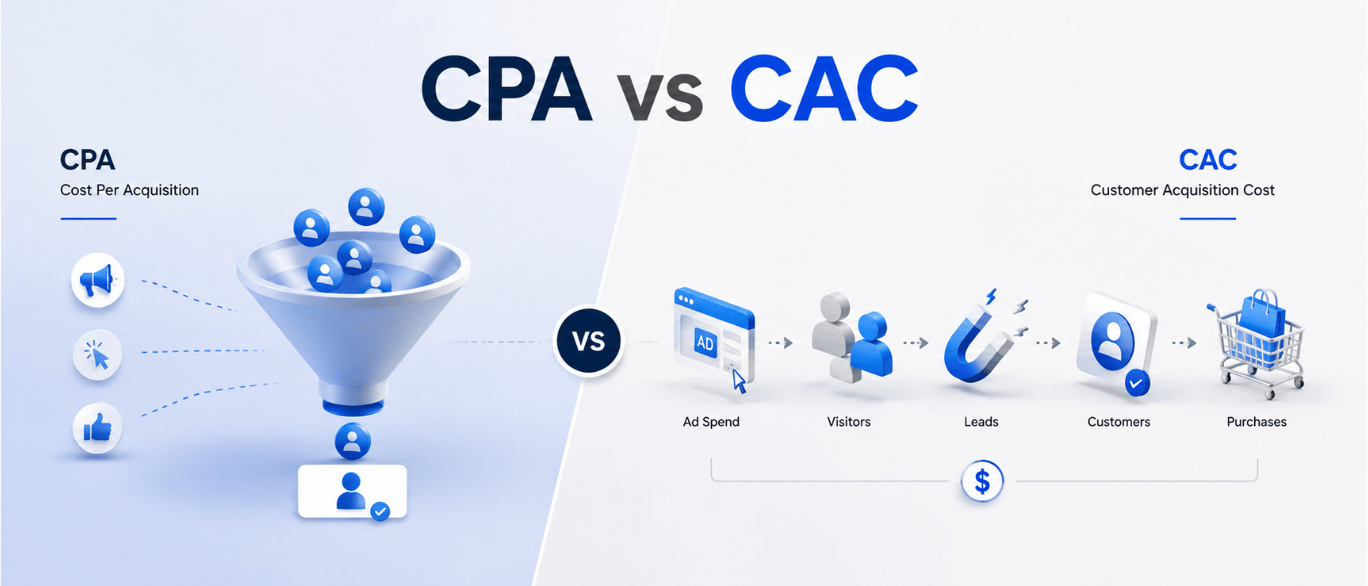
Your marketing team might be proud of a campaign that ‘crushed it on CPA,’ while your CFO might be concerned about CAC climbing for three quarters in a row. Both use numbers and reach very different conclusions about the business’s health.
This is one of the most frequent (and expensive) miscommunications in today’s marketing world. When the team gets the concepts of CPA vs CAC mixed up, budgets are misallocated, growth goals become unrealistic, and resources are optimized toward the wrong outcomes. A good CPA can conceal a bad CAC. Increasing the CAC does not necessarily represent a decrease in efficiency; you could be reaching customers with higher loan-to-value ratios.
In this guide, you will grasp the distinction between CPA and CAC. With that clarity, you open up a whole new avenue of highly effective growth. You put away the pursuit of vanity metrics and begin making long-term decisions. You need a single, real-time view of both metrics. This is where analytics platforms help, enabling teams to move beyond guesswork and make decisions with confidence.
What Is Cost Per Acquisition (CPA)?
Cost Per Acquisition (CPA) is the cost of generating a desired conversion, which can be any action other than a sale. This could be a newsletter sign-up, a free trial activation, a form submission, a demo booking, or an app download.
Consider CPA a highly focused campaign-level metric. You define the desired action, run the campaign, and measure exactly how much it costs to generate that conversion.
Example: if your total cost for a Google Ads campaign is ₹50,000 and you see 200 email leads, your CPA is ₹250. If you have the same cost of ₹50,000 and make 100 real sales, your purchase CPA is ₹500.
CPA is most effective in CPA marketing, a performance-based advertising model where advertisers pay only when a designated action is taken. This model is commonly employed in affiliate marketing, programmatic advertising, and paid social.
What is Customer Acquisition Cost (CAC)?
Customer Acquisition Cost (CAC) is the total of all your expenses to acquire a paying customer across all your channels and costs (not just a single campaign).
CAC is a business-level metric and a strategic measure of acquisition efficiency. It aggregates all sales dollars, marketing software, ad dollars, creative production, event dollars, and even the costs of your acquisition function. The result will tell you the actual amount of investment required to acquire a new customer in your business.
Example: Suppose that your company purchased 200 new paying customers last quarter with a total spend of ₹10,00,000 across all marketing and sales efforts, then your company’s CAC is ₹5,000 per customer.
That is a different approach to accounting than the CPA’s. CAC focuses on the total cost of business growth rather than the performance of individual campaigns.
CPA vs CAC: What’s the Difference?
Understanding the CPA vs CAC difference comes down to three dimensions: scope, purpose, and time horizon.
| Aspect | CPA (Cost Per Acquisition) | CAC (Customer Acquisition Cost) |
| Definition | The average cost of acquiring each customer or conversion. | The total cost to acquire a paying customer. |
| What it measures | The expense incurred for a specific conversion activity. | The full cost to acquire a customer who pays for the product/service. |
| Scope | Campaign or channel level. | Business or company level. |
| Time horizon | Short-term / campaign duration. | Long-term/quarterly or annual. |
| Who uses it | Performance marketers, media buyers. | CMOs, CFOs, growth strategists. |
| Includes sales costs? | No. | Yes. |
| Action type | Any defined action (click, signup, download, purchase, etc.). | Only paying customers. |
| Used to optimize | Individual campaigns, creatives, and ad performance. | Overall acquisition strategy and budgeting. |
| Companion metrics | ROAS, CTR, Conversion Rate. | LTV, Payback Period, Churn Rate. |
The analogy that clicks: a CPA is like measuring the cost of casting a fishing line. CAC is calculating the total expenditure (rod, bait, boat, fuel, time) incurred. Both matter. These are not the only two factors.
How to Calculate CPA?
The CPA formula is straightforward and easy to apply:
CPA = Total Campaign Spend ÷ Number of Acquisitions (desired actions)
Step-by-step:
- Be explicit about what your conversion action is (e.g., “booked a demo,” “completed checkout”)
- Add up all expenses for the campaign (ad spend, creative, agency costs – if campaign specific)
- Record the number of times the defined action was carried out during the campaign period.
- Divide overall spend by overall conversions.
Real-world example:
Campaign spend: ₹1,20,000
Demo bookings generated: 60
CPA = ₹1,20,000 ÷ 60 = ₹2,000 per demo
Tip: CPA varies significantly across industries, funnel stages, and action types. A ₹500 CPA for a low-margin product is great, but not so good for a SaaS trial sign-up that doesn’t always convert to a paid customer. Context is everything.
No more number pulling from spreadsheets, the AI campaign Analytics dashboard automatically calculates CPA for all connected ad channels, including Google Ads, Meta, LinkedIn, and more.
How to Calculate CAC?
The CAC formula is broader, designed to capture total acquisition investment:
CAC = Total Sales & Marketing Costs ÷ Number of New Customers Acquired
What to include in “Total Sales & Marketing Costs”:
- All advertising and paid media expenditure.
- Salaries for the marketing team and fees for the contractors.
- Sales team salaries and commissions
- CRM, marketing automation, and analytics (including a portion of platform fees)
- Creative production (design, video, copywriting).
- Events, trade shows, sponsorships
- Any overhead cost that is related to acquisition functions.
Real-world example:
- Total Q1 sales & marketing spend: ₹25,00,000
- New paying customers gained in Q1: 500
- CAC = ₹25,00,000 ÷ 500 = ₹5,000 per customer
Caution: Some companies break down CAC by channel to identify which acquisition sources deliver customers most efficiently at scale. This channel-level visibility helps businesses understand acquisition performance across multiple sources.
CPA vs CAC in Ecommerce
An ecommerce site will pay particular attention to CAC vs. CPA, as the metrics are extremely significant. Ecommerce margins are tight, competition is tough, and customer acquisition costs on platforms such as Meta and Google continue to rise.
Let’s say in a typical DTC ecommerce scenario, the two metrics are as follows:
CPA in ecommerce is used to measure:
- Cost per purchase from a specific ad campaign
- Cost per cart add or checkout initiation
- Cost per email subscriber from a paid acquisition campaign
- Cost per first-time buyer from a new channel test
CAC in ecommerce is used to measure:
- The fully-loaded cost to bring one new buyer into your customer base
- Whether your blended acquisition spend is sustainable, given average order values
- How acquisition efficiency changes as you scale spend
The critical ecommerce trap: A brand could be racking up a CPA of ₹800 on Meta, but their total CAC (which includes their Shopify subscription, email marketing platform, creative agency, and team salaries) is actually ₹3,500. With an average order value of ₹2,000 and a 40% margin, they are incurring a loss on every new customer they acquire.
CPA vs CAC vs LTV: What’s the Difference?
Customer LifeTime Value (LTV) is an integral part of any CPA vs CAC discussion. These three metrics are interconnected and form a triangle that reflects the sustainability of the whole growth model.
The relationships that matter:
- LTV > CAC is the foundational rule of sustainable acquisition. If acquisition costs exceed customer lifetime value, long-term profitability becomes unsustainable regardless of CPA improvements.
- An LTV: CAC ratio of 3:1 is a widely used benchmark for healthy SaaS and ecommerce businesses, meaning customers spend 3 times their acquisition cost over their lifetime.
- CPA informs CAC: Improving campaign-level efficiency can reduce overall acquisition costs over time.
- CAC Payback Period = CAC ÷ Monthly Gross Profit per Customer. This is a key cash flow metric for funded startups that indicates how many months it will take a new customer to pay for themselves.
Practical example:
| Metric | Value |
| Average CPA (from paid campaigns) | ₹1,500 |
| Fully-loaded CAC | ₹4,000 |
| Average LTV | ₹14,000 |
| LTV:CAC Ratio | 3.5:1 |
| CAC Payback Period | ~8 months |
But our ProactiveAI’s LTV Analytics module provides you with cohort-level LTV forecasts alongside your CAC trends, giving you a more forward-looking perspective on unit economics, not just a snapshot of the past.
How CPA Marketing Supports Scalable Customer Acquisition?
CPA marketing is a performance-based advertising model, meaning advertisers pay only when a user performs a specific action. It is one of the most cost-efficient forms of paid advertising because advertisers pay for outcomes rather than impressions or clicks.
The most common CPA marketing channels:
- Affiliate networks (e.g., impact.com, CJ Affiliate): Pay Publishers Per Conversion
- Google Performance Max: optimizes toward a target CPA across Google’s inventory
- Meta Advantage+ campaigns: They are AI-optimized to hit cost-per-purchase goals
- Programmatic display: With CPA bidding, pay per lead or action across the open web
Here are the tips for a successful CPA marketing campaign:
- Set realistic CPA targets based on your margin structure rather than assumptions
- CPAs can be segmented by funnel stage. A lead CPA is different from a purchase CPA, and they have different benchmarks
- Optimize CPA, but always tie it to CAC to ensure campaign-level wins translate into meaningful business-level efficiency.
- Use CPA trends over time, not single-campaign snapshots, to guide strategy
Best Practices for Tracking and Optimizing Both Metrics
The discipline of measurement and interpretation is needed to achieve the right CPA and CAC. Here are the practices that distinguish analytically advanced organizations from others:
For CPA:
- Be as clear as possible about what you want to measure when you create campaigns; otherwise, you will lose precision.
- Know which ads, campaigns, and channels are actually effective by tracking CPA by channel, campaign, and ad creative.
- Use customer lifetime value segments instead of applying the same CPA target across all audiences.
- Follow weekly CPA activity of active campaigns and tweak bids and budgets as trends dictate.
For CAC:
- Include all relevant costs, as teams often undercount because they exclude salaries or tool subscriptions
- Calculate CAC by channel and customer cohort to identify acquisition trends
- Monitor month-over-month CAC trends and evaluate them against your target LTV-to-CAC ratio.
- Quarterly, reconcile your blended CAC against channel-level CPAs to compare and identify discrepancies
For both:
- Fragmented data across ad platforms, CRMs, and spreadsheets is a leading cause of metric inaccuracies
- Reduce manual calculation errors by automating reporting.
- Create dashboards that present CPA, CAC, and LTV metrics together to help decision makers.
Why ProactiveAI Is Built for This?
Spreadsheets can support CPA and CAC calculations only up to a certain level of business complexity. Manual tracking results in outdated data, disjointed reports, and delayed decisions as businesses expand into new channels, markets, and customer bases. This creates a lack of real-time visibility into acquisition performance and spend efficiency.
ProactiveAI is a business intelligence platform designed to provide a single, real-time view of acquisition metrics for growth teams that affect performance and profitability.
It integrates with Google, Facebook, LinkedIn, and programmatic channels to monitor CPA at the campaign, ad set, and creative levels. The platform automatically calculates fully loaded CAC using ad spend, CRM data, and operational costs while providing LTV and cohort insights.
Users can create CPA or CAC change KPIs, leverage multi-touch attribution beyond last-click, and create executive reports for leadership on CPA, CAC, LTV, and payback period. It helps DTC brands, SaaS teams, and agencies optimize acquisition decisions without manual analysis.
Conclusion
It is not really a debate between the CPA and the CAC; both of these measures are necessary and ask very different questions. CPA gives you feedback on whether or not a particular campaign or channel is currently efficient. CAC gives you an answer to the question of economic sustainability for your whole acquisition function over time.
The best growth teams employ CPA as a tactical optimization tool and CAC as the strategic health check. They define CPA targets based on LTV. They chart CAC trends based on cohort behavior. They make certain that the two measures are always used together, never in isolation.
Without both metrics available in real time, fully attributed, with context and LTV, you are operating with one eye closed when making acquisition decisions. ProactiveAI provides your team the clarity to scale what works, cut what doesn’t, and grow with confidence.
Frequently Asked Questions
Is CPA the same as CAC?
CPA is the cost to create a particular action, such as a sale or sign-up, whereas CAC is the total cost of acquiring a paying customer, including marketing, sales, software, and operational costs.
How do you calculate CAC for ecommerce?
To calculate ecommerce CAC, use the formula:
CAC = Total Marketing + Sales Costs ÷ Number of New Customers Acquired.
This helps measure acquisition efficiency and profitability across campaigns, channels, and overall marketing performance.
What is a good CPA for ecommerce?
Product margins, average order value, and customer lifetime value are crucial for a successful ecommerce CPA. In general, the CPA should not exceed the level at which healthy profits are being made and sustained business growth is achieved.
How does LTV relate to CPA and CAC?
LTV is a customer’s lifetime value, whereas CPA and CAC are acquisition costs. The LTV ratio is much higher than the CPA and CAC ratios for a successful ecommerce business.
You might also like
Handpicked articles for your reading list.

Get the latest insights on Conversational AI
Stay ahead of the curve with weekly updates on data analytics, AI trends, and eCommerce growth strategies delivered straight to your inbox.
Join 5,000+ industry leaders. Zero spam, just pure insights.