
 SparxIT
 SPXCommerce
 What's Your A




eCommerce
eCommerce
Customer Acquisition Cost (CAC): How to Calculate, Benchmark & Reduce It for eCommerce
-
Vikash Sharma
- Jun 16, 2026
- 9 mins read
You launch Meta campaign. New sales starts coming in. Felt good until you got asked by your finance team: “What did each customer actually cost us?” Silence. This is the point at which countless eCommerce brands lose control of their profitability. They are increasing their spending, not knowing whether the new customer will be profitable, only to find out when margins have been squeezed.
As paid media prices continue to climb, competition in the Google Shopping landscape intensifies, and with post-iOS 14 attribution complexity, customer acquisition cost is one of the most important yet least-understood metrics in the DTC arsenal.
But the brands that are doing well in 2026 aren’t only spending more they’re spending smarter with the right customer acquisition cost data and channel-level insights. They also have a clear understanding of customer lifetime value and how it shapes every acquisition decision.
This guide breaks down how to accurately compute your CAC, compare your metrics to your industry benchmarks, understand the relationship between CAC and LTV, and implement effective strategies to lower your CAC while maintaining your growth curve.
What is Customer Acquisition Cost (CAC) in eCommerce?
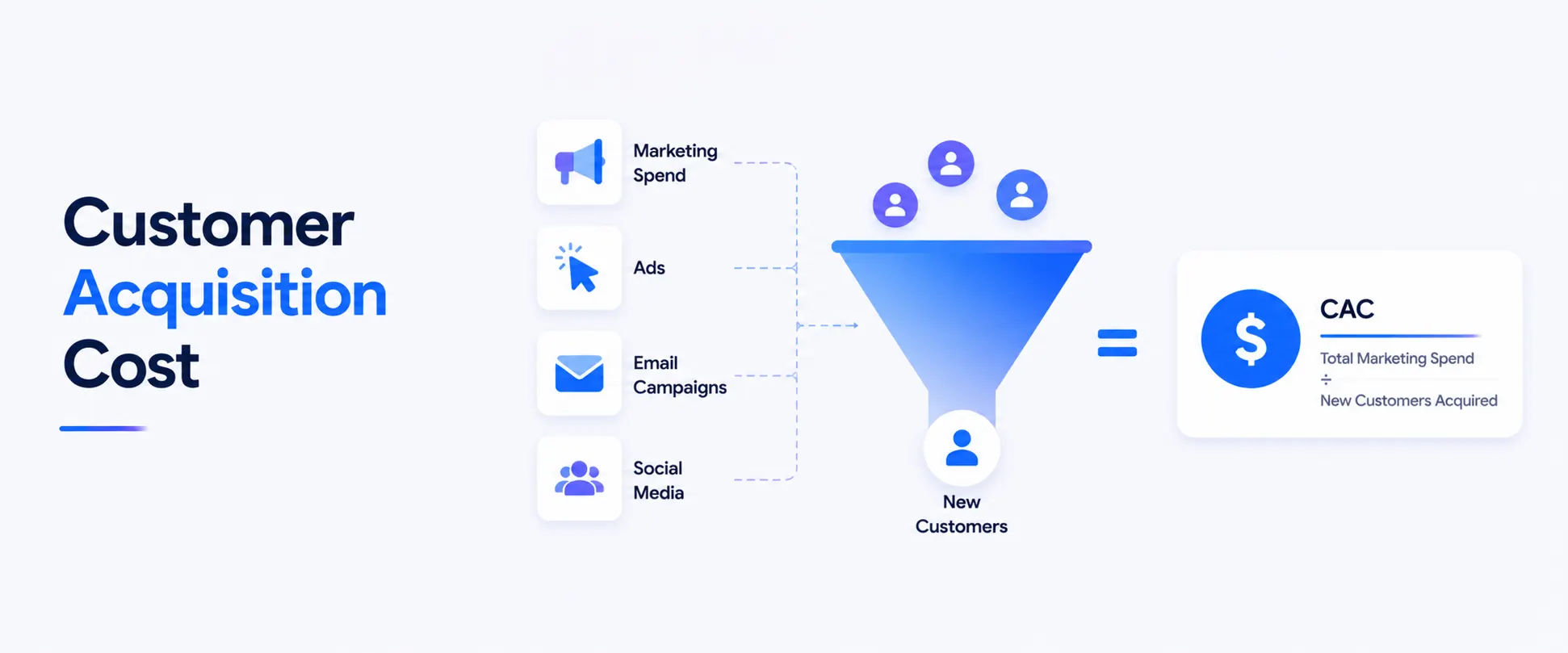
Customer Acquisition Cost (CAC) is the sum of the money that your eCommerce business spends to make one person become a paying customer. It’s not only your ad spend it’s the entire investment in marketing, sales tools, agency fees, creative production, and influencer partnerships. It also includes any overhead costs associated with converting a stranger into a buyer..
Think of CAC as the cost of acquiring each new customer. If you spend $10,000 across all channels and acquire 200 customers, your CAC is $50 per customer. It is a simple concept, yet many brands calculate it incorrectly.
The CAC Formula: How to Calculate It Correctly
The CAC formula for eCommerce is simple, yet many brands apply it incorrectly. Here’s the correct way to think about it:
CAC Formula eCommerce
CAC = Total Acquisition Spend ÷ Number of New Customers Acquired
Total Acquisition Spend includes: Ad spend + Agency/tool fees + Creative costs + Influencer fees + Referral/affiliate commissions + Relevant salaries
What Most Brands Get Wrong
Many eCommerce brands consider only ad spend when calculating CAC. This results in a false sense of security due to an artificially low number. All costs associated with acquiring that customer must be included in a complete CAC calculation:
1. Identify Your Time Period
Choose a consistent time period: monthly, quarterly, or annually. Annual CAC is the most accurate basis for DTC brands, as it accounts for seasonal fluctuations.
2. Add up ALL Acquisition Costs
Paid ads (Meta, Google, TikTok), email platform fees, influencer fees, creative production, agency retainers, and a percentage of team salaries for new customer acquisition.
3. Count Only New Customers
Don’t count repeat buyers in your denominator. The cost to acquire a net new relationship is not the cost per order, and that is a big difference.
4. Divide and Contextualize
Divide the total costs by the new customers acquired. Next, compare your LTVs and industry benchmarks to determine whether this number is sustainable.
Blended CAC vs. New Customer Acquisition Cost
Different CAC calculations serve different business objectives. There are two important versions that savvy eCommerce operators differentiate.
| Blended CAC | Total acquisition + retention spend ÷ all customers acquired | Overall business efficiency snapshot |
| New Customer CAC | Spend on new customer acquisition only ÷ new customers only | Evaluating growth investment performance |
Blended CAC often appears healthier because it includes lower-cost repeat purchases. However, when new customer CAC rises, growth becomes harder because you rely more heavily on existing customers. It is important to monitor both separately.
Calculate the ROI using eCommerce CAC by Channel
Customer acquisition costs vary by channel. You can use this ecommerce CAC by channel information to make savvy spending decisions and find the channels that will give you the best return on investment.
| Channel Type | Channel | Estimated CAC ($) | Notes |
| Paid Social | Meta Ads | $38–$120 | High reach, decreasing efficiency after iOS 14. Ideal for brand awareness. |
| Search | Google Shopping | $30–$90 | High intent and competitive in most niches. Optimized for bottom-funnel conversions. |
| Organic | SEO / Content | $8–$35 | Low continuous CAC after content ranks. Highest ROI over time across channels. |
| Email Marketing | $5–$25 | Lowest CAC channel. Best for reactivation, but also useful for new customers via referrals. | |
| Emerging | TikTok Ads | $25–$80 | Often lower CPMs than Meta in many niches; performance depends on product type. |
| Partnerships | Influencer / Affiliate | $20–$70 | CAC can be controlled via performance-based models, but attribution can be challenging. |
A diversified acquisition strategy with strong organic investment typically delivers a lower blended CAC than a paid-only approach. This is a key tenet of tools such as ProactiveAI’s eCommerce Analytics, which provide deeper insights into your funnel and optimize across the entire funnel.
CAC Benchmarks for DTC eCommerce (2026)
Knowledge of your CAC is meaningless unless there is context. Below are the 2026 CAC benchmarks for eCommerce product categories, so you can determine if your CAC is competitive or bleeding profitability.
| eCommerce Category | Average CAC (2026) | Performance Signal |
| Beauty & Personal Care | $55–$70 | Competitive |
| Fashion & Apparel | $60–$80 | Competitive |
| Food & Beverage | $45–$60 | Strong |
| Consumer Electronics | $70–$95 | Watch margins |
| Furniture & Home Goods | $70–$90 | High AOV needed |
| Jewelry | $85–$105 | LTV critical |
| Health & Wellness | $60–$85 | Subscription boosts LTV |
| Sporting Goods | $60–$80 | Competitive |
| Toys & Hobbies | $50–$70 | Strong if seasonal |
| Automotive Parts | $70–$95 | Lower repeat rate |
CAC vs LTV Ratio: The Profitability Compass
The CAC vs LTV ratio is one of the most significant profitability indicators in eCommerce. It answers a simple question: “Is a customer’s lifetime value greater than the cost to acquire them?
LTV: CAC Ratio
LTV: CAC = Customer Lifetime Value ÷ Customer Acquisition Cost
Aim for a ratio of 3:1 or higher. A ratio below 1:1 means you lose money on every customer.
| LTV: CAC Ratio | Business Signal | Recommended Action |
| Below 1:1 | Losing money on each customer transaction | Freeze paid spend and immediately review expenses |
| 1:1 – 2:1 | Thin margins, risky | Use retention programs or reduce CAC to improve LTV |
| 3:1 | Healthy growth zone | Maintain and optimize the existing marketing mix |
| 4:1+ | Strong unit economics | Consider scaling acquisition and increasing investment |
There’s one caveat here: a really high LTV:CAC ratio might mean you’re underinvesting in customer acquisition and trading away market share. It’s not about getting the smallest CAC but the best one based on the value of each individual customer.
CAC Payback Period for eCommerce
The CAC payback period in eCommerce shows how many months it takes to recover your customer acquisition investment through gross profit. It measures cash-flow efficiency rather than marketing performance alone.
CAC Payback Period
Payback (months) = CAC ÷ (Monthly Revenue per Customer × Gross Margin %)
Example: CAC of $80 ÷ ($40 monthly revenue × 40% margin) = 5 months payback period
If it takes less than 12 months to break even, it’s good for most businesses in the eCommerce industry. Subscription-based DTC brands can afford longer payback times, since their LTV is more predictable.
Low-repeat-rate non-subscription brands have to provide a shorter payback period to remain cash-flow positive. A tool such as ProactiveAI’s Cohort Analysis helps analyze payback periods by cohort and acquisition channel.
7 Proven Strategies to Reduce Customer Acquisition Cost
Now is the time when theory meets practice. These are the most impactful strategies eCommerce brands use to reduce customer acquisition cost without killing growth momentum.
1. Invest in Organic Search (SEO)
SEO remains the top ROI channel for eCommerce businesses in the long term. Organic traffic builds up over time.
The content you post today could bring in customers for years to come, at a near-zero marginal CAC. A mix of collection page optimization, buying guides, and comparison content helps attract high-intent traffic to Shopify stores without paying for ads.
2. Build a Retention Engine That Increases LTV
There are two ways to enhance the LTV:CAC ratio. A strong post-purchase email sequence, loyalty program, and subscription all drive up LTV, making the same CAC more profitable. When brands can double the purchase rate from 20% to 35%, they can effectively cut acquisition expenses in half.
3. Optimize Conversion Rate Before Scaling Spend
Increasing your conversion rate from 1.5% to 3% can reduce CAC by up to 50% while maintaining the same ad spend.
Inspect your landing page UX, product page clarity, checkout friction, and site speed before increasing acquisition spend. Each percentage point of CVR saved directly reduces your CAC on every channel.
4. Leverage Referral and Affiliate Programs
Your existing customers are among the most cost-effective sources for acquiring new customers. A well-designed referral program with an appropriate CAC, when executed regularly, yields substantially lower CACs than comparable paid campaigns, in the range of 30%-50%.
Affiliate partnerships are based on a pure performance cost model, which offers you predictable CAC at scale.
5. Tighten Audience Targeting and Bidding
Widely targeted advertising is a waste of budget on non-targeted audiences. Customers who have purchased before, their email lists, and their behavioral segments are best for creating smaller lookalike audiences and exclusion lists, which will consistently improve CAC on Meta and Google.
This is where ProactiveAI’s Audience Intelligence module can assist by syncing your store data directly to campaign optimization signals.
6. Diversify Beyond Paid Social
Relying too much on any one paid channel is a CAC risk. When costs rise, brands with diversified acquisition channels experience less risk than those that depend heavily on Meta. Channel diversification can be viewed as a form of CAC risk management.
7. Use Attribution Data to Cut Wasted Spend
20-30% of an eCommerce brand’s ad spend is allocated to underperforming ads that aren’t converting. The fix is that there’s a way to get channel-level attribution right: by knowing which channels convert new customers and which simply touch existing customers or are last-click stealers. Use data-driven attribution with predictive analytics tools to clarify how to shift budget to what really works.
How ProactiveAI Helps You Track & Lower CAC
Most analytics tools show what has already happened. Most modern DTC brands are now shifting toward ai-powered conversational analytics to understand CAC trends faster and reduce dependency on static dashboards. Here’s how ProactiveAI features of AI correspond directly with your CAC optimization process:
| ProactiveAI Feature | CAC Problem It Solves |
| eCommerce Analytics Dashboard | Real-time monitoring of blended CAC, new customer CAC, and CAC trends across all channels |
| Cohort Analysis Module | Measures CAC payback period by acquisition cohort, channel, and campaign type |
| LTV & Retention Dashboard | Tracks LTV:CAC ratio and evaluates how retention efforts impact it over time |
| Multi-Touch Attribution | Eliminates last-click bias and identifies which channels truly drive new customer acquisition |
| Audience Intelligence | Identifies the highest LTV customer segments to improve acquisition targeting |
| Channel Performance Reports | Breaks down CAC by channel to enable smarter budget reallocation toward high-performing channels |
From a 7-figure Shopify brand to a large-scale DTC business across multiple markets, ProactiveAI provides your team with the analytics tools they need to make informed, profitable acquisition decisions. Stop relying on gut feelings. No more flying blind with channel ROI.
Conclusion
Today’s eCommerce world demands that CAC isn’t a quarterly number, but a real-time strategic indicator. By thoroughly understanding their CAC by channel, consistently tracking it against LTV, and analyzing their payback periods cohort by cohort, brands make more informed decisions, utilize less budget, and achieve more profitable growth than brands operating on instinct alone.
Lowering CAC does not always require spending less; it requires allocating budgets more effectively. That means investing in organic channels that can compound over time, optimizing conversion rates before scaling spend, activating your existing customers as an acquisition engine, and equipping your team with attribution data so they know exactly what’s working.
The shift toward self service analytics is also changing how eCommerce teams operate, allowing founders and marketers to independently track CAC, LTV, and payback periods without relying on data teams.
Tools like ProactiveAI exist to help eCommerce brands gain the analytical insight needed to shift from reactive budget management to proactive, data-driven growth. To find out what the actual cost of customer acquisition is, book a free demo with ProactiveAI and experience what true eCommerce intelligence is.
Frequently Asked Questions
What is customer acquisition cost (CAC) in eCommerce?
In eCommerce, CAC is the sum of all the money that a business invests in marketing and sales efforts to acquire a single paying customer over a given period of time, divided by the total number of new customers acquired over that time.
How do you calculate CAC correctly for a DTC brand?
Total acquisition expenses (ads, tools, salaries, influencer fees, etc.) over a period of time are divided by the number of net-new customers acquired over that period of time. More importantly, do not count customers who have returned as part of the denominator (and all retention expenses as part of the numerator) as it will lead to underestimating the actual cost of new customer acquisition.
What is a good CAC benchmark for eCommerce in 2026?
For 2026, the eCommerce CAC benchmarks range from $45 to $105 per customer, depending on the category. The average CAC for beauty and food products ranges from $55–$65, while jewelry and health-related products range from $85–$105. Your average order value, gross margin, and customer lifetime value will determine the right CAC benchmark for your brand.
What is the ideal LTV to CAC ratio?
The most widely accepted, ideal LTV:CAC ratio for eCommerce is 3:1, customers are worth three times as much as it costs to acquire them. If the ratio is less than 2:1 then it is not a viable unit economics, and if it is more than 4:1, then it may be an indication that you are not investing enough and losing market share to your competitors.
What strategies reduce CAC without cutting ad spend?
Using site conversion rate optimization to lower effective CAC per dollar spent, investing in SEO to compound organic traffic, and implementing referral programs can significantly improve acquisition efficiency. You can further reduce CAC without lowering spend by using first-party data to target audiences more precisely and eliminate wasted ad spend. Attribution analytics will also help ensure that spend is not wasted on low-efficiency channels.
You might also like
Handpicked articles for your reading list.

Get the latest insights on Conversational AI
Stay ahead of the curve with weekly updates on data analytics, AI trends, and eCommerce growth strategies delivered straight to your inbox.
Join 5,000+ industry leaders. Zero spam, just pure insights.