
 SparxIT
 SPXCommerce
 What's Your A




eCommerce
eCommerce
eCommerce Marketing Attribution: Models, Challenges & How to Pick the Right One
-
Vikash Sharma
- Jun 17, 2026
- 12 mins read
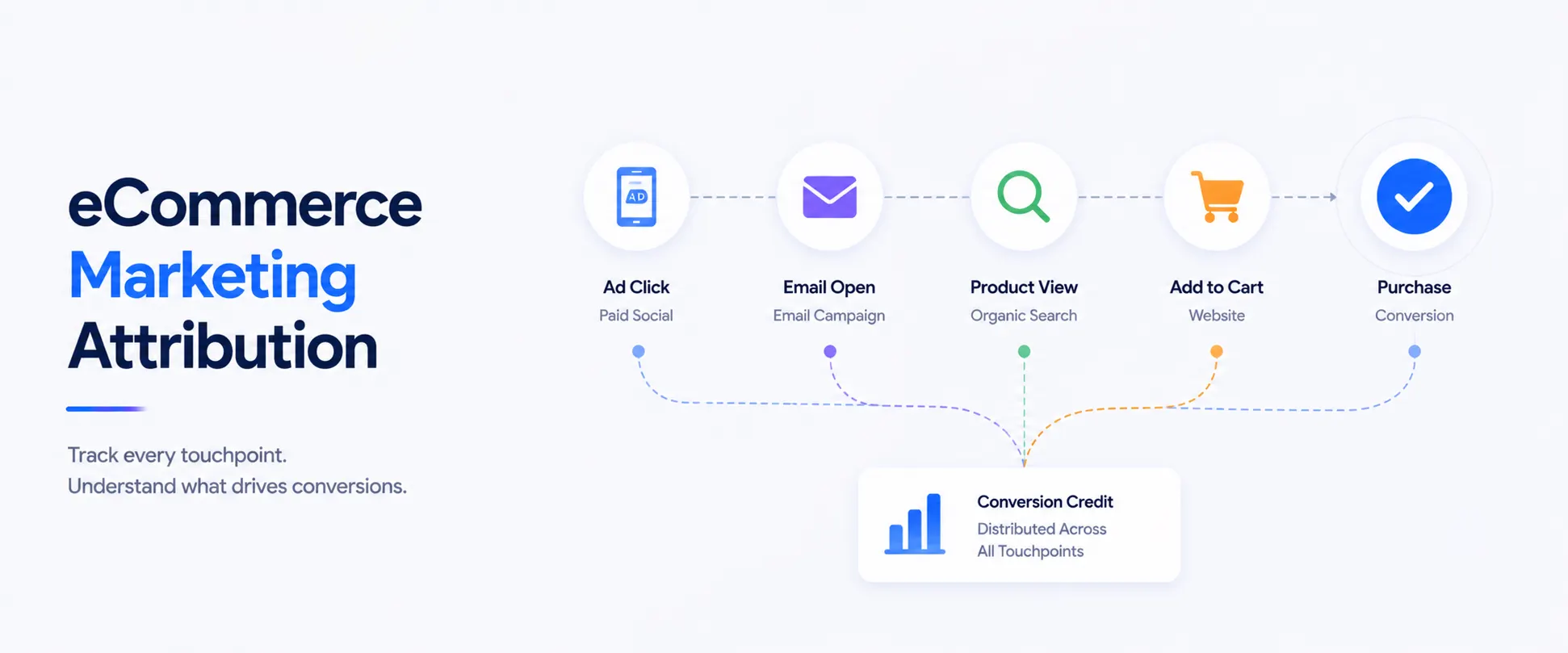
Ecommerce marketing attribution is challenging because each marketing platform measures and reports conversions differently, often producing conflicting performance data. A conversion reported by Google Ads may also be claimed by Meta Ads, while a sale categorized as “direct” in Shopify may have actually been influenced by a previous advertising campaign. This leaves marketing teams with incomplete or conflicting data to make critical decisions on the marketing budget.
The issue is deeper than just reporting. Last-click attribution can inflate the value of bottom-funnel efforts, and privacy updates like iOS 14+ have created key tracking blind spots across the customer journey. These challenges make it difficult to determine which channels generate paying customers and which simply influence conversions at the end of the funnel.
Successful ecommerce marketing attribution requires more than a single tool. It requires the right attribution approach, robust first-party data, and a single reporting framework that provides a single source of truth for teams.
If implemented properly, ecommerce marketing attribution enables brands to optimize with greater confidence, enhance customer acquisition costs (CAC), discover growth opportunities, and create reporting that both the marketing and finance teams can count on.
What is eCommerce Marketing Attribution?
eCommerce marketing attribution is the process of assigning conversion credit to the marketing touchpoints that influenced a customer before they made a purchase. A touchpoint can include an ad impression, an email open, a Google search, a social media interaction, or any other brand interaction that occurs before a purchase.
Attribution works by tracing a customer’s path backward from conversion to identify the interactions that influenced the purchase. Most customers do not purchase the first time they interact with a brand. They click an ad, leave the site, see a retargeting campaign, read reviews, open an email three days later, and then convert. At its core, attribution answers two questions: which interactions influenced the conversion, and how much credit should each receive?
This is important because channel attribution for ecommerce decisions directly impacts where your next marketing dollar is spent. Miss the mark, and you’ll continue investing in revenue that’s nice to see on paper but doesn’t actually drive much incremental growth.
Meanwhile, you’ll miss the opportunity to invest in the channels that have been quietly nudging prospects at the top of the funnel.
What are the Key Components of an Attribution System?
Before evaluating attribution models, it’s important to understand the foundational components that make attribution possible. Think of attribution as a four-layer framework, with each layer building on the one below it.
Layer 1: Data Collection
This is where raw signals enter the system, including pixel events, UTM parameters, server-side tracking, CRM records, and email engagement data. If data quality issues exist at this stage, every layer above it becomes less accurate, a challenge many brands have faced since the introduction of iOS privacy restrictions.
Layer 2: Identity Resolution
Before assigning credit to a touchpoint, you must identify that the interactions belong to the same customer. This layer combines anonymous sessions, digital interaction, and offline data points into a single customer record.
Layer 3: The Attribution Model
This is what determines how the credit will be allocated to the touchpoints detected in Layer 2, which, in more sophisticated configurations, is the statistical model.
Layer 4: Reporting and Activation
If there is one weak link in one layer, the rest of the system is compromised. That’s why so many brands with “good” attribution models receive substandard responses to their data collection layer: it wasn’t that good in the first place!
Which are the Main eCommerce Marketing Attribution Models?
There is no universal attribution model. Brands can choose from simple rule-based approaches to advanced statistical models depending on their needs. The first step in comprehending marketing attribution models that ecommerce brands actually use is to differentiate between single-touch and multi-touch models.
Single-Touch Attribution Models
Single-touch models assign 100% of the credit to one touchpoint, either the first or the last interaction in the customer journey.
First-Click Attribution
It’s the first touchpoint that is responsible for all credit. If a customer clicks your Facebook ad and converts 3 weeks later through direct traffic, the Facebook ad is credited for the conversion. This model can be helpful for measuring top-of-funnel awareness, but it doesn’t account for anything that follows.
Last-Click Attribution
The final touch point prior to conversion is given all of the credit. Even if a Facebook ad created initial demand, a retargeting campaign may receive all the credit simply because the shopper clicked it immediately before purchasing.
Multi-Touch Attribution Models
Multi-touch attribution, ecommerce brands value the multi-touch experience by crediting multiple touchpoints instead of one. This category has a number of varieties:
Linear Attribution:
Each touchpoint along the path is given the same credit. Easy to compute, but it gives equal value to a fleeting impression as to a high-intent email click, which is seldom true.
Time-Decay Attribution:
Points are awarded based on the distance from the conversion event, with later touchpoints receiving higher values and earlier touchpoints receiving lower values. It is effective for shorter sales cycles in which there is a high correlation between sales-cycle recency and intent.
Position-Based (U-Shaped) Attribution:
The first and last touchpoints typically receive 40% credit each, while the remaining 20% is distributed across middle interactions. This is not only for the channel that created the awareness, but also for the channel that closed the sale.
W-Shaped and Z-Shaped Attribution:
W-Shaped and Z-Shaped attribution models expand on position-based attribution by assigning credit to key middle-funnel milestones, making them useful for brands with longer consideration cycles.
Custom Attribution:
Brands can create custom rules for assigning weights, which is helpful when out-of-the-box models do not accurately model their business funnel.
Data-Driven Attribution
Data-driven attribution uses machine learning to evaluate the contribution of each touchpoint rather than relying on predefined rules. The model doesn’t just say, “the first touch is worth 40% credit,” but instead first analyzes thousands of converting and non-converting paths. It then statistically determines which touchpoints actually increased the likelihood of conversion. Rather than assigning fixed percentages, data-driven attribution analyzes real customer behavior to determine which interactions contribute most to conversions.
Marketing Mix Modeling (MMM)
MMM is an aggregate-level model, as opposed to models based at the touchpoint level. Instead of tracking individual users, it examines past spending and profits, as well as external variables such as promotions, seasonality, and even the weather. Without cookies or pixels, MMM has become more pertinent in the privacy-driven marketing world, but at the cost of some granularity.
Why is Last-Click Attribution not effective?
Last-click attribution is one of the most common reasons ecommerce brands misallocate advertising budgets. Imagine if only the final runner in a relay race received credit for the team’s victory. That runner finished the course, but only did so after three fellow teammates completed the difficult portions of the course. Last-click attribution creates the same distortion by rewarding only the final interaction before a purchase.
Consider a real-world path: A customer finds a skincare product in a YouTube influencer’s video, does more research on the brand through organic search, then sees a cart-abandonment remarketing ad and clicks on a branded search ad before purchasing.
Last-click attribution gives 100% credit to that final branded search click, even though that channel only engaged a customer who had already entered the decision-making stage. As a result, the awareness channel that initially generated interest receives little or no credit and may be incorrectly cut from future budgets.
This systematically undervalues the awareness and consideration channels that created the pipeline, and overvalues bottom-funnel and retargeting. Brands that only measure conversions using last-click data often find themselves in a vicious cycle: reducing top-funnel investments because they don’t convert, which leads to a smaller base of customers to close at the bottom of the funnel.
The Post-iOS 14 Attribution Problem
Apple’s iOS 14 privacy updates fundamentally changed how ecommerce brands measure marketing performance. With Apple’s App Tracking Transparency, apps are required to ask for explicit consent from users to be able to track them across apps and websites. A significant percentage of users choose not to grant tracking permission. As a result, a substantial portion of mobile conversion data is delayed, incomplete, or unavailable to advertising platforms.
This created three concrete problems for eCommerce marketers:
- Undercounted conversions: But today, Ad platforms such as Meta are reporting fewer attributed conversions than actually happened because they can no longer see the entire device path.
- Modeled, not measured, data: Platforms are filling in gaps more and more with statistical estimation, rather than what actually happened. As a result, two ad platforms can present vastly different numbers for the same campaign, both of which are “true” within their own modeling logic.
- Delayed reporting windows: Conversion data is not real-time, so it trickles in over days, and decisions for optimal optimization are made during that time, which is not the same and is often less reliable than a same-day decision.
The solution is a migration to first-party attribution, which relies on data your business owns: your website pixel, your CRM, your email platform, and your order management system, rather than on third-party cookies or platform-reported numbers. First-party data is not removed when rules change due to a browser update, and you are not relying on someone else’s tracking policy to track your own customers.
It’s also an opportunity to revisit view-through attribution. View-through attribution attributes a conversion to a touchpoint where a user viewed an ad (impression) without clicking. View-through signals can play a role in the overall picture, but with the advent of post-iOS 14, where click-based tracking has become a much harder metric to rely on, those signals should be used with caution, as impressions can be gamed and boosted more easily than real engagement.
Attribution Model Comparison Table
A side-by-side attribution model comparison makes the trade-offs easier to evaluate at a glance.
| Model | Credit Distribution | Best For | Key Limitation |
| First-Click Attribution | 100% credit to the first touchpoint | Measuring top-of-funnel awareness and acquisition channels | Ignores the rest of the customer journey |
| Last-Click Attribution | 100% credit to the final touchpoint | Quick, simple reporting and conversion tracking | Overvalues bottom-funnel and retargeting channels |
| Linear Attribution | Equal credit across all touchpoints | Brands with short and simple customer journeys, consistent messaging across channels | Treats all touchpoints equally, regardless of their actual impact |
| Time-Decay Attribution | More credit given to touchpoints closer to conversion | Short sales cycles where recent interactions matter most | Underestimates the value of early-stage demand generation activities |
| Position-Based (U-Shaped) Attribution | Typically, 40% to first touch, 40% to last touch, 20% shared among middle interactions | Brands balancing awareness and conversion efforts | Relies on arbitrary fixed percentage allocations |
| Data-Driven (Algorithmic) Attribution | Credit assigned using statistical modeling and machine learning | Multi-channel brands with large volumes of conversion data | Requires significant data volume to produce reliable results |
| Marketing Mix Modeling (MMM) | Aggregate, channel-level credit based on econometric analysis | Privacy-constrained environments and omnichannel measurement | Does not provide a granular, customer-level view of attribution |
There is no single “right” row to this table. It will depend on the length of the funnel, the amount of data, and the complexity of the data that your team can realistically handle and understand.
What are some of the Popular eCommerce Attribution Tools?
It’s important to understand the nature of each attribution tool and what they solve before choosing the right ecommerce attribution tool to automate the hard work of reconnecting touchpoints.
- Google Analytics 4 (GA4): The most popular free choice for tracking web sessions and conversions, it is great for the most basic of reports and last-click tracking, but not good for cross-device and app-to-web journey tracking.
- The platform Triple Whale: A popular ecommerce attribution platform that combines multi-touch reporting with a first-party pixel designed to recover signal loss caused by iOS privacy restrictions.
- CRM-based attribution (HubSpot, Salesforce): These are great for companies that have a longer sales cycle or sell to both B2B and B2C customers, as they can track marketing touchpoints to revenue, not just web sessions.
- ProactiveAI: Not having to switch between isolated attribution dashboards and SQL is what sets ProactiveAI apart from many marketing platforms that require marketers to toggle between disconnected attribution options. Marketers can ask questions in natural language, such as “Which channels generated the most repeat purchases last month?” and receive immediate visual insights without relying on analysts.
Most advanced attribution tools share a common goal: reducing the manual effort required to consolidate and analyze data from multiple marketing platforms.
What are the Practices for Accurate eCommerce Attribution?
Selecting a model is just half the job done. These best practices determine whether an attribution model produces actionable insights or misleading conclusions.
1. Build your strategy around first-party data
Build your measurement foundation on data you own (your website, your CRM, your order history) before layering in platform-reported numbers, which are more vulnerable to tracking restrictions.
2. Match the model to the length of your funnel
It’s important to understand that there is no one-size-fits-all solution for attribution logic, and something that works for one brand or company won’t necessarily fit another, particularly when the company has a different business model.
3. Centralize attribution ownership
Allowing each team to have its own attribution analysis makes it possible to introduce cherry-picked numbers to support each team’s budget. One source of truth prevents this.
4. Reassess quarterly
Customer behavior, algorithms in ad platforms, and privacy laws are in constant flux. What was a good model to use last year is probably outdated.
5. Pair attribution with incrementality testing
Attribution demonstrates correlation, and controlled holdout tests demonstrate causation. When combined, both will catch cases where a channel appears to be attributed but is actually not incremental.
How to Choose the Right Attribution Model
There is no one single “best” model; it depends on your business in its current stage. Consider the following questions before selecting an attribution model:
How long is your typical customer journey?
Time decay, or more commonly last-click models, can work well for shorter, impulsive purchases (single-SKU, DTC purchases with $<50), where the time between awareness and purchase is short. A multi-touch or position-based model is needed for longer consideration journeys, such as furniture or high-ticket electronics, to fairly attribute the channels driving demand over weeks.
How many channels are you actively running?
For a small brand with only a few channels, simpler rule-based models will suffice. When it comes to the point where you’re active on all social, search, email, influencer, affiliate, and organic, that’s when the rule-based models begin to fail, and the increased complexity of data-driven attribution becomes worthwhile.
Do you have enough conversion volume?
Attribution based on data and algorithms requires a substantial amount of conversions to generate meaningful results. A simpler, unambiguous rule-based model might provide a better signal for smaller brands with less volume.
What’s your appetite for complexity?
A small marketing team without an analyst will be better off using a platform with easy-to-use, easy-to-understand attribution logic than a highly configurable enterprise platform that few people on the team know how to use.
Conversational AI in eCommerce analytics helps simplify complex analytics and attribution reporting. A marketer can ask a question and receive a visualized answer within seconds, giving lean marketing teams advanced insights without the cost of a dedicated data science function.
Why Choose ProactiveAI for Your eCommerce Marketing Attribution?
This is the challenge that ProactiveAI is designed to address. We bring attribution data into a unified first-party data layer and provide multi-touch attribution dashboards that teams can easily understand and act upon.
Simply ask, “Which channel generated the most profitable customers this quarter?” and receive a visual answer instantly without waiting for reports from analysts or data teams.
The ability to know exactly which channel is driving the most conversions and to access an ecommerce analytics platform is a powerful combination for eCommerce brands that need to invest across multiple channels but lack the time of an analyst to collect, interpret, and uncover the insights they need.
Conclusion
eCommerce marketing attribution is more than a reporting exercise, and it directly influences whether future marketing investments generate profitable growth or wasted spend.
Last-click attribution is not without its merits when it comes to reporting simply and quickly, but for most brands with multiple marketing channels, the reality is quite different. Multi-touch and data-driven models provide a more complete view, especially when backed by first-party data that won’t disappear whenever a platform changes its privacy policy.
The most successful brands treat attribution as an evolving measurement system rather than a one-time implementation. They consolidate control, re-evaluate their model frequently, and link attribution data with incrementation testing instead of relying on a single number.
Frequently Asked Questions
What is marketing attribution in eCommerce?
Marketing attribution in eCommerce is the process of assigning credit to the marketing touchpoints a customer interacts with before making a purchase, such as ads, emails, search clicks, and other interactions.
What are the main attribution models used by eCommerce brands?
The primary models include first-click, last-click, linear, time-decay, position-based (U-shaped), data-driven algorithmic attribution, and marketing mix modeling. Each assigns conversion credit in a different way to each of the customer’s touchpoints.
Why is last-click attribution misleading for DTC brands?
Last-click attribution attributes 100% of sales to the last touchpoint that a user interacted with before making a purchase, which will likely overlook and miscredit earlier interactions, such as a user reading a brand’s influencer content or seeing a display ad.
How has iOS 14+ impacted eCommerce attribution accuracy?
Brands are moving towards first-party tracking solutions as a result of Apple’s App Tracking Transparency feature, which reduces cross-app and cross-site tracking unless users give explicit consent, leading to undercounted conversions, modeled data, and inconsistencies across ad platforms.
What is the best attribution model for a multi-channel eCommerce brand?
While there’s no one-size-fits-all solution, data-driven attribution is most useful for multi-channel brands with sufficient conversions, as it statistically assigns credit to each stage of the conversion journey based on the true contribution of each touchpoint, rather than arbitrary percentages.
You might also like
Handpicked articles for your reading list.


Get the latest insights on Conversational AI
Stay ahead of the curve with weekly updates on data analytics, AI trends, and eCommerce growth strategies delivered straight to your inbox.
Join 5,000+ industry leaders. Zero spam, just pure insights.