
 SparxIT
 SPXCommerce
 What's Your A




eCommerce
Marketing
Is Your LTV:CAC Ratio Good? Benchmarks and Ways to Improve It
-
Varun Kumar
- Sep 15, 2026
- 8 mins read
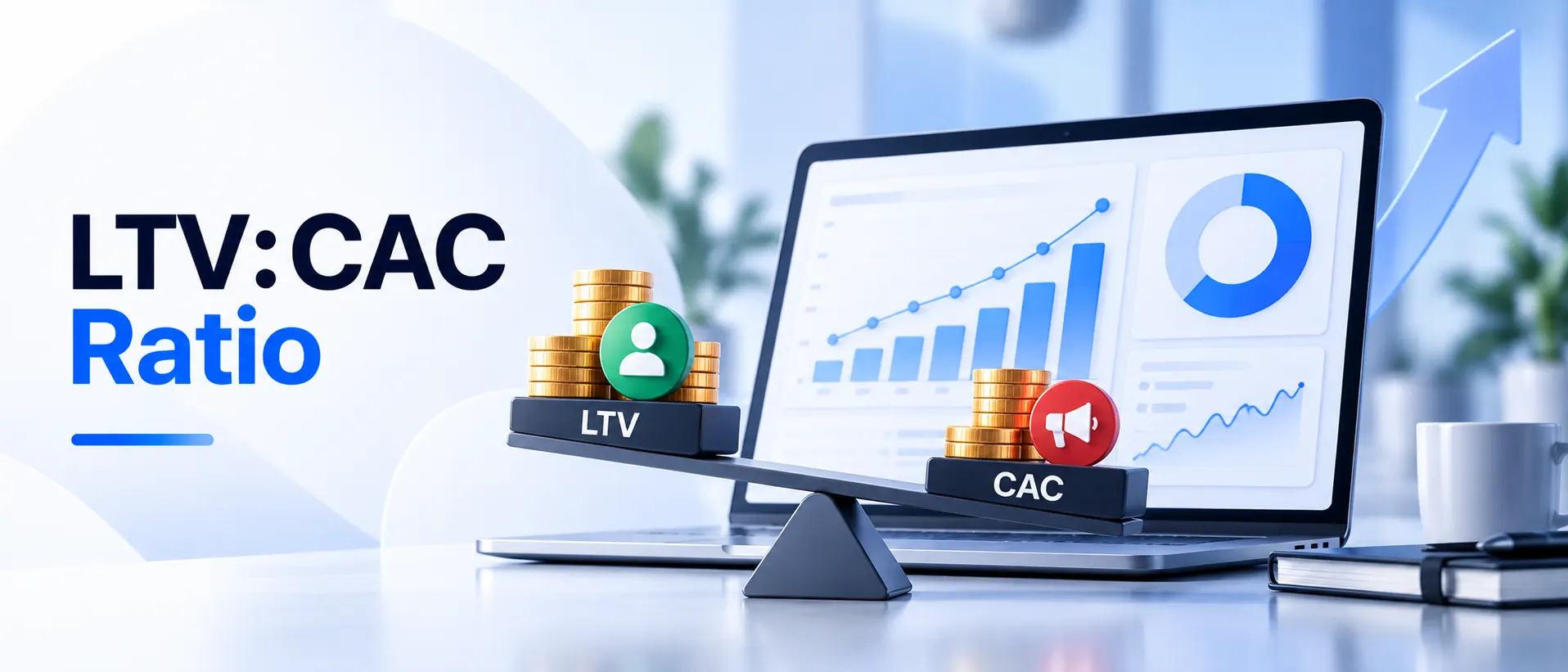
You’ve created campaigns, added SDRs, and started paid ads, and customers are visiting! A question is always lingering in the back of your mind, though: What am I paying to get customers, and is it worth it?
This is exactly what the LTV:CAC ratio answers. For businesses in SaaS, ecommerce, and B2B, operating without this metric is like driving without a dashboard. You may be moving at speed, yet you have no idea whether you are speeding toward profit or the wall.
The bright side is that understanding your LTV:CAC ratio and relevant benchmarks gives you a clear way to improve acquisition efficiency. You can decrease acquisition costs, keep customers longer, and make better budget decisions with data, not guesstimates.
This guide explains what a “good” LTV:CAC ratio is, how it differs across industry and business stage, and how to optimize it, including by using tools such as ProactiveAI to track and optimize in real time.
What Is the LTV:CAC Ratio?
LTV:CAC is the ratio of two key business values:
- LTV (Customer Lifetime Value): How much money a customer brings to your business over their lifetime.
- CAC (Customer Acquisition Cost): The sum of all marketing and sales costs to acquire a new customer.
Dividing LTV by CAC gives you a number that indicates how efficiently your business generates long-term revenue from every dollar spent acquiring customers. Industry studies indicate that businesses with LTV:CAC ratios below 1:1 are losing a dollar on each new customer they acquire, and over time, that creates a vicious cycle that can ultimately drain growth capital.
It’s as if a coffee shop spends $10 on advertising to attract a customer who purchases just one $8 cup of coffee. As the number of customers increases, the company keeps losing money because each customer’s $8 value falls below the $10 acquisition cost.
In SaaS companies, one of the most important metrics investors look at when assessing business health and sustainable growth is the LTV:CAC ratio. A good ratio indicates product-market fit, effective go-to-market motion, and a path to profitability.
How Do You Calculate LTV and CAC
LTV is the total value a customer brings to your business, and CAC is the cost to acquire that customer. By comparing the two, you can see whether your customer acquisition strategy is profitable and scalable.
Calculating CAC
CAC = Total Sales & Marketing Spend ÷ Number of New Customers Acquired
Every expenditure, whether it’s ad spend, agency, sales rep salary, marketing tools, events, commissions, and more, should be included in your marketing and sales stack.
Example: If you spend $60,000/month on sales and marketing and gain 30 customers as a result, your CAC is $2,000.
Calculating LTV
LTV = Average Revenue Per User (ARPU) ÷ Churn Rate
Or, more precisely:
LTV = ARPU × Gross Margin % × Average Customer Lifespan
If you make $500/month and your gross margin is 75% and the average customer is around for 24 months, then your LTV is:
LTV = $500 × 0.75 × 24 = $9,000
Calculating the Ratio
LTV:CAC = LTV ÷ CAC = $9,000 ÷ $2,000 = 4.5:1
It’s a healthy ratio, and the customer spends 4.5 times what you spent to acquire them.
What Is a Good LTV:CAC Ratio?
A widely used benchmark is a 3:1 LTV:CAC ratio, meaning a business generates about $3 in lifetime value for every $1 spent acquiring a customer. For every $1 invested in attracting a purchase, you should receive $3 in lifetime value.
Here’s how to read your ratio:
| LTV:CAC Ratio | What It Signals |
| Below 1:1 | You are losing money on every customer. Immediate action needed. |
| 1:1 to 2:1 | Marginal efficiency. Scaling may require significant improvement. |
| 3:1 | The industry benchmark. Healthy, scalable growth. |
| 4:1 to 5:1 | Strong efficiency. An opportunity to invest more aggressively. |
| Above 5:1 | May indicate underinvestment in acquisition. Others may be able to outrun you. |
A ratio greater than 5:1 isn’t always best, and sometimes you’ll leave growth on the table because you aren’t spending enough to buy customers. The goal is calibrated efficiency, not just a high number.
LTV:CAC Benchmarks by Industry and Business Stage
LTV, CAC, and LTV:CAC benchmarks are not one-size-fits-all. The right range can vary significantly by industry, customer segment, business model, go-to-market strategy, geography, and company maturity:
By Industry
| Industry | Typical LTV | Typical CAC | LTV:CAC Ratio |
| B2B SaaS | $5,000–$60,000+ | $1,200–$15,000 | 3:1–5:1 |
| Ecommerce | $150–$500 | $50–$150 | 2.5:1–3.5:1 |
| Business Consulting | $2,500–$10,000 | $600–$2,500 | 3.5:1–5:1 |
| Entertainment/Media | $500–$2,000 | $150–$400 | 2.5:1–4:1 |
| B2C SaaS | $500–$2,500 | $100–$500 | 2.5:1–4:1 |
By Business Stage
| Stage | Median LTV:CAC | Top Quartile | Notes |
| Seed / Pre-Series A | 2.0–3.0:1 | 3.5–5.0:1 | Higher CAC is acceptable during product-market fit |
| Series A / B | 3.0–4.0:1 | 4.5–6.0:1 | 3:1 minimum for efficient scaling |
| Series C+ / Mature | 3.5–5.0:1 | 5.0–8.0:1 | Below 3:1 at this stage signals channel saturation |
| SMB-focused (low ACV) | 2.0–3.0:1 | 3.5–5.0:1 | Self-serve and PLG models help keep CAC low |
| Enterprise (high ACV) | 4.0–6.0:1 | 6.0–10.0:1 | High LTV compensates for longer, more expensive sales cycles |
For early-stage businesses, it’s about getting the direction right, rather than perfect. That’s not the same thing as 1.5:1 at Series B, when churn is on the rise.
Why Do Most Businesses Miscalculate Their LTV:CAC?
The formula is only half the job. The more common problem is what you add to or subtract from the calculation. Here are some common mistakes that you should not make:
1. Using blended CAC instead of channel-level CAC
You hide an efficient channel by blending CAC across all channels, including organic, paid ads, and referrals. A blended CAC of $500 can contain a $3,000 paid search CAC and a $200 organic CAC.
2. Forgetting expansion revenue in LTV
Ignoring expansion revenue can understate LTV. When Net Revenue Retention (NRR) exceeds 100%, existing customers generate more recurring revenue over time through expansion. Many SaaS businesses consider expansion to be 20-40% of the real LTV.
3. Ignoring gross margin
Revenue does not equal profit. A customer paying $1000/month with a 40% gross margin is not worth as much as one paying $800/month with an 80% gross margin. Don’t forget margin in your LTV calculation.
4. Measuring over too short a time period
Measuring LTV over an inappropriate time period can impact the LTV for subscription businesses. Taking a snapshot after only three months of cohort data can produce an incomplete LTV estimate, particularly when customers have longer lifecycles.
How to Improve Your LTV:CAC Ratio
This ratio can be improved in two ways: decrease CAC or increase LTV. The top-performing firms do both at the same time.
Ways to Reduce CAC:
Reduce acquisition expenses by targeting budget to top-performing channels, optimizing targeting, and streamlining your sales process. These are some ideas for lowering your CAC:
1. Focus on highest-ROI acquisition channels
Not all channels should be funded alike. Use an eCommerce analytics dashboard or marketing analytics tool to analyze performance by channel. Channels with solid intent signals such as organic search, referrals, PLG tend to have lower CAC compared to broader-reaching paid channels.
2. Tighten targeting in paid acquisition
Avoid wasting spend on audiences that won’t convert or retain. Define your ICP precisely and use it to target ads, helping reduce wasted spend without unnecessarily limiting reach.
3. Invest in sales cycle efficiency
A longer sales cycle means more SDR and AE time per deal, which drives up CAC. Shorten the cycle with improved qualification processes, quicker demos, and smoother handoffs between marketing and sales.
4. Use AI sales forecasting to focus on high-value prospects with LTV
Not all leads convert into high-value customers. Predictive analytics for sales can determine which prospects have a higher “lifetime value” and dedicate time to those deals that tip the ratio in your favor.
Ways to Increase LTV:
Retain customers longer, grow account spend, build product stickiness, and prioritize resources to high-value customers to increase customer lifetime value. Here are some methods to increase your LTV:
1. Reduce churn with proactive customer success
The one thing that can destroy all LTV is churn. A customer who leaves after six months can be worth substantially less than one retained for 24 months. The investments in health scoring, onboarding, and proactive outreach ultimately protect LTV.
2. Expand revenue through upsells and cross-sells
Customers who start with the base plan but opt for more costly upgrades or add products have much higher lifetime values. Plan to expand your product tiers and pricing rather than add it on later.
3. Improve product stickiness
Customers stay longer with products that are harder to replace (due to integrations, data history, workflow dependency). The more deeply a product integrates into customer workflows, the harder it becomes to replace.
4. Segment customers by LTV potential
Not all customers are worth the same. Some cohorts generate value quickly, while others build value gradually over a longer customer lifecycle. By breaking down the customer base into segments based on LTV and designing retention programs for each, you can optimize your return on investment on customer success initiatives.
How Does ProactiveAI Advantage Your LTV:CAC Ratio?
You shouldn’t just implement an LTV:CAC tracking system; you should make it a habit throughout the process. That’s where ProactiveAI comes in.
ProactiveAI is an AI-driven conversational analytics solution designed for businesses seeking to transform from reactive reporting to proactive decision-making. Whereas a monthly report must be requested from your analyst, ProactiveAI allows you to pose questions, using natural language, to your data and receive relevant and accurate answers in real-time.
How ProactiveAI’s capabilities directly help with improving LTV:CAC:
Real-Time LTV & CAC Tracking
ProactiveAI’s ecommerce analytics dashboard provides real-time insight into the LTV and CAC for segments, channels, and cohorts, not just a blended average. You’ll be able to view and adjust budget allocation before the end of the quarter based on which channels are yielding high-LTV customers versus low-retention customers.
AI-Powered Sales Forecasting
AI sales forecasting is a major feature of ProactiveAI’s platform, which analyzes historical cohort data to forecast which current leads or customers are likely to grow or drop. This gives your sales and customer success teams the option to target the right accounts, and your LTV forecasts are forward-looking, not historical.
Self-Service Analytics for Every Team
The first issue with LTV:CAC analysis is that almost all non-technical stakeholders don’t have access to the data. The solution is ProactiveAI’s self-service analytics, which lets marketing, sales, and finance teams query data without writing SQL or waiting for the data team. When everyone has access to the same metrics, decisions are faster.
Proactive Anomaly Alerts
ProactiveAI not only answers questions but also identifies problems early. ProactiveAI can automatically flag when CAC rises on a channel, or LTV declines for a cohort. This is a week 2 catch compared to month 6.
Cohort Analysis and Churn Prediction
ProactiveAI’s cohort analysis features let you monitor each segment’s behavior over time, including expansion and reduction trends, when they occur, and how much revenue they generate. This gives you the detail you need to calculate LTV accurately and identify the segments driving your LTV ratio.
ProactiveAI provides the analytical backbone for ecommerce brands to quickly and confidently answer channel-specific acquisition payback questions, and for SaaS companies to map out unit economics for their Series B deck.
Conclusion
One of the most truthful indicators of your business is your LTV:CAC ratio. It’s not about vanity metrics or impressive top-line numbers. It simply tells you if growth is actually working.
The baseline is 3:1. To get above it, you need to know these numbers with precision, act on the right insight, and continuously optimize both sides of the equation. Companies that do this well aren’t necessarily spending more. They’re spending smarter, retaining customers longer, and strengthening their competitive advantage over time.
Looking to put an end to guesswork and embrace data-driven acquisition and retention choices? ProactiveAI has got you covered. ProactiveAI provides all your team needs to monitor, analyze, and optimize your unit economics, whether they have a data science team or not, including real-time LTV dashboards and AI-powered churn prediction.
Frequently Asked Questions
What is the LTV:CAC ratio, and why does it matter?
LTV:CAC is a ratio that compares a customer’s lifetime value with the cost of acquiring them. It matters because it quickly shows whether your acquisition strategy is sustainable and profitable.
What is considered a good LTV:CAC ratio?
A healthy business will have a ratio of 3:1. If the ratio is below 3:1, it may mean you are spending too much on acquisition and experiencing poor retention. If it’s more than 5:1, it could mean you are not investing enough in growth and losing market share to competitors.
How is LTV:CAC different for SaaS vs. ecommerce?
For SaaS, LTV depends on subscription duration and Net Revenue Retention, and expansion revenue is a significant factor. In ecommerce, LTV is influenced by repeat purchase rates and AOV, and can generally lead to a lower absolute LTV but quicker payback time on CAC.
How often should I track my LTV:CAC ratio?
Check it monthly at least and run a thorough cohort analysis every 3 months. For rapidly growing companies, monthly tracking will help you spot churn or CAC inflation early enough to prevent them from becoming significant issues.
Can I have an LTV:CAC ratio that is too high?
Yes. If the ratio is greater than 5:1, you may not be spending enough to gain new customers, which can impact business growth. This is a red flag for investors and growth advisors, who may push for more investment in acquisitions, particularly in competitive markets.
How does ProactiveAI help improve LTV:CAC?
With ProactiveAI, any team has access to the data that matters, such as real-time cohort analysis, channel-level CAC tracking, AI-powered churn prediction, and self-service analytics. It’s not just about replacing manual reporting, but it’s about ensuring you are always in the know about your unit economics.
You might also like
Handpicked articles for your reading list.


Get the latest insights on Conversational AI
Stay ahead of the curve with weekly updates on data analytics, AI trends, and eCommerce growth strategies delivered straight to your inbox.
Join 5,000+ industry leaders. Zero spam, just pure insights.