
 SparxIT
 SPXCommerce
 What's Your A



eCommerce
eCommerce
CAC Payback Period: The Most Underrated Metric for Scaling eCommerce Profitably
-
Diksha Singh
- Jun 24, 2026
- 8 mins read
You are generating exposure aggressively by paying for ads. Revenue is climbing. Your LTV: CAC ratio seems sound on paper. Yet, cash is scarce, margins are under strain, and you just don’t know why growth is so fragile.
There’s a problem with most eCommerce founders and CMOs: they measure the wrong thing. It’s not enough to know how much a customer is worth to you over time. You also need to know how quickly they put money back in your pocket. This is the issue the CAC payback period answers, and it’s the factor that separates brands that will grow with confidence from those that will quietly use up their runway.
The good news? Once you understand your payback period, you can measure it by channel and track it in real time with the right tools—making the economics of your growth strategy much clearer. You no longer fly blind and make capital-efficient decisions based on data.
What Is the CAC Payback Period in eCommerce?
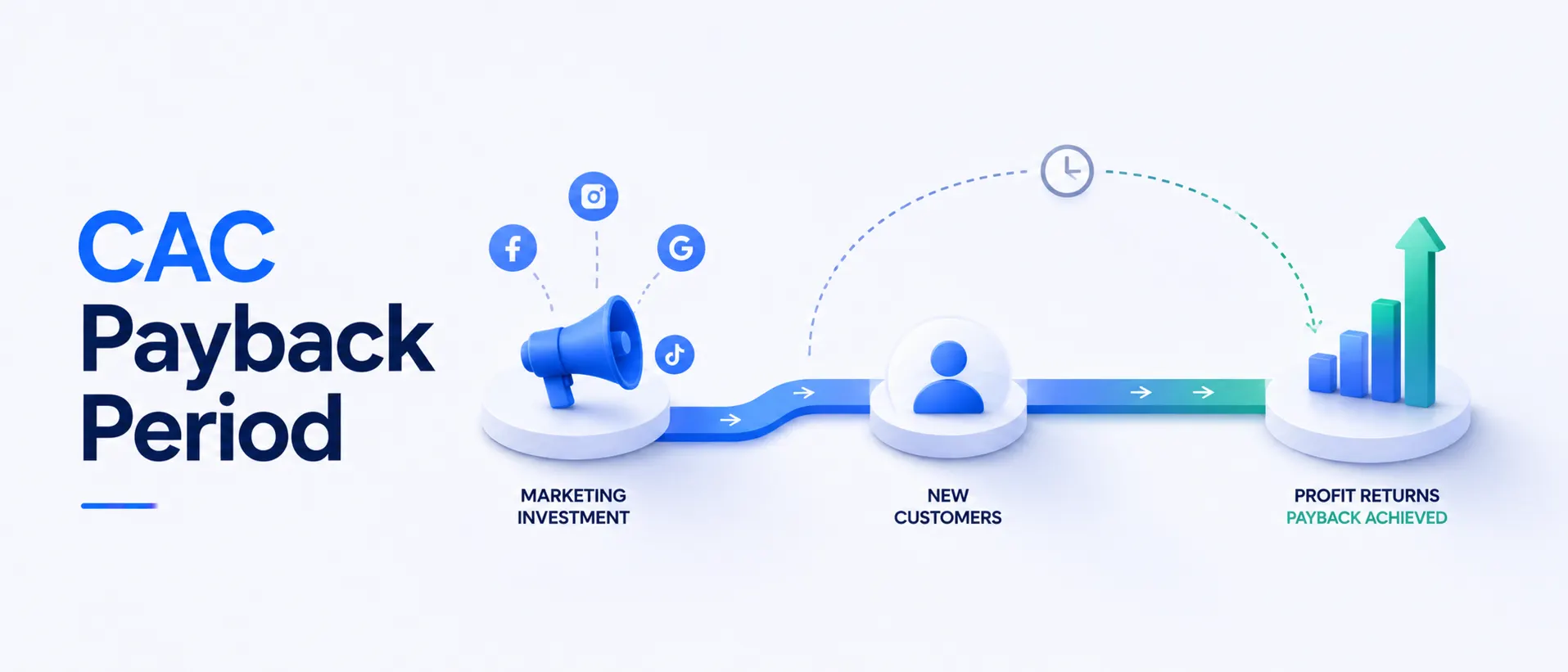
The CAC payback period is the time your business needs to recoup the cost of acquiring a customer through the gross profit the customer generates.
For example, if you pay $120 to get a customer and that customer makes $20 in gross profit each month, you break even in 6 months. Until you reach the six-month mark, every dollar the customer spends helps recover your marketing investment. After that, it is money in the bank.
This time span is a make-or-break for eCommerce brands, particularly DTC companies with aggressive upfront ad costs and thin margins. It determines:
- How long is your cash tied up in customer acquisition
- How quickly can you reinvest into growth
- Whether your business model is fundamentally sustainable
Unlike LTV, which focuses on long-term value, the CAC payback period provides a more immediate and practical view of cash flow. It reflects actual cash flows rather than optimistic projections.
The Customer Payback Period Formula
The typical payback period formula is:
CAC Payback Period = CAC / Gross Profit per Customer (Average per Month)
Let’s look at the individual elements one by one:
CAC (Customer Acquisition Cost): Cost of all marketing and sales activities / Number of new customers gained over a specific time period.
CAC = Total Acquisition Spend / New Customers Acquired
Monthly Gross Profit per Customer: Average Revenue per Customer per Month (ARM) – the Cost of Goods Sold (COGS).
Monthly Gross Profit = (Average Monthly Revenue per Customer) x Gross Margin %
|
Variable |
Value |
| Total monthly ad spend | $50,000 |
| New customers acquired | 500 |
| CAC (Customer Acquisition Cost) | $100 |
| Average order value (AOV) | $75 |
| Purchase frequency (monthly) | 0.5 orders |
| Gross margin | 55% |
| Monthly gross profit per customer | $75 × 0.5 × 55% = $20.63 |
| CAC Payback Period | $100 ÷ $20.63 = ~4.8 months |
This is a good way to quantify the time to recoup CAC, not as a nebulous idea, but as a real number with real unit economics.
Payback Period Benchmarks for eCommerce
What’s a good number? The short answer: it depends on your category, margin profile, and business model. However, here are the widely accepted benchmarks of time to payback for eCommerce:
| Business Type | Healthy CAC Payback Period |
| Subscription DTC (consumables, beauty, wellness) | 3–6 months |
| One-time purchase businesses (furniture, electronics) with high AOV | 6–12 months |
| Fashion and apparel | 4–8 months |
| Marketplace-dependent sellers | 6–15 months |
| DTC brands with high retention rates | Under 6 months |
Here are some important guidelines to follow:
- A payback period of less than 6 months is considered excellent for a DTC brand, indicating that the capital is being used efficiently and the brand can quickly recoup its investment.
- Payback periods longer than 12 months are risky, particularly if you’re using debt or VC to grow.
- The shorter the payback period, the more aggressively brands can invest in growth without jeopardizing cash flow.
For brands that have bootstrapped or are in the growth stage, a payback period of under 6 months is a strategic priority, whereas for many venture-backed DTC brands, that timeframe is flexible because they are willing to wait for a rapidly scalable product.
CAC Payback Period by Channel
Perhaps one of the most powerful uses for this metric is to funnel it through the acquisition channel. Some channels cost you more to acquire and convert into customers, and your CAC payback period by channel tells you which ones are profitable and which aren’t.
Here is a general direction:
|
Channel |
Typical CAC | Repurchase Likelihood |
Approximate CAC Payback Period |
| Email / SMS | Low ($5–$20) | High | 1–2 months |
| SEO / Organic | Very low (long-term investment) | Medium–High | 1–3 months |
| Referral / Word-of-Mouth | Low ($10–$30) | High | 1–3 months |
| Meta Ads (Retargeting) | Medium ($30–$80) | Medium | 3–5 months |
| Google Shopping | Medium ($40–$100) | Medium | 4–7 months |
| Meta Ads (Prospecting) | High ($80–$200+) | Lower | 6–12 months |
| Influencer / Affiliate Marketing | Variable | Variable | 4–10 months |
| TikTok Ads | Medium–High | Lower initially | 5–10 months |
The bottom line: Email, SMS, and SEO typically deliver the shortest payback periods because acquisition costs are low and customers from these channels often have longer lifecycles.
Prospecting campaigns on Meta or TikTok often have longer payback periods, but they can still be highly effective when supported by sufficient capital and strong retention strategies.
CAC Payback vs. LTV: Why You Need Both
Most eCommerce teams end up making this mistake: CAC payback and LTV are not the same, and this is where they get confused.
- LTV: CAC ratio is the ratio of the lifetime value of a customer against the cost of acquisition of that customer.
- The CAC payback period answers a critical question: How long does it take to recover customer acquisition costs?
Having an excellent LTV: CAC ratio of 4:1 and a poor business with a 24-month payback period is possible. Why? Because you invest capital upfront and may not recover it for two years. That’s a significant cash-flow commitment, particularly if you’re scaling!
Unit Economics and the Ecommerce Profitability Timeline
The CAC payback period lies at the crossroads of two important factors that influence your brand’s ability to scale: unit economics and timing.
Your unit economics payback period reflects whether your per-customer economics are designed to sustain and grow. Most eCommerce brands go through the following stages of profitability:
- Month 0: You acquire the customer, incur the full acquisition cost, and operate at a negative customer margin.
- Months 1–3: Customer begins generating revenue. Gross margin contributions start to cover CAC.
- At the payback point, cumulative gross profit equals the CAC. At this stage, you have fully recovered the customer acquisition cost.
- Payback: All purchases are incremental profits. Retention, repeat purchases, and referrals are no longer costs and benefits, but are pure value.
The brands most likely to break the code for profitability are those with high repeat-purchase rates, low acquisition costs, and diversified acquisition channels. They are also likely to use self-service analytics platforms, enabling teams to explore and act on this data without relying on a data analyst.
How to Reduce Your CAC Payback Period
There are 2 levers: either reduce CAC or increase gross profit per customer per month. In practice, the winning brands do both simultaneously.
Strategies to lower CAC:
- Optimize budget for high-intent, low-CPM channels (SEO, email capture, referral programs)
- Reduce CPAs on paid channels by improving creative quality and relevance to ads.
- Improve conversion rate optimization (CRO) to convert more site visitors into customers.
- Developing community and owned audiences reduces reliance on paid traffic.
Strategies to increase monthly gross profit:
- Boost AOV with upsells, bundles, and cross-sells at checkout
- Increase purchase frequency through loyalty, subscriptions & trigger email flows.
- Increase gross margins by negotiating with suppliers or positioning offerings as premium.
- Minimize return rates, which directly impact margin erosion
The multiplier is retention. A customer who purchases only once recovers CAC more slowly. Anyone who buys 4x per year will substantially shorten their payback time. All retention efforts, from post-purchase e-mail communications to personalizing a customer’s experience to offering loyalty perks, have a direct impact on your ecommerce profitability timeline.
Brands that leverage AI-powered conversational analytics uncover retention opportunities faster because teams can ask questions in natural language and receive actionable insights in seconds.
Analytics Tools That Help Track CAC Payback Period
For CAC payback period tracking at scale, it’s crucial to have connected data, your ad spend, orders, COGS, and customer purchase history all in one place. These are the kinds of tools that count:
The tools that enable advertisers to connect ad spend to real customers, not clicks, are essential: Attribution Platforms. If your CAC is not correctly attributed, then you’re already off target.
- Customer Analytics / Cohort Tools: It’s important to view the gross profit earned by each customer cohort for the month they were acquired. This is the raw data you will use to create your payback curve.
- Ecommerce Analytics Dashboards: A custom ecommerce analytics dashboard delivers unit economics metrics, such as CAC, payback period, LTV, and contribution margin, in one place, eliminating manual spreadsheet work that slows decision-making.
- eCommerce Sales Forecasting Tools: With the knowledge of your payback period by channel, you can now model what impact changes in your acquisition mix will have on your cash flow months ahead of time.
- ProactiveAI is a solution designed specifically for such eCommerce intelligence. It is a single source for all your marketing, sales, and customer data, and it provides self-service analytics. This means founders, CMOs, and finance teams can now answer complex unit economics questions without writing a single SQL query.
Why Choose ProactiveAI for CAC Payback Period Tracking?
ProactiveAI enables eCommerce brands to monitor and shorten CAC payback periods in a single, data-backed approach. It can be integrated with ad platforms, Shopify/WooCommerce stores, and CRM systems, providing a single source of truth for accurate CACs.
The platform breaks down payback periods by channel, campaign, and cohort, allowing you to identify which acquisition channels are driving profitable growth and which need optimization.
By tracking gross profit at the cohort level, teams can understand customer value over time and monitor the actual payback curve across major acquisition channels.
It has a conversational AI that provides real-time answers to questions about acquisition performance without requiring manual analysis.
ProactiveAI also enhances retention by identifying customers at risk of churn and enabling smarter budgeting through AI forecasting, providing a forward-looking view of profitability in a single intelligent workspace.
Conclusion
The CAC payback period is not some vanity metric. It’s the obvious indicator of whether your business has sufficient financial strength to expand. It will tell you if your capital is being used properly, where you should allocate more capital, and if your unit economics will support the growth path you’re on.
The payback period is an absolute must-have for any DTC brand that wants to achieve sustainable, profitable growth across channels and cohorts, in real time. Brands that are successful in today’s competitive eCommerce landscape aren’t merely growing faster, but are growing more rapidly. They’re regaining their investment faster and making better use of their money.
ProactiveAI provides the tools to do just that. It’s designed for the eCommerce operator who demands clarity, speed, and confidence at every turn, from unified data to AI-powered cohort analysis, and channel-level payback dashboards.
Frequently Asked Questions
What is the CAC payback period in eCommerce?
For an eCommerce business, the CAC payback period is the number of months it takes to recoup the customer acquisition cost through the gross profit generated by that customer. It tracks the effectiveness of your marketing investment and is one of the most important indicators to monitor to ensure your profitability and cash flow.
How do you calculate the CAC payback period?
Divide your CAC (total acquisition spend / new customers) by your monthly gross profit per customer (average monthly revenue per customer x gross margin %). The CAC of $90 and a gross profit of $18 per customer per month will result in a payback period of 5 months. Use gross profit, NOT revenue, to make sure you are accurate.
What is a good payback period for a DTC brand?
A payback period of less than 6 months is good for most DTC brands. For businesses operating on subscription-based models with high rates of repeat purchases, 3–5 months is typical. Beyond a year, it becomes a reality: cash flow risk comes into play, and for brands without ample external funding to support their growth, this is especially true.
How does the payback period differ from LTV:CAC ratio?
LTV:CAC is a ratio that determines if a customer is profitable throughout their lifetime. Payback period is a measure of the time it takes to start to be profitable. A good LTV:CAC ratio could be achieved, but the payback period could be 18-24 months, which would cause the brand to experience cash flow problems. These are both important measures and are used together to explain the whole story.
Which channels typically have the shortest CAC payback periods?
The quality of customers and low acquisition costs yield the shortest payback periods with email and SMS marketing and, in some cases, even with organic SEO and referral programs, all within 1–3 months. Meta and TikTok Ads are paid prospecting channels that are important for top-of-funnel scale, but have longer payback times.
You might also like
Handpicked articles for your reading list.

Get the latest insights on Conversational AI
Stay ahead of the curve with weekly updates on data analytics, AI trends, and eCommerce growth strategies delivered straight to your inbox.
Join 5,000+ industry leaders. Zero spam, just pure insights.